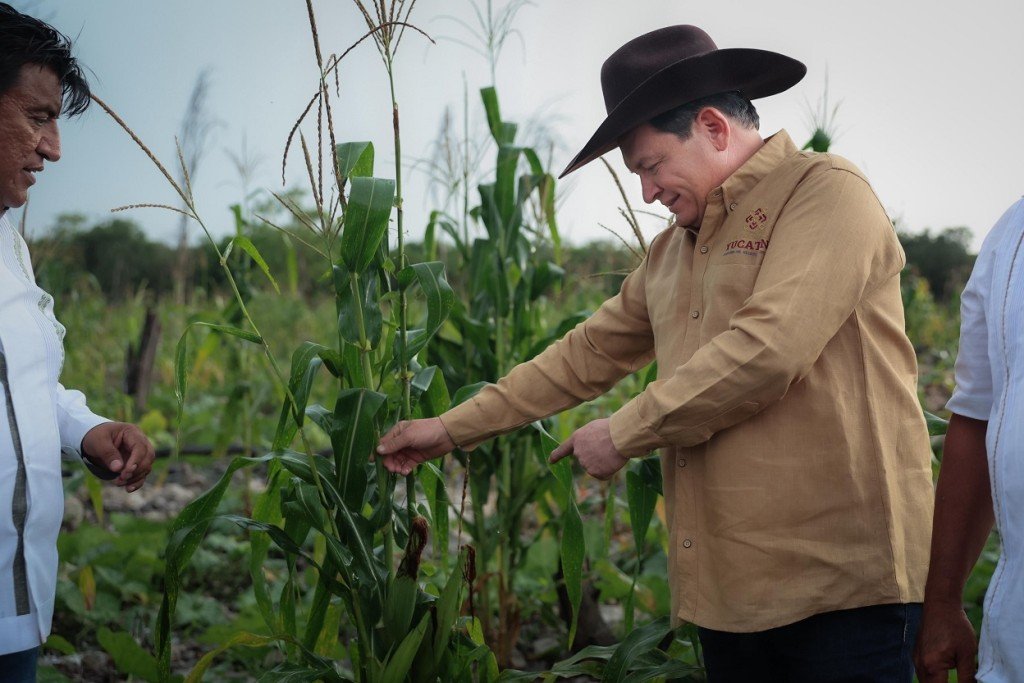
Yucatán, Mexico — The expansion of assets of the governor of Yucatán, Joaquín “Huacho” Díaz Mena, has come under public scrutiny after official documents and property records revealed that the governor owns at least 235 hectares of rural land registered in his name, acquired mainly during the last decade.
The growth of this wealth occurred in parallel with his political career within Morena, first as federal delegate of the Government of Mexico in Yucatán, later as a candidate for governor and finally as governor of the state, a position he assumed in October 2024.
Asset Expansion and Agrarian Context
The public records consulted show the existence of three rural properties identified as cattle ranches, whose accumulated area exceeds 235 hectares, located in municipalities in the east of the state.
Another factor that raises questions about the accumulation of rural land in eastern Yucatán is the legal status of much of the land in the Tizimín region and surrounding municipalities, where the ejido system has historically predominated. In these areas, most of the land originally belongs to agrarian communities registered with the National Agrarian Registry (RAN), meaning it is not conventional private property. For ejido land to become private property with a title registered in the Public Registry of Property, it must undergo a complex legal process that includes ejido assemblies, parcel demarcation, certification by the RAN, and, in many cases, the adoption of full ownership, a procedure that can take years and requires formal agreements from the agrarian community.
For this reason, when in areas where ejido lands historically predominate, properties registered directly as private property appear, the need arises to accurately analyze the exact location of the land, its agrarian origin, and the history of transformation of the property regime. In municipalities like Tizimín, much of the rural land remains under the ejido system, so the transition to private ownership typically occurs in sections or specific parcels approved by ejido assemblies, rather than in a generalized or immediate manner. This makes it crucial to verify whether the properties in question underwent the corresponding agrarian procedures, including parcel certification and authorization of full ownership from the National Agrarian Registry, before being registered as private property.
Analysis of a Recent Acquisition
This last property was purchased during his term as governor, according to available property records. In total, these acquisitions amount to approximately 235 hectares of rural land, an area equivalent to more than 2.3 million square meters.
In the case of the “San Manuel Number One” ranch, located in the municipality of Panabá, the purchase and sale documents indicate that the property was acquired on April 2, 2025 with an area of 755,500 square meters, equivalent to approximately 75.5 hectares, for a reported amount of 1 million 400 thousand pesos, which yields a price close to 18 thousand pesos per hectare.
However, that value is far below the actual ranges of the rural market in eastern Yucatán. Livestock producers and appraisers in the region place the average price of land suitable for livestock in municipalities such as Tizimín, Panabá, Sucilá and their surroundings between 50,000 and 80,000 pesos per hectare, depending on factors such as access, proximity to farm roads, availability of water sources and quality of the pastures.
If that market range is taken as a reference, the 75.5-hectare property could have an approximate real value of between 3 million 775 thousand and 6 million 40 thousand pesos, well above the amount reported in the transaction.
Market Value Evidence
A clear example of the true value of the livestock market in eastern Yucatán can be seen in open listings for ranches for sale in the Tizimín region, where the sellers themselves list prices per hectare much higher than the amounts appearing in some registered transactions. In a Facebook post published on October 20, 2025, a 250-hectare ranch located 6 kilometers from the Tizimín livestock auction is offered, fully operational with mechanized pastures, corrals, livestock scales, water sources, a well, drinking troughs, infrastructure, and an irrigation system, with an advertised price of 65,000 pesos per hectare.
This type of public offering allows us to gauge the true value of the rural market in the region, since even ranches with similar production characteristics are usually sold for between 50,000 and 80,000 pesos per hectare in municipalities in the eastern part of the state. The aforementioned listing can be viewed directly on the social network where it was disseminated, under the announcement, “250-hectare ranch just 6 km from the Tizimín Livestock Auction, Yucatán – Investment $65,000 per hectare,” which highlights the difference between the market values in the livestock sector and the amounts sometimes recorded in registered transactions.
Discrepancy in Declared Values and Other Properties
The difference between the declared value and the actual market value is not insignificant; it could represent between 2.3 and 4.6 million pesos. This gap coincides with a widely known practice in rural areas of the country, where some transactions are registered for amounts lower than the real value in order to reduce taxes and property transfer fees.
In addition, the governor owns two other properties in the same region: the “San Ramón” ranch, with 91 hectares acquired in 2015 with a declared price of just 50,000 pesos, and the “Cocoyol” ranch, purchased in 2020 with 68 hectares, which reinforces the contrast between the amounts established in the transactions and the prices that currently prevail in the livestock land market of eastern Yucatán.
Questioning the Origin of Resources
After these properties became public, the governor himself indicated that the purchases were made with private funds obtained from family livestock activities. According to his statements, his family has been involved in livestock farming for decades and he himself claims to have more than 30 years of experience in that activity.
However, the economic analysis of livestock farming raises questions about the profitability needed to accumulate land of that magnitude. According to estimates from the livestock sector in the region, a breeding ranch with around 100 cows, with an approximate value depending on the genetic quality of the cow and its age, is an investment of around $2,400,000 pesos, which generates an approximate economic flow under average conditions:
- Each cow produces 1 calf per year
- Average mortality rate: 10%
- Estimated survival: 90%
Under that scenario, a herd of 100 cows would produce approximately 90 to 95 calves per annual cycle. The average price of a weaned calf in the region is around 80 pesos per kilogram, with an estimated weight of 180 kilograms.
This represents an approximate gross income of:
- 1,368,000 pesos annually
However, the operating costs of a cattle ranch include:
- supplemental feeding
- pasture maintenance
- animal health
- labour
- machinery
- infrastructure
Therefore, net profit usually represents around 20% of gross income. This is roughly equivalent to: 273,600 pesos in annual profit, under favorable scenarios. In years affected by droughts, diseases or price variations, the profit can be reduced to even 200 thousand pesos annually or less.
The Real Cost of Starting a Livestock Operation
Added to this is the initial cost of establishing a ranch with productive capacity. To form a breeding stock lot of 100 cows, the average value in the livestock market is currently around 2.3 to 2.5 million pesos plus the costs of soil mechanization and livestock development for the adaptation of the ranch, to create conditions for the production of breeding stock.
This amount is in addition to investments in:
- fencing of land
- corrals
- wells or water systems
- agricultural machinery
- planting forage for drought seasons
This implies that developing a profitable livestock operation requires considerable initial capital and long periods of productive maturation.
The Heritage Chronology
The current governor's territorial expansion can be summarized in three stages:
- 2015: Purchase of the San Ramón ranch (91 hectares).
- 2020: Acquisition of the Cocoyol ranch (68 hectares).
- 2025: Purchase of the San Manuel Number One ranch (75.5 hectares).
The sum of these properties reaches 235 hectares.
Political Debate and Financial Discrepancy
The case has generated political debate because the political movement to which the governor belongs has promoted the principle of republican austerity for public servants. Although the president maintains that all acquisitions were made with private resources and duly registered with tax authorities, the size of the rural assets and the speed of their growth have raised questions about the origin of the resources used. Even more so considering that the governor himself has held high-level public office for the past decade.
Beyond the political narrative, information available in public records shows that the governor of Yucatán has accumulated more than 235 hectares of rural land in less than ten years, including acquisitions made during his current administration. The public discussion now focuses on whether the evolution of assets fully corresponds with the declared income and with the economic activity that has been indicated as the source of said resources. An answer that can only be fully clarified through full asset transparency and institutional review.
Based on an analysis of updated market prices, the expansion of Joaquín “Huacho” Díaz Mena's assets represents a real investment that ranges between 11.7 and 18.8 million pesos, a figure that triples the amounts recorded in the official records. While purchase and sale documents report acquisitions for just 1.4 million pesos in properties such as "San Manuel Number One" (at an unrealistic price of $18,500 per hectare), appraisers and producers from eastern Yucatán confirm that the commercial value of land suitable for livestock in Panabá and Tizimín is currently between $50,000 and $80,000 per hectare.
This technical discrepancy reveals that, to consolidate his 235 hectares (2.3 million square meters) in less than a decade, the president would have required a capital flow far exceeding the savings capacity of his livestock operation, which generates a maximum net profit of $273,600 pesos annually. In financial terms, covering the real value of this land would have required more than 43 years of continuous livestock production, demonstrating a growth in assets that is disproportionate to his declared income and the standard returns for the sector in the region.
Discover more from Riviera Maya News & Events
Subscribe to get the latest posts sent to your email.