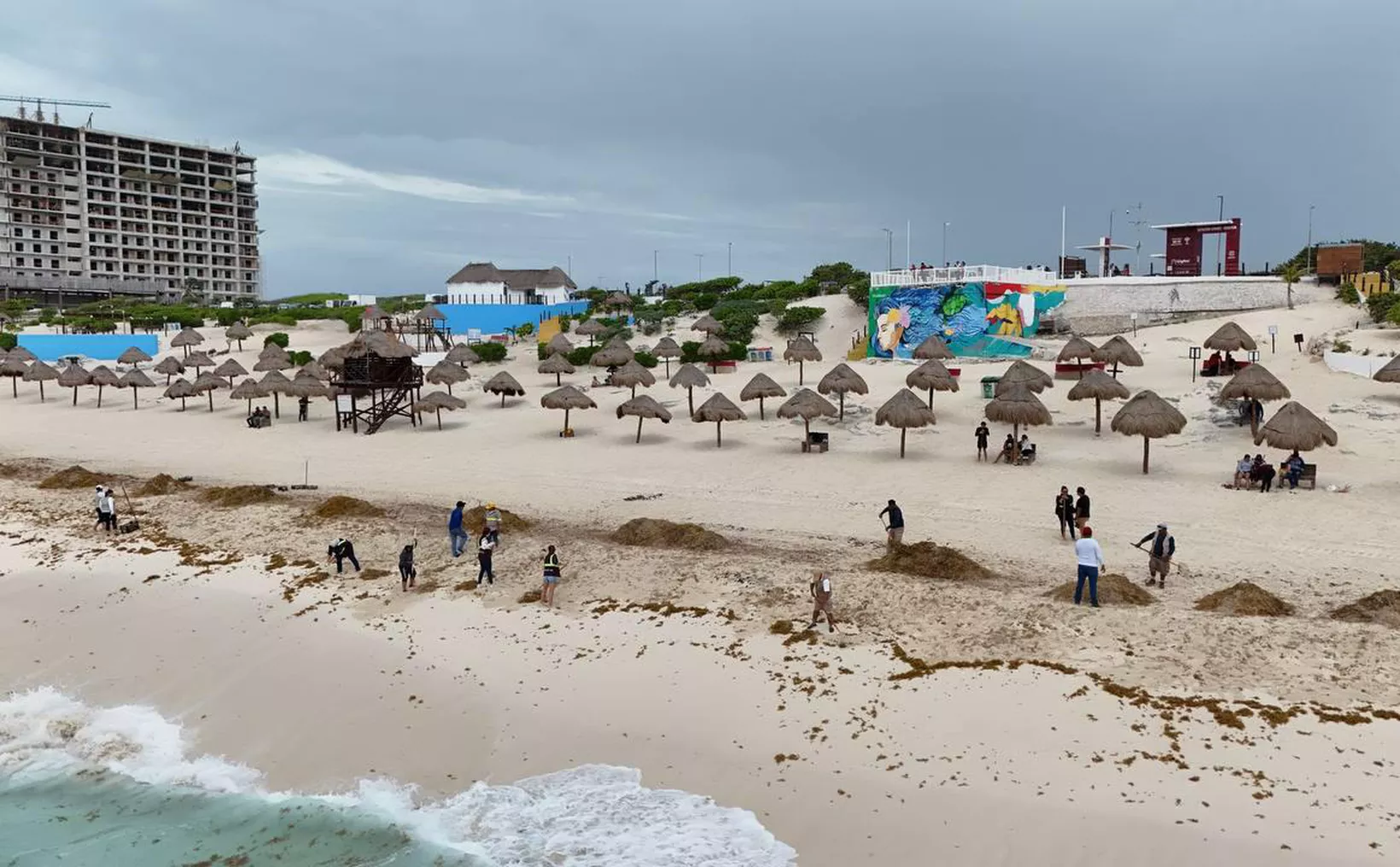
Cancún, Mexico — Facing an atypical influx of sargassum impacting the Mexican Caribbean coasts at the start of 2026, the scientific community has expressed its support for the implementation of transoceanic barriers. This strategy, currently being analyzed by the State Government for critical areas such as Cozumel and Banco Chinchorro, aims to contain and divert large accumulations of the macroalgae.
According to specialists like Doctor of Physical Oceanography, Laura Elena Carrillo Bribiesca, these measures are fundamental to facilitate efficient collection in open waters, ensuring the biomass maintains its quality to be transformed into an economically viable resource.
This technological advancement occurs within a renewed legal framework, following the formal inclusion of sargassum in the National Fishing Charter in 2025. This legal transition allows the algae to no longer be considered a mere “environmental liability” or trash, but to be legally managed as an “economic asset.”
The researcher explained that thanks to coordination led by the Secretariat of the Navy (Semar) and support from the National Council of Humanities, Sciences and Technologies, working groups have been consolidated that integrate satellite monitoring with biological impact assessment.
However, experts warn that although the floating biomass in the Atlantic is currently estimated between 50 and 60 million tons, its arrival on the coasts depends on complex variables such as sea temperature and ocean currents.
For this reason, technical alternatives are being evaluated to ensure the barriers can withstand wave force and remain stable. The goal for 2026 is to consolidate collaboration between academia, government, and the private sector to transition from reactive mitigation to comprehensive strategic management.
The scientific community agrees that, while all efforts made to address the sargassum problem are valuable, they are insufficient given the global magnitude of the phenomenon.
“Sargassum should not be seen solely as the central problem, but as a symptom of a profound environmental imbalance in the ocean,” stated a scientific representative.
Under this premise, the strategy in the Mexican Caribbean seeks not only to protect local ecosystems but to position the region as a pioneer in converting a climate crisis into a sustainable and productive industry. This allows companies like Sargapac, Ensol, and Dianco to already operate in Quintana Roo, transforming tons of algae into commercial products.
Discover more from Riviera Maya News & Events
Subscribe to get the latest posts sent to your email.