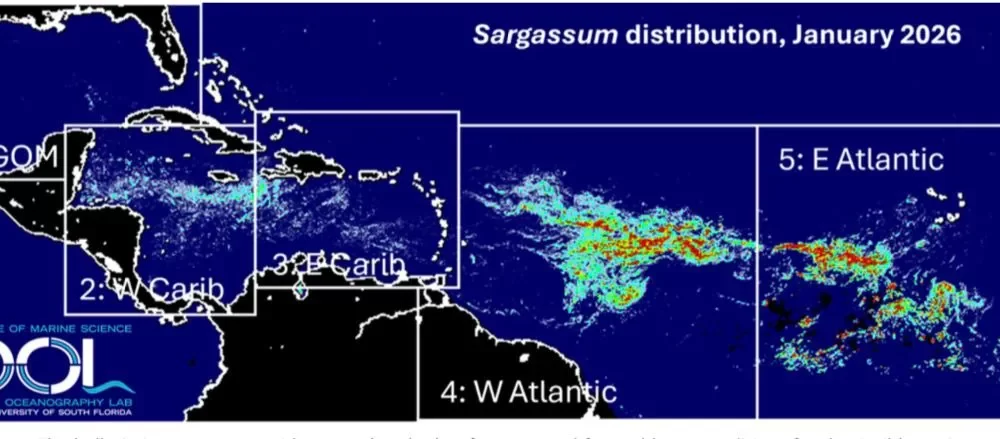
Cancún, Mexico — The Mexican Caribbean has already begun recording sargazo seaweed arrivals in January, with regional presence of the macroalgae reaching record levels for the month, according to the latest monitoring report from the University of South Florida (USF) with NASA support.
The report for January 2026 shows the amount of sargazo in the Caribbean Sea grew rapidly, increasing from 0.45 million tons in December 2025 to 1.7 million tons, confirming the continuous upward trend observed since late last year.
All monitored regions except the Eastern Atlantic recorded the highest sargazo quantities for any January since historical records began between 2011 and 2025. In the Western Atlantic, biomass increased from 4.1 to 5.5 million tons, while the Gulf of Mexico detected around 0.2 million tons, mainly north of the Yucatan Channel.
For the western Caribbean, where the Mexican Caribbean is located, the report warns that beach wash-up events have already occurred, particularly in Belize, Honduras, and the Quintana Roo coast—a situation that could intensify in coming weeks.
Satellite analysis shows three large, clearly defined sargazo masses in the Eastern Atlantic, Western Atlantic, and Caribbean, reinforcing the scenario of a year with high macroalgae presence.
Looking ahead to February, scientists predict sargazo quantities will continue increasing in most regions, with greater impact in the western Caribbean where more coastal arrivals are expected, while some eastern Caribbean islands might begin recording wash-ups.
Due to sustained growth between November and January and the record levels observed, the report concludes 2026 has a high probability of becoming another critical sargazo year, exceeding 75 percent of historical values, representing a significant environmental and tourism challenge for destinations like the Mexican Caribbean.
Discover more from Riviera Maya News & Events
Subscribe to get the latest posts sent to your email.