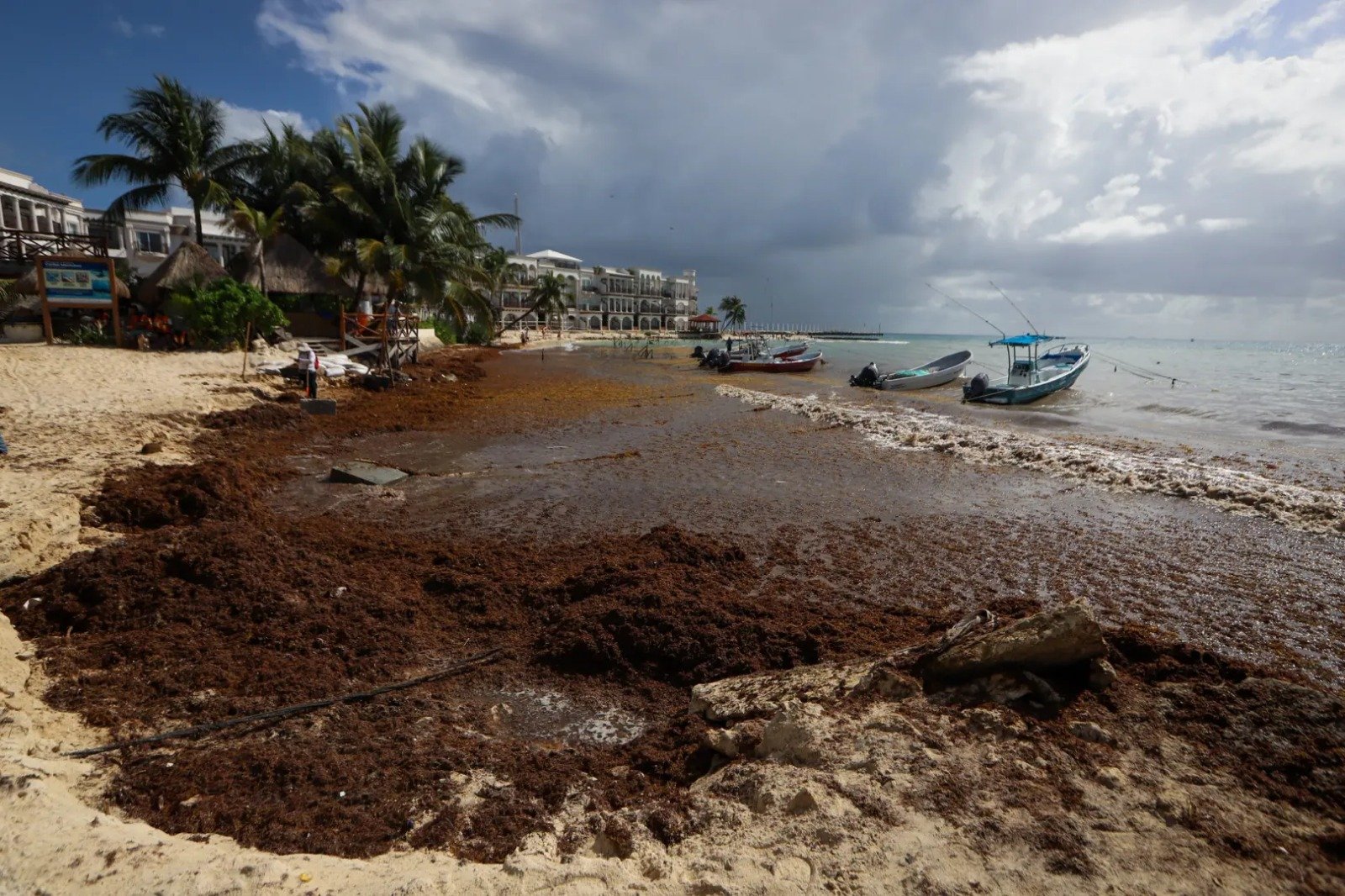
Riviera Maya, Mexico — The sargassum that arrives annually on the Mexican Caribbean coast not only represents a tourism and economic problem but also releases a mixture of potentially dangerous chemical compounds when decomposing, posing risks to human health and coastal ecosystems.
This is revealed by a study conducted by the Tecnológico Nacional de México, the Centro de Investigación y de Estudios Avanzados del Instituto Politécnico Nacional (Cinvestav), and the Centro de Investigación Científica de Yucatán.
It is estimated that the mass of sargassum accumulated in the tropics last year would be equivalent to nearly 1.9 million dump trucks, almost double the record from 2018.
The work, which analyzed the chemical composition of the leachate generated by this algae as it degrades, shows that it contains concentrations of hydrocarbons, metals, and other substances that exceed the limits of Mexican and international safety standards, posing risks for coastal communities and the environments where it is deposited.
In 2011, a large-scale accumulation of sargassum in the ocean spread across the Atlantic and caused massive golden tides on the west coast of Africa and in the Caribbean. In Mexico, the unusual arrival of sargassum began in 2014, and the first massive accumulations on beaches emerged in 2015.
During the month of highest influx, for every kilometer of coastline, the equivalent of 337 dump trucks loaded with sargassum arrived. In 2019, at its critical point, the arrivals were equivalent to half a million trucks. For 2025, the mass of sargassum accumulated in the tropics is estimated at nearly 1.9 million dump trucks, almost double the record from 2018.
While in the open sea, sargassum fulfills a key ecological function by serving as a refuge, food source, and reproduction zone for fish, crustaceans, and other marine species, when these large masses reach the coasts, the balance is broken: their accumulation and decomposition consume oxygen and release toxic compounds.
Sargassum, which also has the capacity to absorb metals and metalloids such as arsenic, cadmium, chromium, nickel, and zinc from the marine environment, can release these components during its decomposition.
For this research, scientists collected sargassum from the beaches of Akumal in the Riviera Maya. Once in the laboratory, the biomass was monitored for 80 days at room temperature, a period during which the leachate was generated and later analyzed using different methods to detect the presence of metals and hydrocarbons.
The results were conclusive: the detected concentrations exceed the limits established by NOM-001-Semarnat, which sets the maximum limits of pollutants that wastewater discharges can contain; even, according to the criteria of the United States Resource Conservation and Recovery Act, sargassum leachate should be considered a toxic waste due to the high concentrations of arsenic, a recognized carcinogen.
The research warns that the risk is aggravated in the Yucatán Peninsula—where groundwater flow occurs through an extensive network of underground rivers—when sargassum removed from beaches is deposited in inadequate sites, such as mangroves, forests, or unurbanized land that lack the appropriate infrastructure for leachate management and treatment.
“Given the high permeability of the karst substrate, characteristic of the Yucatán Peninsula, there is a significant probability that toxic elements will rapidly infiltrate the aquifer, thus compromising the region’s main source of freshwater,” the study states.
In the work published in the scientific journal Marine Pollution Bulletin, the authors underline the urgency of comprehensively addressing the leachates generated by large sargassum deposits in the Mexican Caribbean through the design and operation of final disposal sites with adequate infrastructure for their containment and treatment.
Discover more from Riviera Maya News & Events
Subscribe to get the latest posts sent to your email.