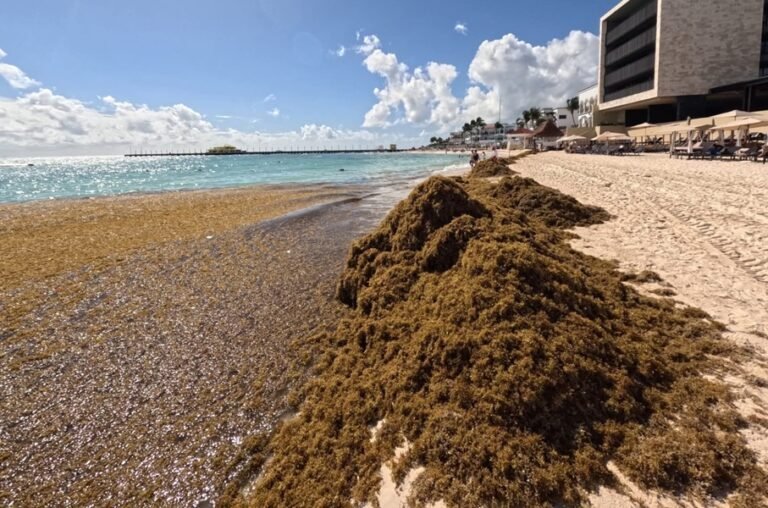
Cancún, Quintana Roo — The early arrival of sargassum along the shores of Quintana Roo has raised concern among scientists, tourism stakeholders, and local residents, with satellite data indicating the potential for a severe season comparable to the record influx in 2025.
According to Esteban Jesús Amaro Mauricio, director of the Sargassum Monitoring Network of Quintana Roo, five of the state’s ten coastal municipalities—including Tulum, Playa del Carmen, and Puerto Morelos—have already registered sargassum landings. Patches have also been spotted off Cozumel, while Xcalak and Mahahual in the south are reporting the heaviest initial arrivals.
What’s worrying experts is not just the presence of sargassum—but its timing. This year’s blooms are appearing months earlier than expected, during a period when beaches are typically clear for winter tourism. In previous years, the influx usually begins around April or May, but in 2026, the seaweed is already washing up in January. This shift threatens peak season tourism in popular destinations like Cancún, Playa del Carmen, and Tulum, where clean beaches are essential to the local economy.
The University of South Florida’s Optical Oceanography Lab reports over 7 million tons of sargassum spread from the coast of Africa to the Gulf of Mexico—mirroring the conditions of 2025, when over 73,000 tons were collected in Quintana Roo alone.
Unlike cohesive mats, current satellite images show fragmented sargassum fields, a pattern attributed to strong cold fronts and shifting ocean currents. Amaro noted that these currents have become increasingly erratic—speeding up, slowing down, or even reversing direction—likely influenced by climate change.
Sargassum poses multiple threats to coastal regions: when it piles up onshore, it decays quickly, releasing hydrogen sulfide gas and creating an unpleasant odor that deters tourists. In the water, thick mats can smother coral reefs, block turtle nesting, and disrupt marine ecosystems. Cleanup efforts are expensive and labor-intensive, placing additional strain on municipalities already stretched thin.
With peak tourist season underway and Holy Week fast approaching, authorities are closely monitoring conditions. If trends continue, 2026 could mark another record-setting year for sargassum arrivals—delivering an environmental and economic blow to Quintana Roo’s beach-dependent tourism industry.
Discover more from Riviera Maya News & Events
Subscribe to get the latest posts sent to your email.