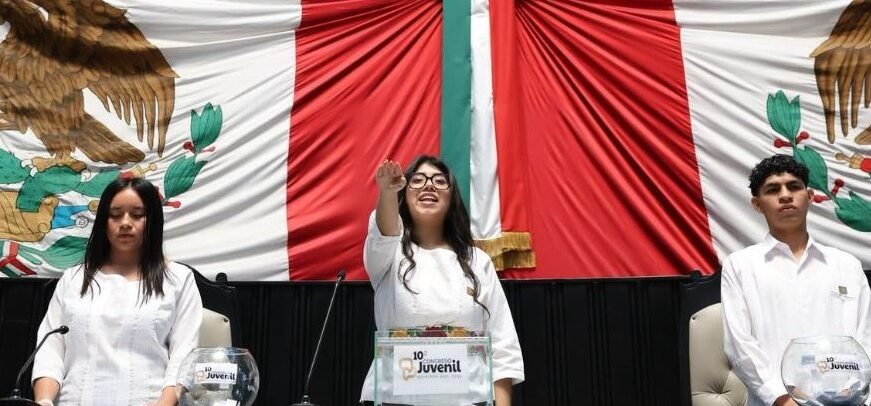
Chetumal, Quintana Roo — Young delegates from across Quintana Roo proposed protecting the state’s underground water and cenotes, improving daily commutes for students and young workers, and denying tax benefits to parents who owe child support, during the 10th Quintana Roo Youth Congress.
Representatives from the state’s 11 municipalities and 15 electoral districts took the floor of the State Congress after two days of courses and workshops organized by the state Legislature, together with the Quintana Roo Electoral Institute, the Quintana Roo Youth Institute and the Technological Institute of the Maya Zone.
Environmental protections
On environmental matters, the delegates proposed a law to protect and regulate the quality of underground water in Quintana Roo. The measure aims to safeguard the state’s karst system, cenotes and underground rivers from contaminant infiltration. They also called for stronger management and final disposal of sargassum seaweed.
Schools, mental health and online safety
Education proposals included inclusive professional internships, better treatment of university social service and steps to recognize the emotional strain on teachers facing unresolved allegations. Delegates also proposed an early-detection and support pathway for children showing low performance or isolation linked to family problems, along with monthly first-aid training in schools and measures to prevent grooming and cyberbullying of minors.
Youth mobility and public spaces
The delegates proposed a State Youth Mobility Program under which the Quintana Roo Mobility Institute and the Quintana Roo Youth Institute would carry out annual assessments of priority routes for students and young workers, including travel to schools, cultural centers and sports facilities.
On security, they presented a program built around reclaiming public spaces, neighborhood reporting networks and a free preventive fitness campaign offering risk identification and self-protection training for young people and women.
Transparency and Indigenous representation
Among civic participation proposals was a “Digital Cabildo” platform where residents could check who their council members are, which commissions they lead, session minutes and how they voted. Delegates also raised the representation of Indigenous youth, the creation of direct channels with lawmakers and steps to strengthen open justice for young people.
On the economy, they proposed support for youth entrepreneurship, community financial education and strategies to add value to beekeeping and strengthen its rural commercial ties.
Child support debtors
Another proposal would bar people listed in the State Registry of Delinquent Child Support Debtors from receiving subsidies, vehicle discounts or government tax incentives while they fail to meet their obligations to their children.
The items were presented as proposals within the youth exercise, and reports on the gathering did not indicate they had been approved as laws or programs.
Lawmakers praise participants
Jorge Sanén Cervantes, president of the Governing Board and Political Coordination, praised the participants’ commitment to building a state with more opportunities and social justice. Diana Gutiérrez García, who heads the Commission on Youth Development with Equal Opportunities, said the forum allows lawmakers to learn about young people’s proposals for transforming the state.
The session was led by María Carolina Mis Alcocer as president, with Cristóbal Guzmán Cruz as vice president, Kenia Rebeca Juárez Campos as secretary and Isaac Gómez Sánchez as general alternate.
More Community
- University in Playa del Carmen Opens New Archery Range
- Esperanza Azteca Cancún Opens Auditions for Youth Orchestra and Choir
- Quintana Roo Launches Targeted Mpox Vaccination Campaign With Jynneos
- ZOOXANTELA Exhibition Closes in Cancún With Workshop on Listening to the Reef
- Cancún Animal Welfare Hospital Nears Completion With 50 Million Peso Investment
More Quintana Roo
- Quintana Roo Governor Says Prosecutor’s Office Must Explain Arrest of Former Playa del Carmen Mayor
- Caribbean Culture Festival 2026 Opens in Bacalar and Chetumal with Books, Dance and Bacilos
- Quintana Roo Projects $450 Million in Clean Energy Investment
- Quintana Roo Jumps to Sixth Nationally in Property Registry Modernization
- Playa del Carmen Launches ‘Rodar en el Sureste’ to Build Regional Film Industry