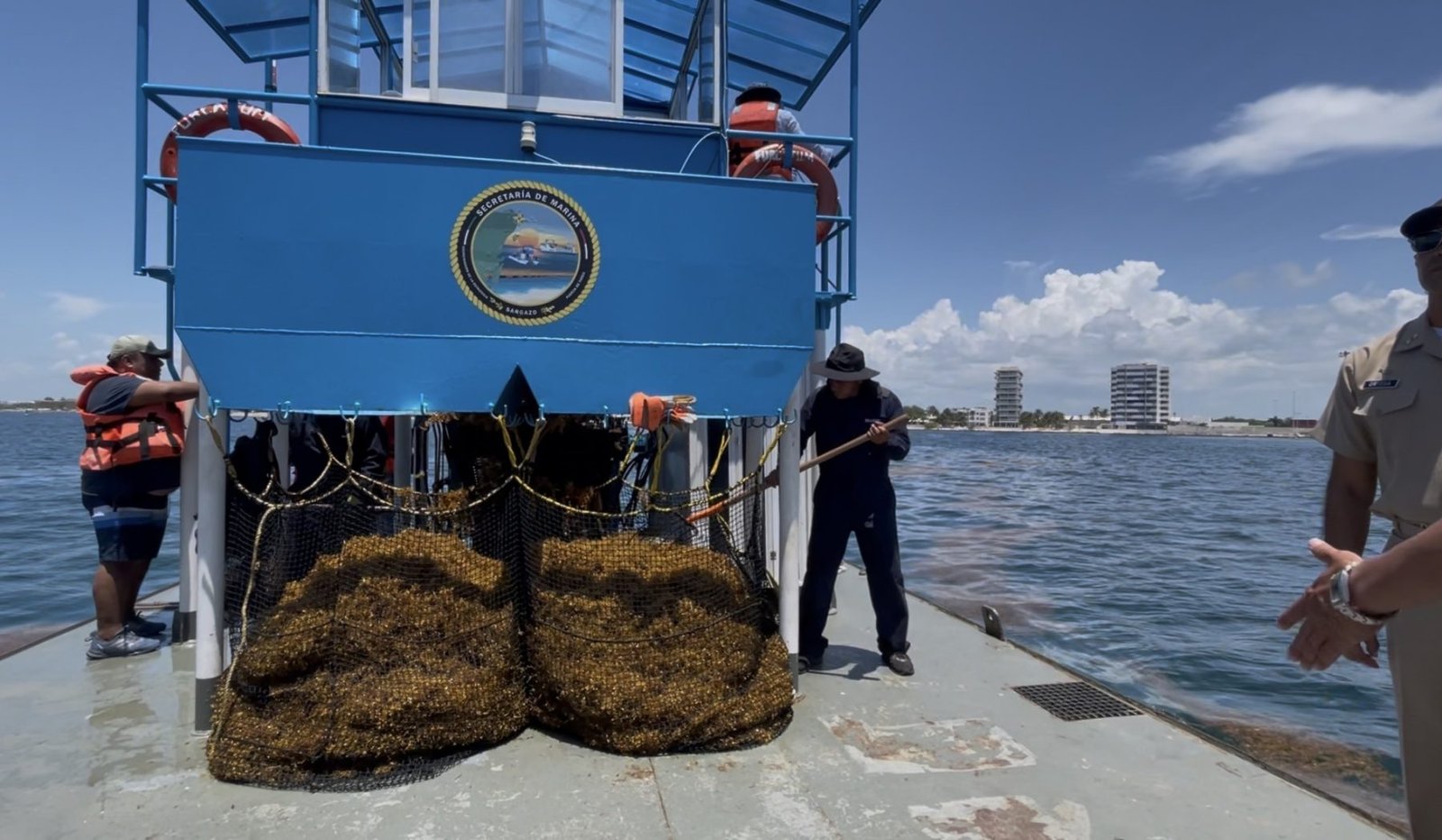
Quintana Roo, Mexico — The Government of Quintana Roo is strengthening its actions against sargassum, having collected more than 10,000 tons of the macroalgae so far in 2026. This effort is part of a strategy focused on early containment and reducing the impact on the beaches of the Mexican Caribbean.
Governor Mara Lezama reported that operational capacity was enhanced this year with four sargassum harvesters for shallow waters, 11 sargassum harvesters—two more than in 2025—one transoceanic vessel, and 22 smaller vessels. These resources work in coordination to intercept the algae before it reaches the coast.
Strategic Barriers and Coordinated Operations
A primary line of action is the installation of sargassum barriers at strategic coastal points. The plan for 2026 is to install 15,000 meters of barrier; to date, 7,200 meters have been installed. Work is continuing ahead of schedule due to an early sargassum influx recorded this year.
Operations are being conducted in coordination with the Mexican Navy, prioritizing efforts at sea to reduce the amount of debris arriving on beaches. Beyond the maritime deployment, activities include barrier anchoring, constant monitoring using early detection and collection systems, and other high-impact work in areas such as Playa del Carmen, Tulum, Puerto Morelos, and Mahahual.
Early Activation and Regional Context
The state's Secretary of Ecology and Environment, Óscar Rébora, explained that while the official sargassum season begins in April, containment measures were activated earlier than planned following the algae's early arrival. A budget advance was requested to facilitate this early response.
According to regional estimates, more than 60 million tons of sargassum are currently floating in the Atlantic, a figure higher than last year. Authorities emphasize, however, that the floating volume does not necessarily equate to the same level of material washing ashore, as factors like ocean currents, winds, and water temperature influence the final amount.
A Permanent Strategy for Resilience
State authorities reiterated that, although the phenomenon is natural and affects the entire Caribbean region, Quintana Roo maintains a permanent strategy to protect its coastline and mitigate the impact on the tourism sector.
The government highlighted that the state continues to promote the diversification of its tourism offerings, fostering segments such as sports, community, adventure, and wellness tourism. This is part of a comprehensive strategy to strengthen the destination's resilience to recurring environmental phenomena.
Discover more from Riviera Maya News & Events
Subscribe to get the latest posts sent to your email.