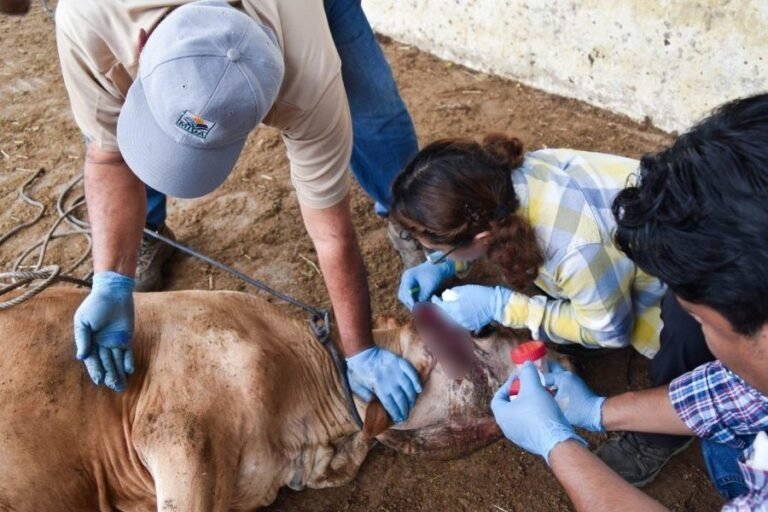
Chetumal, Quintana Roo — The Regional Cattle Union (UGR) of southern Quintana Roo closed the year 2025 with nearly 300 cases of screwworm in cattle, a figure that remained practically unchanged during the last months of the year. However, this stagnation is not necessarily due to the eradication of the problem, but because cattle producers themselves have stopped reporting cases and opted to address infestations privately on their ranches.
Carlos Rodríguez García, president of the Regional Cattle Union (UGR), explained that at the last count, conducted shortly before the end of 2025, there were officially 245 recorded cases of screwworm infestation, of which 25 remain active.
According to the cattle leader, the number stopped growing not because the presence of the parasite has decreased, but because many producers decided to no longer notify cases, considering that the process of institutional reporting and attention is slow, which puts the health of the animals at immediate risk.
“What is happening is that ranchers prefer to act immediately to save their cattle. When they detect the infestation, they themselves purchase the supplies and carry out the treatment without reporting it, because waiting could mean losing the animal,” explained the leader.
The screwworm represents one of the main health threats to the livestock sector, as the larva feeds on the living tissue of animals, causing serious injuries that, if not treated in time, can lead to the death of the cattle. Additionally, its presence generates significant economic losses for producers, especially for small and medium-sized ranches.
The president of the UGR warned that the lack of official reports could lead to an underestimation of the real problem in the state, which in turn hinders the implementation of broader health strategies for the control and eradication of the parasite.
“If cases are not reported, there is no real diagnosis of the situation. That limits coordinated actions and the support that can be managed to combat this pest more effectively,” he emphasized.
Carlos Rodríguez García called on health authorities to strengthen attention and response mechanisms, as well as on ranchers not to lower their guard, since the screwworm remains present in various regions of the state.
He recalled that before the screwworm arrived in the entity, the organization held talks and prevention campaigns in different communities; however, he insisted that now the key lies in unity and shared responsibility.
“Reporting does not mean neglecting the cattle; on the contrary, it implies strengthening health in the state and achieving federal support. Not doing so only delays the collective actions we need,” he pointed out.
The leader insisted that the priority is to add official reports so that the Federation releases the sterile fly as soon as possible.
Discover more from Riviera Maya News & Events
Subscribe to get the latest posts sent to your email.