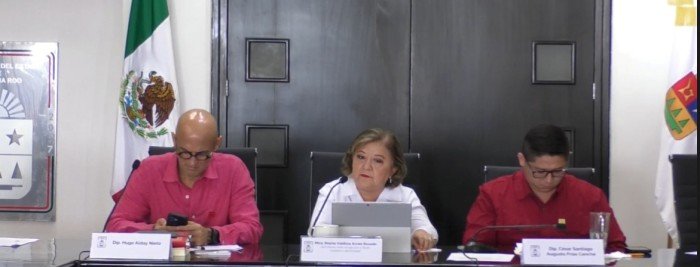
Chetumal, Quintana Roo — Quintana Roo’s Anti-Corruption and Good Government Department (SAGOB) opened 1,879 case files over alleged administrative wrongdoing and issued a total of 82 sanctions in the year ending Aug. 3, 2026, officials said during an appearance by department head Reyna Arceo Rosado before the state Congress.
Undersecretaries presented the figures in place of a single departmental report, with each area chief addressing lawmakers in turn. They stressed that the administration’s stated aim is to prevent misconduct rather than punish it after the fact.
Between July 2025 and Aug. 3, 2026, the department opened 1,879 files for alleged administrative responsibility, issued 2,823 reports of alleged administrative responsibility, and reached 3,948 conclusion agreements and closures, officials said.
Of the administrative responsibility proceedings handled by the investigating and ruling authority, 2,680 rulings were issued and 1,734 cases were closed. Of those rulings, 718 proceedings were opened, nine were challenged, and 13 were sent to the Administrative and Anti-Corruption Justice Tribunal.
The 82 sanctions applied over the past year consisted of 50 temporary disqualifications, 12 suspensions, and 20 reprimands. Across four years of the current administration, SAGOB has imposed 199 sanctions: 26 reprimands, 33 suspensions, 133 disqualifications, five financial penalties, and two dismissals.
Officials said the Federal Superior Audit Office has audited 13.162 billion pesos in state funds, producing five observations for the Potable Water and Sewerage Commission, one for the Executive Secretariat of the State Public Security System, one for the Women’s Secretariat, and five for the State Prosecutor’s Office. All observations were addressed with the federal anti-corruption department, they said.
This year, the department reviewed more than 3.054 billion pesos across 613 files financed through nine funds and programs involving 11 public institutions. Officials said the reviews were intended to detect deficiencies in contracting and in the execution of public works, acquisitions, and services, and to prevent repeat findings.
Authorities also carried out comprehensive financial, technical, and regulatory audits covering more than 507 million pesos in 708 works, acquisitions, and social benefit actions tied to funds and investment programs at 10 public institutions.
A further audit covered more than 2.999 billion pesos in 269 supervision actions involving 641 works or services executed by 11 public institutions and funded through 12 state and federal sources.
Undersecretaries said the administration inherited a heavy institutional backlog from the terms of former governors Roberto Borge Angulo and Carlos Joaquín González, including unresolved federal audit observations that at one point amounted to 3.448 billion pesos.
For the 2023 and 2024 public accounts, the state reported zero pesos pending clarification, a historic result. Under the 2024 annual audit program, 26 audits were scheduled for the state government and all concluded with no outstanding amounts.
Officials said the department also ran 1,515 quality tests on 641 works executed by 11 public institutions with state and federal financing, but did not say whether the reviews uncovered any irregularities or generated findings requiring corrective action.
More Government
- Mexico Investigating 17 People After New Review of Phone Calls in Ayotzinapa Case
- New Disciplinary Model Leads to 106 Sanctioned Police Officers in Quintana Roo
- Quintana Roo Expands Civic Justice Model to Five Southern Municipalities
- Drought Damages Farmland in Felipe Carrillo Puerto as Quintana Roo Assesses Losses
- Quintana Roo Real Estate Sector Pushes for Legal Reforms to Curb Fraud
More Quintana Roo
- Riviera Maya Hotels Offer Free Nights When Sargassum Blocks the Beach
- Nayarit Overtakes Quintana Roo in Mexico Tourism Investment
- Quintana Roo Slips to Second Place in Mexico Tourism Investment
- Morena Polls Confirm Gino Segura’s Lead in Quintana Roo as Marín Trails Ana Paty
- Drought Reaches All 11 Municipalities in Quintana Roo