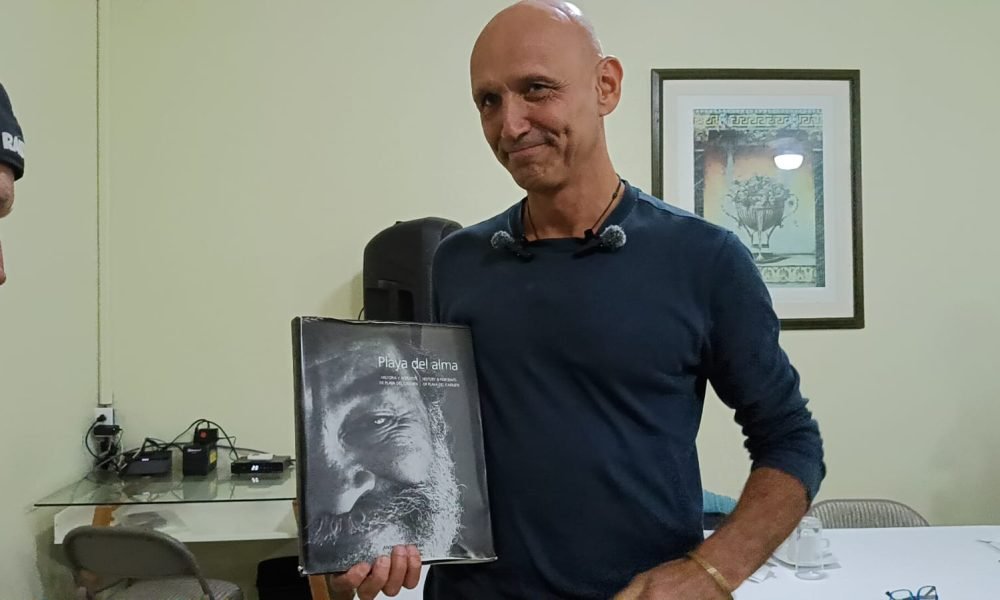
Playa del Carmen, Quintana Roo — Italian photographer Anthony Caronia, a long-time resident of Playa del Carmen, has announced plans to publish a second volume of his photographic book Playa del Alma, continuing a deeply personal visual record of the people, traditions, and everyday life that shaped the destination long before it became a global tourism hub.
Caronia, who arrived in Playa del Carmen in 1996, is widely regarded as one of the earliest foreign residents to document the town from within, rather than through the lens of promotion or real estate marketing. When he first settled here, Playa del Carmen was still a modest coastal community—defined more by fishing families, dusty streets, and informal commerce than by the resorts and international brands that dominate the landscape today.
A book that became a time capsule
The first volume of Playa del Alma, published in 2000, was never intended as a commercial project. Instead, Caronia conceived it as an art book—an intimate, anthropological portrait of a place in transition. Shot in black and white and color, the photographs focused on faces rather than facades: fishermen, shopkeepers, musicians, street vendors, children, elders, and everyday moments that rarely made it into official narratives about the town.
According to Caronia, the book was met with an unexpectedly warm reception. Locals and long-time residents recognized themselves and their neighbors in its pages, while newcomers saw a version of Playa del Carmen that was already beginning to disappear. The book quietly became a visual time capsule—one that preserved a sense of place at a pivotal moment in the town’s history.
Yet the response also carried a note of regret.
“Many people told me they loved the book,” Caronia recalled, “but they also said, ‘Why didn’t you photograph my father?’ or ‘Why wasn’t my family included?’” Those comments stayed with him. Over time, they evolved into the motivation behind a second volume.
Completing the collective portrait
The forthcoming second volume of Playa del Alma aims to broaden that original narrative by including individuals and communities who were part of Playa del Carmen’s social and cultural growth but were not featured in the first edition. Rather than revisiting the same subjects, Caronia has focused on expanding the circle—capturing additional voices that helped shape the town’s character during its formative years.
In this sense, the new book functions less as a sequel and more as a continuation of an unfinished conversation. It acknowledges that no single volume can fully represent a living community, especially one experiencing rapid demographic change driven by migration, tourism, and development.
Caronia describes the project as both artistic and ethical. “If you are going to document a place honestly,” he said, “you have to accept that memory is shared. This book belongs as much to the people in the photographs as it does to me.”
Ready to print, searching for support
From a creative standpoint, the second volume is complete. The images have been selected, edited, and sequenced. The remaining hurdle is financial. Caronia is currently seeking sponsors to cover printing and production costs—an increasingly common challenge for independent art publications, particularly those that prioritize quality materials and small print runs over mass distribution.
If sponsorship is secured in time, Caronia hopes to release the book in March 2026, a symbolic date that aligns with nearly three decades of his life in Playa del Carmen.
Unlike mainstream photo books tied to galleries or large publishers, Playa del Alma is envisioned as a locally rooted project. Sponsorship, Caronia notes, is not about branding the work, but about enabling the preservation of collective memory in a physical, durable format.
Distribution challenges in a growing city
Ironically, one of the obstacles facing the project reflects the broader transformation it documents. Playa del Carmen, despite its size and international profile, has very few independent bookstores or cultural distribution spaces. This reality complicates traditional book sales.
Caronia expects that most copies of the new volume will be sold through hotels, boutique spaces, and select specialty shops, as well as the limited editorial outlets that currently operate in the city. While this approach mirrors how many art books circulate in tourist destinations, it also highlights the ongoing gap between Playa del Carmen’s economic growth and its cultural infrastructure.
For Caronia, the goal is not mass circulation but meaningful placement—ensuring the book reaches readers who value the city’s history and the people who lived it.
Preserving identity amid rapid change
At the heart of Playa del Alma lies a concern shared by many long-time residents: the speed at which Playa del Carmen has changed, and the risk of losing touch with its roots. Over the past three decades, the town has grown from a village of a few thousand to a city of well over 300,000 residents, driven by tourism, migration, and real estate development.
In that process, entire neighborhoods have been reshaped, populations displaced, and social dynamics reconfigured. Caronia’s work does not attempt to judge these changes. Instead, it insists on remembering what came before—and who was there.
“Places don’t just transform physically,” he said. “They transform emotionally. Faces disappear, routines change, and suddenly the memory of how things were exists only in stories.”
Through his lens, Caronia has sought to slow that erasure.
Photography as cultural testimony
Unlike promotional imagery designed to sell an experience, Caronia’s photographs function as testimony. They capture gestures, glances, work-worn hands, celebrations, and quiet moments that rarely survive in official archives. In doing so, they align with traditions of documentary and anthropological photography that prioritize presence over spectacle.
The second volume of Playa del Alma continues that approach, reinforcing the idea that Playa del Carmen’s identity is not defined solely by beaches or nightlife, but by the people who built their lives here long before the destination appeared on international travel maps.
As Caronia prepares for publication, his project stands as a reminder that memory—like community—requires care, intention, and support. Whether the book reaches hotel lobbies, private collections, or family living rooms, its purpose remains the same: to honor a Playa del Carmen that exists not just in nostalgia, but in images that refuse to let it be forgotten.
Discover more from Riviera Maya News & Events
Subscribe to get the latest posts sent to your email.