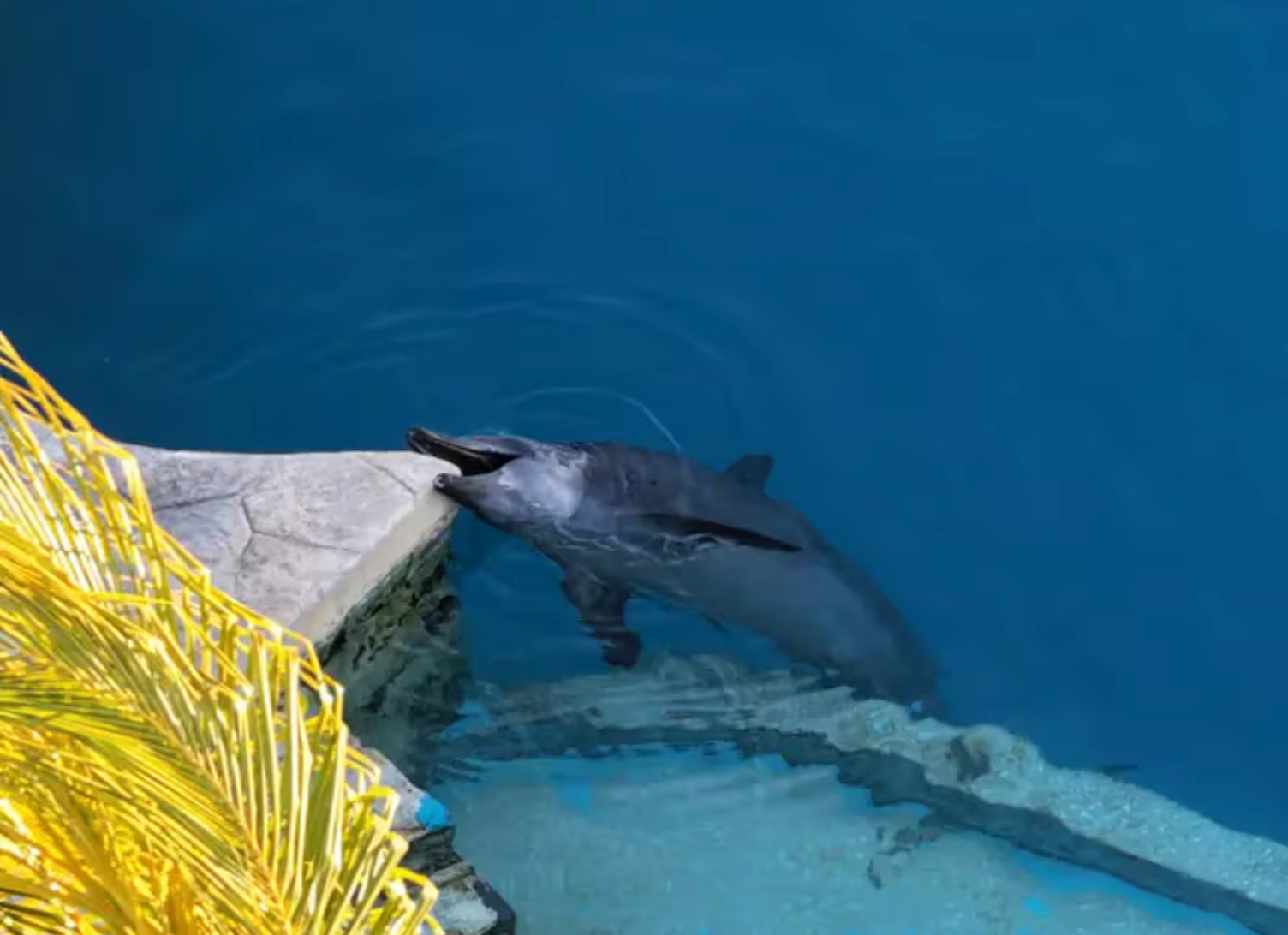
Cancún, Quintana Roo — Nine dolphins are living in deteriorating conditions in a shuttered aquatic park just a few meters from Cancún’s white-sand beaches, nearly a year after authorities closed the facility.
Two females, Solei and Oceanía, and seven males — Mincho, Diego, Apolo, Flex, Satu, Squalo and Salomón — have spent most of their lives in captivity performing in dolphin shows, according to Veeleaf, a Mexican animal rights group that has monitored them for the past year. They range in age from 13 to 38 and suffer from a range of chronic illnesses and health complications.
Mincho is the most seriously ill, with a carcinoma on his tongue diagnosed by specialists from Profepa, Mexico’s federal environmental protection agency. Years earlier, he suffered a severe blow against the concrete of a pool while performing a jump at a hotel in the Riviera Maya. Diego lost part of his tail fluke and has severe dental abrasion. Solei has lost the sight in both eyes. All nine show inflamed corneas or mouth ulcers.
The dolphins belonged to Ventura Park and performed at the resort’s Dolphin Connection dolphinarium until authorities shut the park down. Since then they have been caught in a legal limbo, surviving in minimal conditions in three pools at the semi-abandoned site.
Stress and neglect, activists say
Veeleaf says the dolphins bite the concrete of their pools and spend long periods motionless or submerged, behavior it attributes to stress and boredom.
“The water hasn’t turned as green as we once documented, but the last time we went [in early September] there was both algae and dolphin feces present. We think they have a problem with the filtration systems,” Fabián Pinto, co-founder of Veeleaf, told BBC Mundo.
“The dolphins stay still, they keep diving because they are bored, because they have no activity. They’re just there, practically all day long,” he added.
The dolphins spent months without any shade until workers installed strips of mesh a few weeks ago, which Pinto considers insufficient. Veeleaf says company staff are on site for “a couple of hours” to take photographs, leaving the animals alone for the rest of the day. The group also found chlorine being used to control algae growth, which it says harms the animals’ health.
“Dolphins’ and sea lions’ eyes need seawater, or at least water that mimics the salinity of seawater, because that’s how their eyes work. If they are in fresh water, their eyes suffer alterations,” said marine biologist Gisela Heckel.
In a report on an August inspection, Profepa said it found “the health of three [dolphins] is very delicate due to their advanced age and chronic conditions,” and that “various alterations and illnesses have also been documented in the rest of the animals.” The agency said water quality had improved substantially since its specialists began monitoring the site, and that it receives and evaluates information daily on the animals’ care.
Pinto counters that inspections are infrequent and that weeks pass without inspectors visiting. Ventura Entertainment, which owns the park, did not respond to a request for comment.
A legal limbo
Ventura Park closed after Mexico’s Congress approved the so-called “Mincho Law” in July 2025 — named after the dolphin — banning shows featuring marine mammals. But ambiguities in the legislation created legal loopholes that some dolphinarium operators have used to keep staging shows or limit their responsibility for animals still in captivity.
“When the law came out, many organizations celebrated the end of captivity in Mexico, where there are many dolphinariums and many dolphins,” Pinto said.
“But after the celebrations there was almost a year of silence in which we kept seeing irregularities. In the end, everyone always knew this was a dolphin graveyard,” he said.
Several dolphinariums continue operating through court injunctions against the Mincho Law. In Quintana Roo, home to the Riviera Maya, 13 remain active.
“In Isla Mujeres there are 100 people interacting with dolphins every hour throughout the day. In Cozumel it’s 60 an hour. Cruise ships arrive and people go straight to swim with the dolphins, from the early hours of the morning,” Pinto said.
The law gives owners until January 2027 to relocate the animals, requiring that dolphins and other cetaceans be moved within 18 months to sea pens — open enclosures connected to the sea — rather than concrete tanks. Where geography makes that impossible, they must be kept in facilities that receive an exchange of water from outside. Owners must cover the cost of their upkeep.
The legislation gave the federal government 180 days to issue updated regulations governing its application. That has not happened, leaving unclear the technical criteria that authorities and owners must follow to manage animals in captivity.
Why release is not an option
Experts and activists say releasing the nine dolphins is not the best option because of their individual conditions. The dolphins were brought from the Solomon Islands in Oceania, which would make it hard for them to adapt to the waters around Mexico.
Two other factors weigh more heavily: their health problems and advanced age make relocation risky, and they have developed a deep dependence on humans, along with the sociability typical of their species.
“When they are in captivity they establish hierarchies, they have social exchanges. If it’s a male, he looks for females during the breeding season. Calves are born and stay with the mother. The females all care for the calves together. They are very social animals in captivity too. And some get along with certain dolphins and others don’t,” Heckel said.
“And they no longer have the ability to catch their own food,” she added, recalling the orca Keiko and the 1990s campaign to free him, which ended in the animal’s premature death.
Pinto said that rather than removing the dolphins from the park, which could expose them to death, authorities should guarantee “that at least the conditions they are in are adequate.”
Veeleaf has launched a petition calling on authorities to enforce the law so that no more generations of marine mammals are kept for aquatic shows and those remaining in captivity are protected.
“Let them have an excellent life, nothing less than that, in the place where they are,” Pinto said.
Heckel warned that a funding campaign is needed to guarantee resources for the upkeep of animals that have become dependent on humans. “They can live up to 40 years in captivity. These are animals that in the wild don’t live much longer than that,” she said.
“Releasing them would be ideal, what we would want for all dolphins. But since we are in this situation, we have to give them the best possible life in captivity.”
More Crime
- Mexican Navy Rescues 45 Migrants From Two Yachts Near Ensenada
- Playa del Carmen Cuts Intentional Homicides by 51.6% in First Eight Months of 2026
- Tulum Firearms Seizures More Than Double 2024 Total, Officials Say
- Fatal Motorcycle Crash Closes Federal Highway 307 at Tulum
- Assault Survivor Robert González Praises Eugenio Derbez’s ‘El juicio’ in Emotional Message
More Cancun
- Cancún Protesters Demand Answers on Fate of Big Cats Kept by ‘Pepe Tigre’
- Cancún Street Markets See Customers Return in Sign of Economic Recovery
- Cancún Hotel Zone Projects Must Include Wastewater Pre-Treatment Plants
- MOBI Route 27 in Cancún Ends Free Service Monday as Paid Fares Begin Tuesday
- Kukulcán Interchange Hits 70% as Cancún Delivery Slips to December