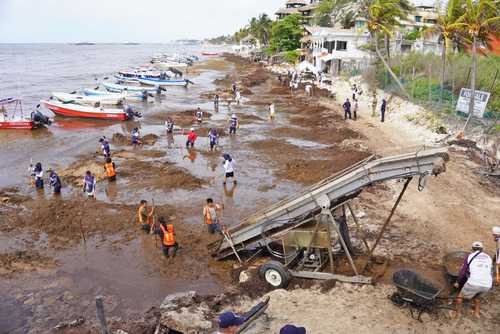
Faced with the accumulation of sargassum on the coasts of the Mexican Caribbean, students from the National Polytechnic Institute (IPN) are using the seaweed as a raw material to remove contaminants from wastewater, while also contributing to the removal of this organic waste from beaches.
Through the extraction of vegetable carbon from the dried plant, the students produce electrodes (conductors) that degrade contaminants from the textile industry, such as pigmentation from fabric dyeing liquids, via an electrochemical process.
The project is led by students from the master's program in sustainability of innovation in environmental technology at the National School of Biological Sciences (ENCB). The team is comprised of Geovani Flores, Frida López, Ángel Eduardo Lugo, and José Fernando Carmona. Their project was tested at a semi-pilot scale, successfully removing contaminants from wastewater provided by a textile company, which contained pigments from the coloring of denim.
The students note that indigo dye is very difficult to remove from wastewater, which often leaves conventional treatment processes incomplete. Therefore, the goal of using the electrodes is to remove the majority of the organic and inorganic matter present in the water.
Transformation into Vegetable Carbon
The students explain that they apply a technique called pyrolysis to the dehydrated sargassum. This process chemically transforms the seaweed through a thermal process at high temperatures and specific operating times until a solid fraction, known as biochar or vegetable carbon, is obtained.
Subsequently, they add catalysts, which they also developed, to modify the initial amorphous sizes and achieve carbon nanotubes and graphene with uniform nanometric measurements. When fabricating the electrodes, they add semiconductors to the biochar and subject this formulation to a thermal process so that the electrical conductors acquire the required hardness to carry out the electrochemical process.
Solar panels are incorporated into this process to increase sustainability; these panels provide the energy to the system to carry out the decontamination.
Recently, the Secretariats of Agriculture and Rural Development and of Science, Humanities, Technology and Innovation reported that 147 projects that use sargassum as a raw material are currently under development in the country, with the most advanced projects corresponding to biofuels.
Discover more from Riviera Maya News & Events
Subscribe to get the latest posts sent to your email.