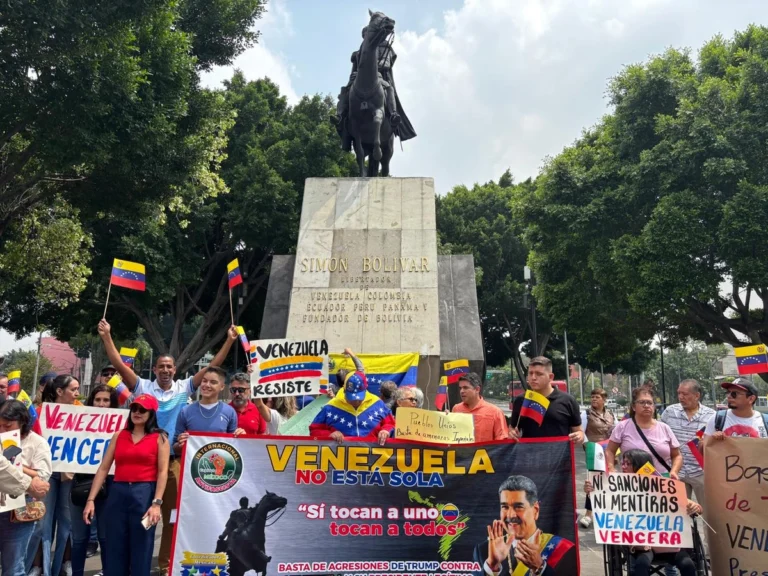
Mexico City, Mexico — On January 3, 2026, the detention of Venezuelan President Nicolás Maduro by United States forces unleashed a wave of mixed reactions in Mexico. The political class divided sharply between condemnation of the Caracas regime and warnings about the implications of the U.S. military intervention in Venezuela for Latin America.
The National Action Party Demands Release of Political Prisoners
The National Action Party (PAN), from its national headquarters in Mexico City, issued an official statement on January 3, 2026 at 10:30 a.m., condemning the government of Venezuelan leader Nicolás Maduro. The PAN expressed its “firmest condemnation of the regime that has systematically oppressed the Venezuelan people and canceled democratic freedoms.”
The opposition party, whose pronouncement came after Maduro’s detention by U.S. forces during the early hours of Saturday, demanded a “peaceful transition to democracy” in Venezuela.
The PAN’s Condemnation and Accusations of ‘Narco-Tyranny’
In the issued text, the PAN detailed its arguments against the Caracas government, noting that the current situation is the result of a “narco-tyranny” that abandoned democracy to become a “criminal network linked to drug trafficking, deepening poverty and exclusion.”
The party highlighted critical data about the humanitarian crisis:
- More than 80 percent of the population lives in conditions of misery.
- More than 8 million people have been forced into exile.
- Hundreds of citizens remain imprisoned for political reasons.
To these conditions, the PAN added the “electoral fraud committed in the 2024 presidential elections, which denied the Venezuelan people their right to freely decide.”
National Action advocated for a transition that guarantees the Venezuelan people the possibility of choosing their political future with full freedom, without interference or persecution. Furthermore, the party demanded the immediate release of all political prisoners, considering it an “indispensable condition to begin a genuine process of national reconciliation and restoration of the rule of law.” The PAN reiterated its solidarity with the Venezuelan people and its commitment to the defense of democracy, freedom, and human dignity in Latin America.
Mixed Voices in the Mexican Opposition
Reactions to Maduro’s detention and Washington’s military action generated opposing positions among leaders of Mexican political parties.
Rejection of War and the Fall of the ‘Narco-Dictatorship’
In opposition to the military intervention, though sharing rejection of the Venezuelan regime, the national leader of Movimiento Ciudadano, Jorge Álvarez Maynez, stated. Through the social network X, he declared:
“Wars do not democratize. Wars do not bring peace. Latin America must reclaim its right to free self-determination. That objective also involves shaking off the authoritarian and criminal regimes that have been established in the region. There is no sovereignty without democracy.”
For his part, the national leader of the PRI, Alejandro Moreno, affirmed on the same social network that Maduro’s detention “marks a breaking point in Latin America.” Moreno celebrated the fall of the regime, which he described as:
- Corrupt and repressive.
- In league with organized crime cartels.
- A “terrorist and communist narco-dictatorship” that destroyed Venezuela from within.
The PRI leader concluded that, from Mexico, they welcome “the fall of a terrorist and communist narco-dictatorship that should never have existed.”
The Legislative Power Condemns the Violation of International Law
Beyond partisan positions, Mexican legislative bodies expressed their condemnation of the United States’ action, aligning with a stance in defense of sovereignty.
The Chamber of Deputies and the ‘Kidnapping’ of Maduro
The Chamber of Deputies condemned the violation of international law following the United States’ attack on Venezuela. The president of the Chamber of Deputies’ Foreign Relations Commission, Pedro Vázquez, expressed his rejection of the U.S. military intervention in Venezuela, which resulted in “the kidnapping” of that country’s president, Nicolás Maduro, qualifying the action as an attack against international law.
The Senate and the Diplomatic Path
For its part, the Mexican Senate condemned the U.S. military intervention in Venezuela and demanded the intervention of the United Nations (UN). The Senate backed the stance of President Claudia Sheinbaum on resolving international conflicts only through dialogue and by diplomatic means. The polarization in Mexico reflects the continental dilemma: Is armed intervention the legitimate route to restore democracy, or does the principle of non-interference prevail in the face of actions that violate international law and the sovereignty of Latin America?
Discover more from Riviera Maya News & Events
Subscribe to get the latest posts sent to your email.