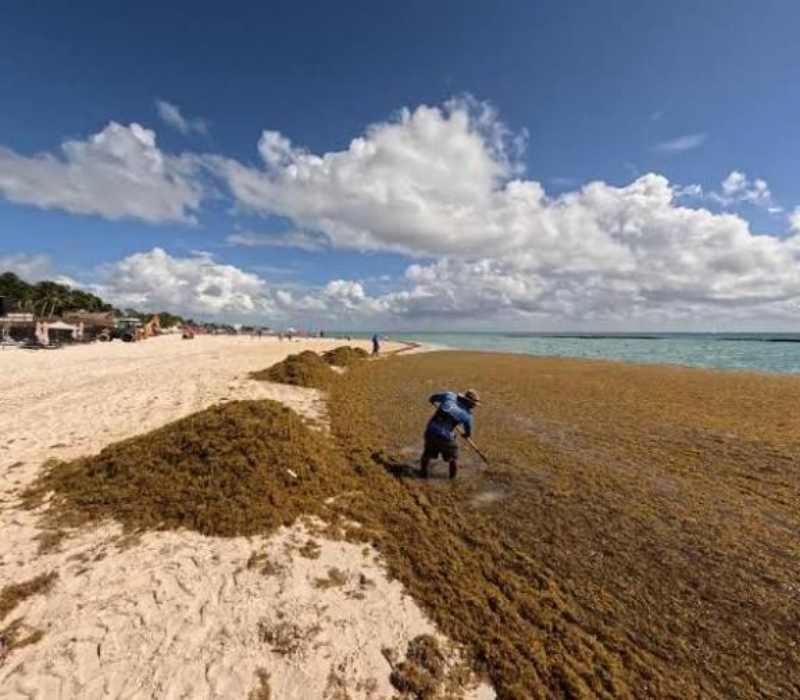
Playa del Carmen, Mexico — The Mexican Navy expects this year’s sargassum season in the Mexican Caribbean to be similar to last year’s, though officials say the seaweed’s behavior depends heavily on weather and ocean conditions in coming months.
Topiltzin Tlacaelel Flores Jaramillo, coordinator of the Navy’s Sargassum Containment Strategy, explained that forecasts come from large-scale monitoring in open ocean, which tracks sargassum presence. However, he noted that statistically only about 1 percent of the volume detected offshore has a chance of reaching the coast, and even that arrival can vary based on wind direction, ocean currents, and waves.
“Phenomena like cold fronts have helped mitigate sargassum accumulation on beaches by altering the movement conditions of floating algae,” Flores Jaramillo said after meeting with small hotel owners.
He acknowledged that each site has particularities that require specific evaluations before implementing actions like barrier placement.
The Navy representative said his agency maintains permanent coordination with scientific and research institutions through its Directorate General of Oceanography, whose studies have been key to adjusting containment and collection strategies.
As part of this work, a research cruise by the National Institute of Forestry, Agricultural and Livestock Research (INIFAP) recently analyzed sargassum behavior in open sea, with results already being incorporated into operational planning.
Based on these studies, he said officials are advancing in finding strategic positions for installing marine barriers to redirect sargassum toward collection points.
The naval authority specified that the effectiveness of these schemes depends directly on factors like wind, current, and waves, so not all coastal stretches are viable for placement.
Operationally, the Navy representative noted they have installed collection capacity of up to 580 tons, plus 16 operational maritime units ready for deployment when weather conditions permit. This capacity, he said, has been strengthened through coordination with the state government, which has contributed resources and logistical support to maximize at-sea collection.
The authority acknowledged that sargassum represents not just an environmental challenge but an economic problem impacting tourism and productive activities in the region. He reiterated the call for collaboration between agencies, the business sector, scientific community, media, and citizens.
Discover more from Riviera Maya News & Events
Subscribe to get the latest posts sent to your email.