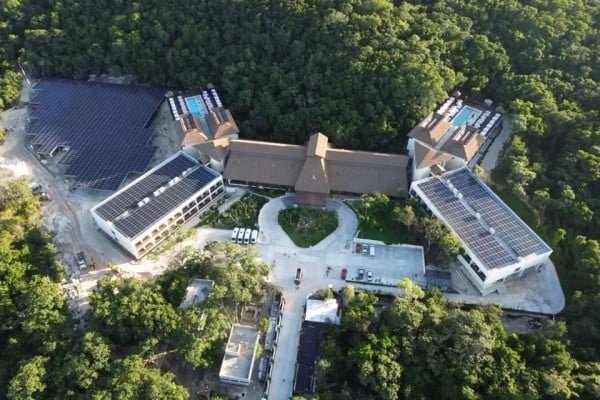
Calakmul, Campeche — Local tourism businesses in Mexico’s Maya region are accusing a military-run conglomerate of creating a monopoly that is driving them toward bankruptcy through unfair competition and government subsidies.
The Grupo Aeroportuario, Ferroviario, de Servicios Auxiliares y Conexos, Olmeca-Maya-Mexica (GAFSACOMM), commercially known as Grupo Mundo Maya, was announced in 2022 by then-President Andrés Manuel López Obrador and placed under military control. The enterprise manages 12 airports, an airline, the 1,500-kilometer Tren Maya railway, seven hotels, four parks, two museums, and 18 fuel stations.
Despite its extensive operations, the company reported minimal profits and requested subsidies of 45.166 billion pesos in 2025 and 58.212 billion pesos for 2026, according to Reforma newspaper. These subsidies allow GAFSACOMM to offer “all-inclusive” packages with up to 50% discounts that local businesses say they cannot match.
“It’s unfair competition because that entire hotel is subsidized by the federal government,” said Baltazar González Zapata, a hotelier and former deputy director of the Calakmul Biosphere Reserve. “They’ll never go bankrupt because we’re all subsidizing them while we’re going bankrupt.”
In Calakmul, hotel occupancy plummeted from 87% in early 2025 to less than 8% in the same period this year, according to tourism industry data. Meanwhile, the archaeological zone saw visitor numbers increase by 44% in 2025, rising from 28,000 to 49,000.
Enrique Rodríguez Córdova, president of Calakmul’s Municipal Tourism Committee, said the monopoly began when the Mexican Army (SEDENA) received permission to build a hotel within the UNESCO World Heritage biosphere reserve—something no private developer had been allowed to do.
“Today, 50% of my services are at the archaeological zone, but no longer as tours, just as guide services,” said Rodríguez Córdova, who represents 84 communities. “I have to travel 120 kilometers to Calakmul.”
The military-built hotel in Calakmul, which cost over 1 billion pesos and required clearing 30,000 square meters of protected forest, now appears as the only hotel option for Calakmul on booking platforms like Booking.com, despite other hotels operating up to 100 kilometers away.
Roque Camacho, a hotelier from Xpujil, alleges that when seeking permits, SEDENA claimed it was building a wildlife monitoring center, not a 144-room hotel.
The impact extends beyond Campeche. In Tulum, Quintana Roo, certified guide Raúl Morelos Castro says he was displaced after SEDENA took control of Tulum National Park and the archaeological zone last year and hired its own guides.
“GAFSACOMM is the first company that groups airports, Tren Maya, hotels, and the famous Catvis (Visitor Attention Centers), which are the entry points to archaeological sites,” Morelos Castro said.
He criticized the military’s management of tourism services, saying bathrooms don’t work, observation towers are closed, and electric transportation is deficient. Visitors must pay 180 pesos for the Jaguar Park ticket plus 125 pesos for the National Commission of Natural Protected Areas (Conanp) to access the archaeological site.
López Obrador justified military involvement in tourism infrastructure by citing the armed forces’ supposed honesty and efficiency, though the Tren Maya project’s cost ballooned from an estimated 150 billion pesos to over 500 billion pesos.
The former president also ordered that 75% of GAFSACOMM’s profits go toward military pensions. “That company, which will depend on the Armed Forces, will allocate 75% of its profits to the pensions of sailors, soldiers, and members of the Armed Forces,” López Obrador said in February 2022.
A 2025 study by the organization Community Cohesion and Social Innovation (CCIS) warned about the militarization of the tourism sector in the Yucatan Peninsula, predicting the displacement of local and community participation.
“It’s important to keep questioning why the military should be offering tourism services,” said CCIS director Suhayla Bazbaz via telephone. “But if they want to act as an economic actor, it’s important that they at least comply with the same rules that other companies and cooperatives face.”
State legislator Tania González Pérez has called for measures to address the imbalance caused by SEDENA’s operations. “When a monopoly exists, measures are applied to reestablish equilibrium,” she said.
Óscar David Lozano, director of the Tren Maya, recently defended the all-inclusive packages during a press conference with President Claudia Sheinbaum, saying they give people the opportunity to use the Felipe Ángeles International Airport, Mexicana de Aviación flights, and included accommodations.
The train has carried fewer than 2 million passengers since December 2023, far short of the promised 10 million annually.
Discover more from Riviera Maya News & Events
Subscribe to get the latest posts sent to your email.