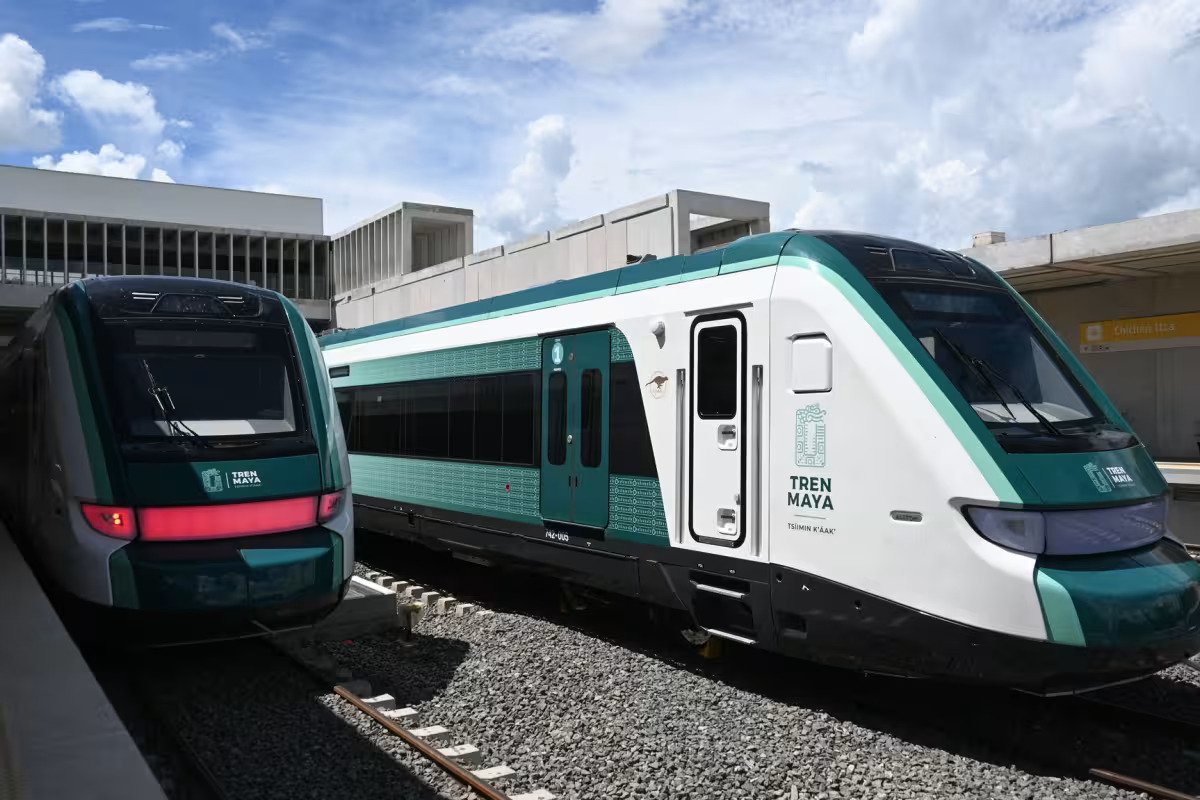
Quintana Roo — The Mexican Army’s engineering corps projects it will complete the main infrastructure for the Maya Train’s multimodal freight terminal in Quintana Roo by the end of 2026, with operational testing to follow in the first half of 2027. The announcement came from General Gustavo Ricardo Vallejo Suárez, commander of the “Felipe Ángeles” Military Engineering Group, during a presidential press conference on Thursday.
If the schedule holds, commercial freight service on the Maya Train could begin in 2026, initially operating on strategic sections across the five southeastern states the rail line traverses: Yucatán, Campeche, Quintana Roo, Tabasco, and Chiapas.
General Vallejo stated that military engineers have finished the basic engineering studies for the first stage of the broader freight rail project connecting Mexico City with Querétaro, Irapuato, and Saltillo—sections already under construction. In the southeast, work continues to enable the Maya Train’s cargo transport infrastructure, a key component to expand the rail system’s purpose beyond tourism and passenger service.
“For the specific cargo system, we are developing switching yards, rail spurs, logistics centers, and transfer stations that will allow the movement of agricultural goods, construction materials, fuels, and manufactured products,” Vallejo explained. He noted complementary works include adapting intermodal terminals, expanding road access, and connecting with strategic ports in the region.
Local business leaders see the freight project as an opportunity to reduce logistics costs. Jacinto Méndez, a construction materials distributor in Quintana Roo, said the Maya Train would allow more efficient transport of cement and steel from central Mexico with less reliance on trucking. “A savings of 15 to 20 percent on freight would make our prices more competitive,” he estimated.
Laura Guarneros, an agribusiness entrepreneur in the state, added that freight rail would facilitate shipping natural products like honey and citrus, as well as processed goods, to northern Mexico and export ports. “If the schedule is met and the rates are accessible, it could transform regional logistics,” she commented.
Esther Barrientos, a member of the Cancún College of Engineers, considered that with basic engineering complete and construction underway, the Maya Train’s freight system is entering a decisive phase that will define its economic impact on southeastern Mexico.
Separately, Edna Vega Rangel, head of the Secretariat of Agrarian, Territorial and Urban Development (Sedatu), reported that authorities have secured right-of-way access for railway projects covering 24.9 million square meters nationwide to date. For the Maya Train, the right-of-way corresponds to the entire route, spanning approximately 1,800 kilometers across the five southeastern states.
The approximate breakdown by state is:
- Chiapas: 233 km
- Tabasco: 286 km
- Campeche: 606 km
- Yucatán: 259 km
- Quintana Roo: 410 km
Vega Rangel clarified that the right-of-way includes not only the rail line itself but also areas for associated infrastructure, accounting for the large surface area reported. According to Mexican Army (Sedena) data, the overall rail project investment exceeds 500 billion pesos, covering track construction, stations, complementary works, and rolling stock.
Discover more from Riviera Maya News & Events
Subscribe to get the latest posts sent to your email.