MÉRIDA, Yucatán — The night of March 8, International Women's Day, once again placed Mérida before a complex scenario: a mixture of social indignation, legitimate demands for justice, and an atmosphere of confrontation that reflects a society increasingly polarized in the face of violence against women.
By approximately 8:30 p.m., hundreds of women of different ages had walked through the streets of the Historic Center and Paseo de Montejo, participating in the commemorative March 8th mobilization, an event that grows in both attendance and intensity year after year. Dressed in purple clothing and scarves, participants marched with banners, slogans, and public denunciations to demand justice for victims of femicide, gender violence, economic violence, and vicarious violence.
The streets were filled with messages like “We want to live,” “Not one more,” “The police don’t protect me, my friends do,” and “We were all there,” slogans that reflect both accumulated pain and anger toward a system that many protesters consider incapable of guaranteeing safety and justice. The mobilization brought together young people, adult women, older adults, and even mothers with children, reflecting that the movement has transcended generations and become a social phenomenon crossing different sectors of the population.
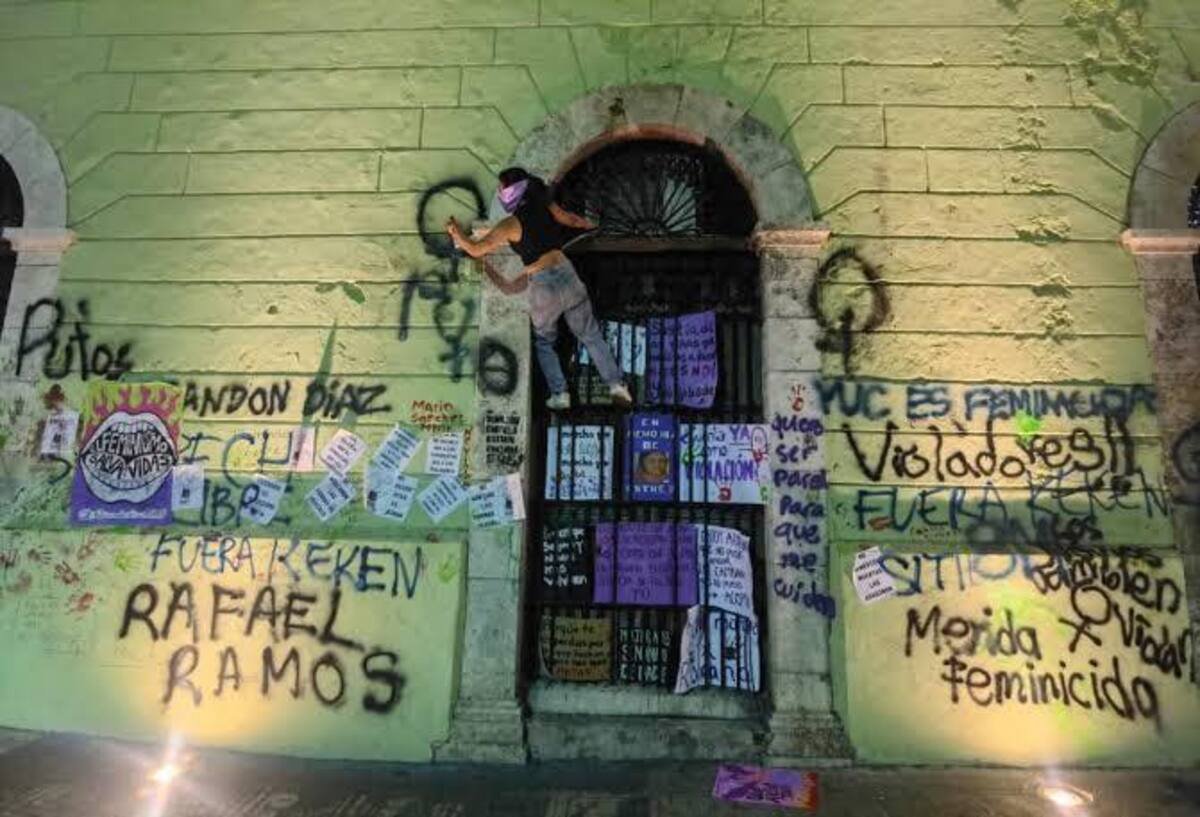
Hours before the march began, various feminist collectives started gathering in public spaces where they placed signs and improvised structures to display their grievances. Among the most visible actions were the so-called "clotheslines of denunciation," where sheets and cardboard signs with the names of alleged aggressors, testimonies of violence, and messages from victims were placed.
Some of the complaints mentioned cases of harassment, abuse, economic violence, and vicarious violence, while others pointed to alleged aggressors linked to different social spheres. Several messages included full names, while other testimonies remained anonymous, a practice that has generated debate among specialists and civil organizations. For some collectives, these spaces allow for the visibility of experiences of violence that often do not reach legal instances; however, specialists have also pointed out the need for these complaints to be channeled toward institutional processes that guarantee justice and protection for the victims.
Amid the messages, slogans could be heard that reflected the feelings of many attendees. "No girl should leave home in fear!" some protesters shouted into the microphone while others held up signs with the names of victims.
Hours before the mobilization, authorities installed metal fences and wooden panels at various points in the Historic Center and along the march route to protect historic buildings and monuments. Among the protected areas were structures and monuments located on Paseo de Montejo, one of the main stages of the March 8th demonstrations in Mérida.
However, as the mobilization progressed, some participants tore down the fences placed to protect monuments, which resulted in graffiti and slogans on the panels installed by the government. One of the most visible moments occurred at the boarding up of the monument to Justo Sierra, located on Paseo de Montejo with 35th Street, where women made graffiti while chanting the slogan "We were all there," a phrase that has become a collective response to criticism for the damage to monuments during feminist protests. The graffiti included messages related to femicides, violence against women, and accusations against institutions that, according to the protesters, have not acted firmly against these crimes.
The slogans also appeared at other points along the route, including the Monument to the Fatherland, where several protesters gathered during the night.
Beyond the graffiti or material damage, the mobilization brought to the forefront once again a reality that continues to be a cause for concern: cases of violence against women that remain unresolved or take years to find justice. For many participants, March 8th is not a celebration but a day of remembrance and protest against a problem they consider structural. The central demand remains: greater security, effective justice, and public policies that truly prevent gender-based violence.
At various points during the march, protesters remembered women who were victims of femicide and denounced the lack of progress in investigations. Criticism was also voiced towards the judicial system and the institutions responsible for handling complaints, noting that many victims face lengthy procedures, lack of follow-up, or processes that end up being archived.
Social Outrage, Radicalization, and Public Debate
The March 8th mobilization also highlighted once again a social tension that becomes more visible every year. On one hand, there is a sector of society that believes protests are necessary to make visible a problem that has historically been ignored. On the other hand, there are those who question the material damages and believe that some demonstrations have led to actions that go beyond the original objective of demanding justice.
Amid this debate, more radical positions are also emerging, reflecting a growing social polarization. Some analysts warn that the phenomenon cannot be understood solely from the perspective of activism or public order, but rather as the result of years of accumulated frustration with the lack of results in security and justice.
The March 8th protests in Mérida once again left a scene that is repeated every year: monuments protected with fences, women tearing down barriers, and slogans that reflect anger, pain, and demands for change. In that scenario, one question remains unanswered: Is the intensity of the protests the result of social radicalization or is it the consequence of years of violence and unsolved cases that have eroded trust in institutions?
While the debate continues, the reality is that violence against women remains a present problem and that the March 8th demonstrations continue to be one of the spaces where that indignation finds a voice.
Discover more from Riviera Maya News & Events
Subscribe to get the latest posts sent to your email.