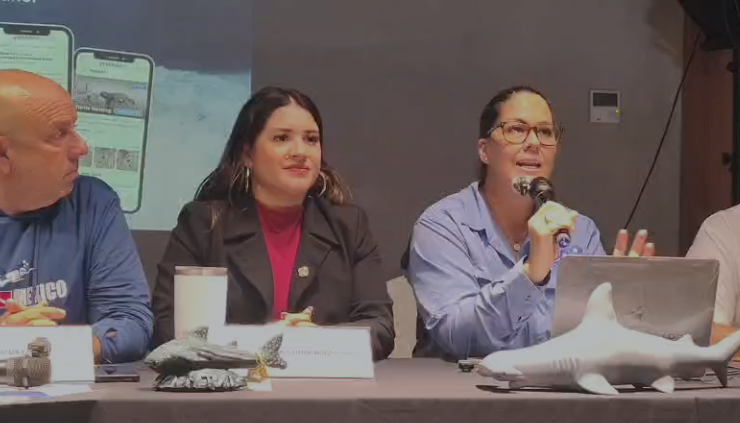
Playa del Carmen, Quintana Roo — The conservation organization MarAlliance has launched MARAP, a free community science app built to strengthen participatory monitoring of coastal ecosystems in the Mexican Caribbean by logging sightings of sharks, rays, manatees and other marine species.
Speaking at a press conference, Cecilia Gutiérrez Navarro, a project officer at MarAlliance and co-founder of the Little Shark School (Escuelita del Tiburón), said the tool is aimed at fishermen, divers, tour guides, swimmers, visitors and anyone who has the chance to observe marine wildlife.
The goal is to pool information supplied by the public to better understand the region’s biodiversity, spot possible changes in its ecosystems and develop conservation proposals alongside specialists, authorities and local communities.
Gutiérrez Navarro noted that a single sighting can take on greater significance when analyzed together with other records, making it possible to identify patterns in the behavior or movement of certain species.
As an example, she described the tracking of a tagged tiger shark whose journey began in an area near Honduras, continued toward Mahahual and later extended north through the Caribbean.
By comparing its movements with other data, she said, researchers identified a possible link to the sea turtle nesting season — information that helped them better understand how the animal travels.
Estefanía Hernández Flores, Playa del Carmen’s secretary of Economic Development and Investment Attraction, said MARAP represents an opportunity to strengthen collaboration between the public sector, the scientific community, fishermen, divers and tourism service providers.
She argued that putting technology to work alongside the conservation of marine ecosystems matters for a destination whose tourism industry depends heavily on its natural resources.
Hernández Flores also acknowledged the participation of the 26 permit holders tied to bull shark activities, as well as the work of activists and specialists involved in protecting the species.
With the launch of MARAP, MarAlliance aims to broaden citizen participation and build a body of information that can document sightings, shed light on how wildlife moves and flag changes along the Mexican Caribbean coast. The organization’s stated intent is for those records to feed scientific knowledge and serve as a reference for future marine biodiversity protection efforts.
More Environment
- Playa del Carmen Residents Blast Six-Year Illegal Dump
- Cozumel to Host 18th Island Bird Festival Oct. 7-11
- Playa del Carmen Seeks Million-Dollar Investment for Sargassum Processing Plants
- Yucatán Officials Rule Out More Brain-Eating Amoeba Infections at Mérida’s Plaza La Isla
- Tropical Storm Isaias Forms in Gulf of Mexico, Forecast to Hit US as Category 2 Hurricane
More Quintana Roo
- Quintana Roo Sends Para-Dance and Para-Athletics Teams to National Paralympiad
- Five Quintana Roo Mayors Seek Morena Federal District Posts
- Quintana Roo Cyber Police Handle 235 Complaints and Remove 278 Posts and Profiles
- Former Quintana Roo Tourist Police Chief Bound Over for Trial in Human Trafficking Case
- Quintana Roo Gains Power to Inspect Tourism Service Providers