
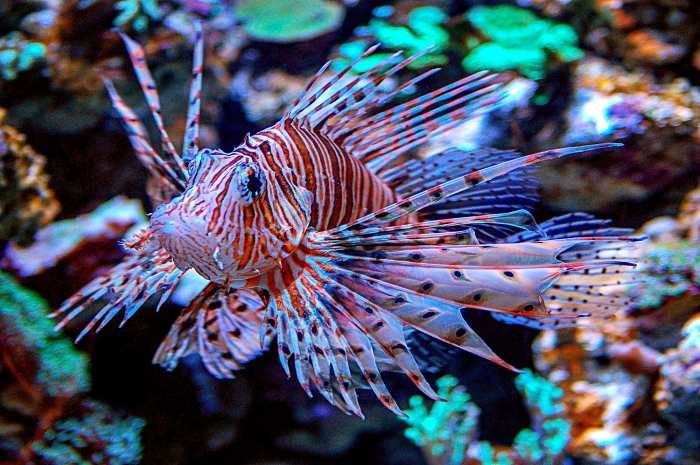
Playa del Carmen, Quintana Roo — The invasive lionfish remains present in the Mexican Caribbean, but local fishermen say the species is no longer behaving the way it did when it first began spreading across Quintana Roo’s reefs.
José Gómez Burgos, president of the Xaman Ha fishing cooperative in Playa del Carmen, said juvenile lionfish appear to have moved away from shallow reef areas into medium-depth waters, while larger specimens are now being found farther offshore and in deeper zones.
That shift has made the fish more difficult to catch. It has also changed the way local fishing cooperatives and divers approach control efforts, which for years focused heavily on removing lionfish from reef areas where they posed a direct threat to juvenile fish and reef biodiversity.
The lionfish is native to the Indian and Pacific Oceans, but it has become one of the most damaging invasive species in the Caribbean, Gulf of Mexico, and Western Atlantic. It was first reported in Mexican waters in 2009, and control efforts began soon after. Since then, divers, fishermen, conservation groups, protected-area managers, and restaurants have all been part of attempts to reduce its population.
The problem is not simply that lionfish are present. It is how they feed. Lionfish are efficient predators that consume small reef fish, crustaceans, and juvenile species that are important to the health of coral reef ecosystems. In places where their populations grow unchecked, they can reduce native reef fish populations and disrupt the balance of the food chain.
Gómez Burgos said the species may have moved deeper as a survival strategy. On the reef, lionfish became targets for divers and fishermen. In deeper water, they are harder for humans to reach. At the same time, larger fish in those deeper zones may prey on them, something that rarely happened in shallow reef environments.
Even so, Gómez Burgos warned that the species remains a serious concern. Wherever lionfish appear, he said, they can wipe out smaller marine life around them.
Control efforts have had mixed success throughout the Caribbean. Lionfish reproduce quickly, can live in a wide range of habitats, and are difficult to eliminate once established. Because of that, most conservation programs focus on management rather than eradication. The goal is to keep numbers low enough to reduce pressure on native species, especially in important reef and nursery areas.
In Quintana Roo, local action continues. In Akumal, organized lionfish hunting efforts still take place regularly, including weekly outings by divers who help remove the species from local waters. These efforts have become part of Akumal’s broader reef conservation culture, where dive shops, trained divers, and community members have long worked to protect Akumal Bay, Half Moon Bay, and nearby reef areas.
Those hunts are not casual activities. Lionfish have venomous spines that can cause intense pain and swelling if handled incorrectly. Divers generally need training, proper equipment, and knowledge of safe handling practices. Specialized containers and spears are often used so the fish can be removed without endangering divers or other marine life.
At the same time, lionfish can be safely eaten once properly cleaned, and for years conservationists encouraged restaurants and consumers to help create demand for the species. The idea was simple: if people eat lionfish, fishermen have an incentive to remove them.
That market has weakened since the pandemic, according to Gómez Burgos. Lower demand makes it less attractive for fishermen to target lionfish, especially now that the fish are being found in deeper and more difficult areas.
That creates a challenge for reef protection. The lionfish problem has not disappeared. It has become less visible.
For residents and visitors, the takeaway is clear. Lionfish may not be seen as often in shallow reef areas as they once were, but they remain part of the conservation picture in the Mexican Caribbean. Continued monitoring, targeted removals, trained diver participation, and responsible consumption can all help reduce their impact.
The species may have adapted, but so have the people working to protect the reef.
More Environment
- Polo strengthens to a Category 5 hurricane off Mexico’s Pacific coast in Record Time
- Cozumel Launches Rabies Vaccination Drive With 3,000 Free Doses for Pets
- Sargassum Collection in Quintana Roo Tops 133,000 Tons, Setting New Record
- Isla Mujeres Collects Over 160,000 Tons of Waste in Five Years
- Tulum Beach Cleanup Pulls 32 Kilos of Marine Debris From Playa del Pueblo
