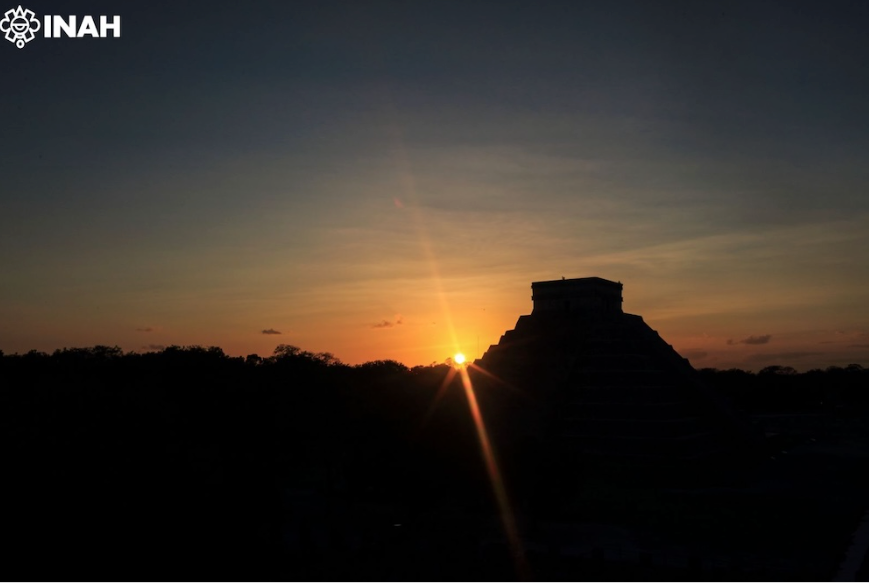
Chichén Itzá, Yucatán — The National Institute of Anthropology and History (INAH) announced it is ready to welcome visitors to the Chichén Itzá archaeological zone for the 2026 spring equinox, scheduled for March 20-22. The astronomical event will begin at 8:46 a.m. Central Mexico Time on March 20, according to the National Institute of Astrophysics, Optics and Electronics.
The Spring Equinox Operation aims to safeguard the UNESCO World Heritage site and ensure public safety. INAH urged visitors to follow staff instructions at all times.
The initiative is coordinated with the Yucatán State Government, the Cultur Trust, the Yucatán Tax Administration Agency, the State Prosecutor’s Office, the National Migration Institute, the Red Cross, civil protection services, state police, and students from Benito Juárez University.
Operating Hours
On Friday, March 20, Chichén Itzá will open at 9 a.m., with ticket booths and access closing at 4 p.m. and evacuation by 5:30 p.m. On Saturday, March 21 and Sunday, March 22, the site opens at 8 a.m., with ticket booths and access closing at 4 p.m. and evacuation by 5:30 p.m.
Restrictions and Prohibitions
Access to restricted areas, ceremonies of any kind, and drone flights are prohibited. Professional photography or videography equipment requires prior authorization from INAH’s National Coordination of Legal Affairs, with permits available online.
Bags and backpacks will be inspected at entry. Prohibited items include flammable products, cigarettes (electronic or any type), costumes, tarps, flags or items with commercial branding, tripods, camera lenses, alcohol, narcotics, sharp or firearms, ashes, or any device that risks personal safety or monument integrity.
The last access to the Ball Court, the Osario, the Observatory, the Nunnery Complex, and the Plaza of the Thousand Columns will be at 3:30 p.m., with evacuation at 4 p.m. This measure will concentrate visitors in front of the Temple of Kukulcán to observe the archaeoastronomical event.
The Equinox Phenomenon
The natural event involves the projection of seven triangles of light and shadow on the north alfarda of the Temple of Kukulcán. When these join with the serpent head sculpture at the base of the building, they create the appearance of a serpent descending the staircase, visible approximately from 3 p.m. to 5 p.m.
Last year, the phenomenon drew 32,872 people, and similar light effects can be seen on days near the equinox.
Additional Information
The Great Museum of Chichén Itzá will be open from 8 a.m. to 3 p.m., accessible from inside the archaeological zone via the Sacred Cenote area, with re-entry possible at the same point. Visits to the Initial Series area will be suspended during the operation.
To expedite evacuation for groups traveling in buses, vans, or sprinters, the Visitor Center exit (via the Sacred Cenote) will be enabled on March 21 and 22, with boarding at gates 5, 6, and 9.
Site access costs 105 pesos, plus an additional fee from the Yucatán Tax Administration Agency. On Sunday, INAH offers free entry to national visitors and neighboring indigenous communities with INE identification, and foreign residents with proof of residency.
Entry tickets issued by INAH can only be purchased at the ticket booth and electronic modules in the zone. Due to high attendance, officials recommend considering visits to nearby archaeological zones like Izamal, Ek’ Balam, Uxmal, and Kabah.
Discover more from Riviera Maya News & Events
Subscribe to get the latest posts sent to your email.