
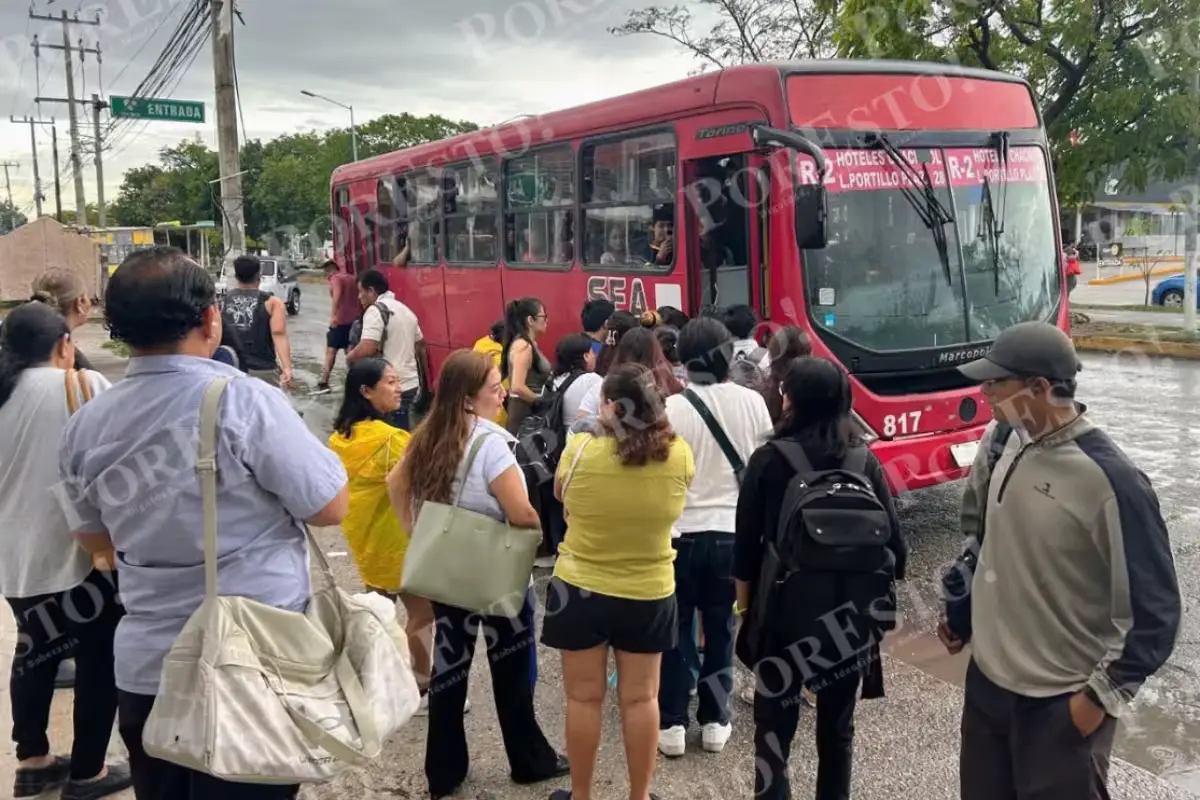
Cancún, Quintana Roo — Heavy rain overwhelmed Cancún’s public transport system on Tuesday, leaving workers and students stranded at bus stops for as long as 50 minutes as flooded streets snarled traffic across the city.
From early morning, bus stops filled with people who could not squeeze onto buses, and even fewer could board the smaller vans known as combis. The scene repeated itself across the resort city: workers carrying umbrellas and inadequate rain gear, students and employees trying to shield themselves from the downpour.
Among those waiting were hotel employees heading to or returning from shifts, ending up soaked while they waited for transport that either arrived at full capacity or failed to stop.
“I’ve been here about 50 minutes, three buses have gone by but they’re full, there’s no way to get on,” said a resigned young woman on her way to work.
Other passengers said some combis did not even pull over at stops because drivers feared being stranded in flooded areas.
“In this area there are combis that take you downtown, but they come by and sometimes they don’t stop because of all the water, and you just keep waiting,” said Lidia Suárez, a resident of Barrio Maya.
Frustration ran higher in irregular neighborhoods, where transport options are even more limited. “Around here there are only mototaxis, and today there were fewer because they get stuck in the potholes,” said Don Nazario.
Stranded Vehicles and Hidden Potholes
While some tried to reach their destinations, others focused on keeping their cars from ending up underwater. Major avenues flooded, and several drivers were left stranded, requiring tow trucks to pull vehicles out of inundated areas.
“You have to look for alternatives, Chichén and other avenues are flooded, I hope my car doesn’t get stuck,” one motorist said while creeping forward.
Water also turned potholes into traps. With the pavement’s irregularities hidden beneath the surface, several drivers were involved in collisions after failing to spot them. Unfinished roadwork further reduced circulation space and complicated pedestrian crossings.
The Municipal Transit Department reported temporary closures at several points because of significant flooding, including:
- Avenida Cobá at Palenque
- Avenida Xcaret at Yaxchilán
- The area around the General Hospital in Supermanzana 65
- The turnaround at San Johns, Boulevard Colosio
- Boulevard Colosio at Residencial Campestre
Transit officers kept up a presence to carry out prevention and traffic support duties, and to monitor dark or flashing traffic lights, stranded vehicles, obstacles on public roads and other hazards.
They also patrolled areas including Boulevard Colosio near Plaza Luxury and Motel Play, Colosio at Contoy Oriente, Avenida Tulum at Cobá, Avenida Bonampak at the Glorieta del Kilómetro 0 and its junction with Nichupté, Yaxchilán at Cobá, and the surroundings of the Municipal Palace. Officials urged drivers to slow down, increase following distance, turn on their lights and avoid crossing flooded areas.
In Puerto Juárez, authorities also restricted navigation for vessels under 40 feet because of the adverse weather and forecasts that the rain would continue.
Once again, the storm exposed two sides of Cancún: a tourist destination that showcases infrastructure built to host visitors, and a city where a downpour can upend public transport, paralyze roads, strand vehicles and force hundreds of workers to wait in the rain.
More Community
- Gasoline in Cancún Hits 25.39 Pesos a Liter, Topping Profeco’s Priciest Fuel List
- Cancún Airport Travelers Forced to Sit on Floor at Terminal 2
- Cancún Residents Block Avenida Tules Over Sewage Overflow
- Aluxes Endure in the Beliefs of Maya Communities in Quintana Roo
- Federal Youth Program Enrolls 100 in Cancún and Playa del Carmen
More Cancun
- Atelier Playa Mujeres Named Best All-Inclusive Cancun Resort for Foodies by Forbes Vetted
- Authorities Deactivate Search Alert for Emma Solís After Cancún Girl Is Located
- Cancún Man Arrested in Connection With 24 Violent Store Robberies
- Hit-and-Run Driver Kills Worker on Cancún’s Colosio Boulevard
- Man Arrested in Miami Turned Over to Quintana Roo in Cancún Fraud Case