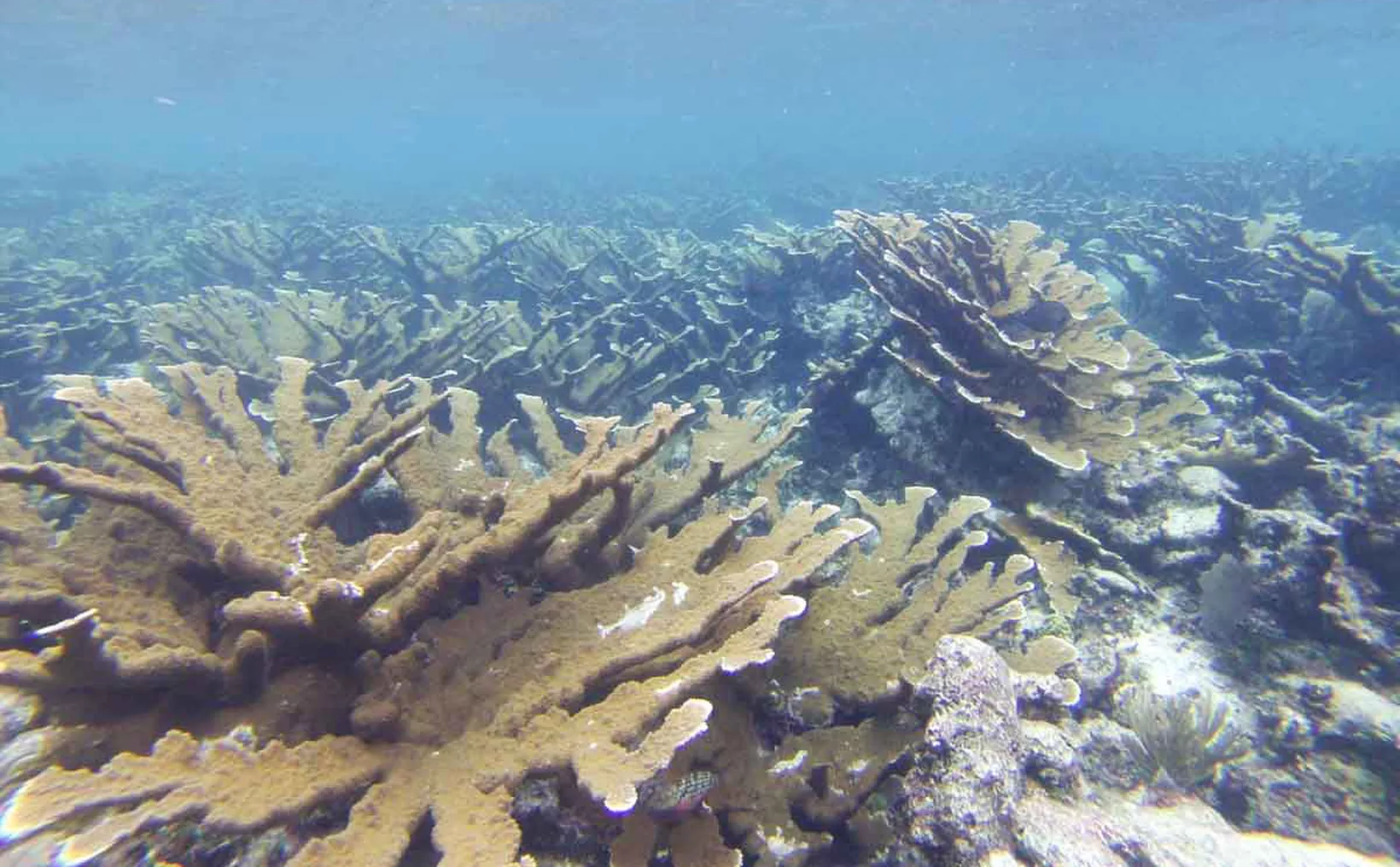
Cancún, Mexico — A global scientific report has issued an alert for Quintana Roo. The coral reefs of the Mexican Caribbean, part of the Mesoamerican Reef System (SAM), have crossed a critical threshold. The document "Global Tipping Points 2025" from the University of Exeter in England declares that warm-water coral reefs worldwide, including those off the coast of the state, have crossed their first global climate point of no return.
According to researcher Claudia Padilla Souza, corals have until now been resilient to tissue loss syndrome and bleaching caused by high sea temperatures, in addition to the effects of hurricanes, overfishing, and high visitation to Protected Natural Areas. Therefore, in an adverse scenario, there is only one path forward: active restoration.
The study, backed by more than 160 scientists, states that reefs are the first global ecosystem to reach an irreversible tipping point due to climate change, and a large portion of the corals have exceeded their heat tolerance, entering a phase of irreversible degradation. It notes that since 2023, more than 80 percent of tropical corals have suffered massive bleaching episodes, a direct signal of thermal stress.
"The situation is really difficult because in the last five years a series of events have been generating deterioration in the reefs and there has not been any period of stability in which they could recover naturally, which has decreased coral coverage in a more accelerated manner," emphasized the specialist, who has studied Caribbean corals for decades.
Experts consider it "highly likely" that the degradation will continue without pause, which implies a coastal risk that threatens the subsistence of one billion people and leaves coastal communities chronically vulnerable to erosion and storms.
"The problem is that there are more and more diseases and new, very devastating events at a global level; these types of phenomena are occurring all over the world and Quintana Roo is no exception," added Padilla Souza.
In this way, the health of the corals in the SAM faces a "perfect storm" by combining global threats with local pressures such as pollution and high reef visitation.
"Starting in 2018, what is now identified as tissue loss syndrome began to proliferate. It is very invasive because it peels and the coral dies, with up to 90 percent tissue loss in corals calculated, which marked an abrupt change in the health of the reefs," she indicated.
Subsequently, in 2023 and 2024, a period of stress and bleaching occurred where, due to high sea temperatures, a massive mortality of species that were already damaged from 2020 by the presence of different meteorological phenomena took place.
"We are having continuous disturbances, where they cannot recover from one event before another one comes," highlighted the environmental consultant.
The study underscores that, although the global trend is bleak, immediate local action is crucial to preserve the corals. This is why in Quintana Roo there are coral nurseries like the one at "Bajo Pepito" in Isla Mujeres, but also in Puerto Morelos, Playa del Carmen, and in the south of the state, which offer the hope of fostering the reproduction and repopulation of these specimens.
This can be achieved through active restoration or the planting of corals that were previously cultivated, trying to find those colonies that have survived and are resilient because they withstood stressful situations so that they can be propagated.
"The idea is to generate more biomass, and although it is a complicated task, it has to be carried out because otherwise, if we are inactive, the reef will end," she emphasized.
Discover more from Riviera Maya News & Events
Subscribe to get the latest posts sent to your email.