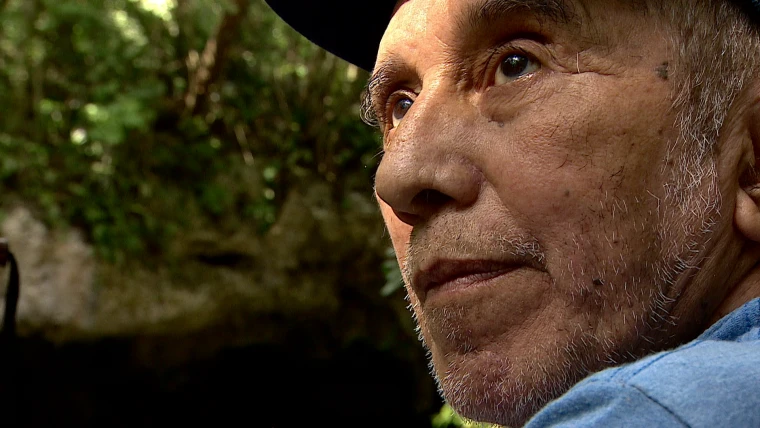
AKUMAL, Mexico — Through deception, threats, and the backing of political power, a 73-year-old Maya elder was dispossessed in 2019 of his sacred land containing three cenotes in Akumal, Quintana Roo. The individual responsible, José María Rejón de la Guerra, the brother-in-law of the then-governor Carlos Joaquín González, used a legal and notarial scheme to appropriate the property known as "La Caverna," a case that reveals how corruption and impunity intertwine when political power protects its own.
Six years later, justice is beginning to reverse the abuse. A federal judge and a civil judge in Yucatán have ruled in favor of the elder, ordering the reopening of the criminal investigation and declaring null and void the fraudulent sale that stripped him of his patrimony and the cenotes he had cared for over decades.
Antonio Manrique Mac, 73, worked the land for decades and obtained it legally in 1999. The property included three cenotes—La Caverna, Aluxe, and Jaguar—and an underground river. For 23 years, Don Antonio enjoyed and cared for these 37 hectares of jungle with its sacred bodies of water. He originally received the land as payment for his work as a chiclero, granted by the Secretary of Agrarian Reform. Over time, he sold parts of his land to subsist, retaining only the final parcel: the 37 hectares with the cenotes, a natural and family patrimony he had always vowed never to sell.
The 2019 Dispossession: Power and Deception Against an Indigenous Elder
In April 2019, that last parcel was taken from Antonio through a fraud orchestrated by José María Rejón de la Guerra, the brother-in-law of the then-governor of Quintana Roo, Carlos Joaquín González. The governor's wife, Gabriela Rejón de Joaquín, had fallen in love with the ranch after seeing its cenotes, and her brother acted to fulfill that desire using a fraudulent legal framework.
The operator of the plan was Cecilia Yvette Castillo Parra, who during 2018 gained the family's trust and pressured them to sell the ranch, arguing that the first lady "wanted it because she liked it, she was in love with the property."
On April 29, 2019, Castillo arrived at Antonio's home with several armed men he identified as police officers. Under threats, they forced him into a vehicle and took him to a notary's office in Mérida, Yucatán—Notary Public Number 85 of Yucatán, under the charge of notary Rodolfo Cerón Palma. There, they made him sign documents without allowing him to read them or fully explaining their content.
Antonio, 73 years old, with difficulty understanding Spanish and a brain injury affecting his memory, did not understand he was selling his ranch. He had been deceived into believing he was signing a lease agreement when it was actually a sales contract.
"They wouldn't stop threatening me that if I didn't sign, I would end up in jail," Antonio later stated about that moment.
The notary failed in his duty to verify the seller's will and capacity, as he certified the signature despite Don Antonio's evident lack of comprehension and consent. The deed of sale registered a price of 7.5 million pesos (approximately 394,000 USD) for the ranch. To give an appearance of legality, José María Rejón deposited part of the money into a new bank account opened in Antonio's name, an account that Cecilia Castillo controlled due to the elder's lack of knowledge.
With these funds, the fraudsters paid the taxes for the operation and the notary's fees, and immediately withdrew the rest of the money. Castillo transferred 4.5 million pesos from Antonio's account to a personal account of hers, and they also issued checks in the name of Rejón. In less than 24 hours, the "paid" money disappeared from Mr. Manrique's account, leaving him without a single cent of the supposed sale price. José María Rejón simulated the payment; they never delivered to Don Antonio the value of his land, despite the deed suggesting otherwise.
After the forced signing, Antonio lost ownership of La Caverna and its cenotes. Since April 2019, José M. Rejón's name appeared as the registered owner of the 37 hectares, and Don Antonio was left without his ranch and without money. Worse still, during the fraud he suffered coercion and abuse. His daughter Concepción recounted that "My father never agreed on a price nor knew he was selling… He would never have sold that ranch because it was his children's patrimony."
Cover-up and Impunity: Colluding Authorities
After realizing the dispossession, Antonio Manrique Mac sought justice by filing a criminal complaint. On August 31, 2019, he went to the Prosecutor's Office in Tulum (FGE Quintana Roo) and accused José M. Rejón, Cecilia Yvett Castillo, and others involved of robbery, fraud, and dispossession. However, facing the powerful resulted in indifference and a cover-up by local authorities. For days, the Maya elder went to the prosecutor's office and remained seated without his complaint being taken, on the orders of the then-prosecutor of Tulum, Estela Noemí Labastida Rodríguez.
They finally managed to file it, opening case file FGE/QR/AMPTUL/08/1113/2019, but in a meteoric span of just three months, the Prosecutor's Office closed the case without investigating. In November 2019, the prosecutor of the Ministerio Público, Jeans Gaspar Chablé Yupit, determined the non-exercise of criminal action, meaning he decided not to proceed against the accused. This resolution was endorsed by Deputy Prosecutor Estela Labastida and by the Deputy Attorney General Alfonso Marcos García, despite clear evidence of crime and the victim's vulnerable situation.
The manner in which the case was archived violated Don Antonio's rights. He never had a real legal advisor representing his interests, although he was assigned a public advisor from the Victims' Commission (Fernanda Leo Barney), she never contacted him nor performed any procedures on his behalf. In practice, Antonio was left in total legal defenselessness, with no one to object to the expeditious closure of the investigation in favor of the influential governor's brother-in-law.
The irregularities accumulated. The notification of the decision not to exercise criminal action was not even personally informed to the victim; the Prosecutor's Office published it on its public notice board, so Antonio found out months later, thanks to private lawyers who later supported him reviewing the file. These lawyers requested a hearing before a control judge to challenge the determination, but on August 6, 2020, the day of the hearing, another setback occurred. Antonio's lawyers surprisingly resigned from representing him, and he and his daughter (who acts as his interpreter from Maya to Spanish) did not attend due to illness. Without the legal advisor present or the complainant's attendance, the judge dismissed the challenge. All this occurred without anyone clearly explaining to Don Antonio the importance of appearing that day, considering his age and disability.
Parallelly, instead of punishing the perpetrators, the justice apparatus attempted to invert the roles. José M. Rejón de la Guerra filed a criminal complaint against Antonio in April 2020, accusing him of alleged "false complaint" and "false testimony" for having accused him. That is, the victimizer sought to have the dispossessed elder treated as a criminal, in a maneuver to intimidate and halt his search for justice.
The Legal Battle: From Federal Injunction to Annulment of the Sale
Faced with local impunity, Antonio's family and his lawyer, Fabiola Cortés Miranda, persisted for years through legal channels. In October 2020, Fabiola took the case and promoted a writ of amparo before a federal judge, arguing that the Quintana Roo Prosecutor's Office violated Don Antonio's due process and right to justice by closing the investigation irregularly.
In December 2021, the Third District Court in Cancún ruled in Antonio's favor, granting him an amparo that ordered the proceedings to be restarted. The federal judge concluded that due process had been violated because Antonio was not personally notified of the key August 2020 hearing, nor was the significance of his absence explained to him, especially being an elderly adult with a disability and a language barrier. Therefore, the amparo instructed that a control judge hold a new hearing, with Antonio properly assisted by his lawyers, to reconsider the decision not to exercise criminal action.
This amparo ruling (case file 784/2020) represents a crucial step, as it opened the door to reopening the criminal investigation against José M. Rejón and accomplices. José M. Rejón, as an interested third party, attempted to stop this legal setback. He filed an appeal for review against the amparo ruling, prolonging the battle in federal courts. Finally, after several months, the Third Collegiate Court of the circuit resolved in August 2025 to confirm the amparo in favor of Antonio.
With this, the order became final. The "non-exercise" ruling issued by the Prosecutor's Office in 2019 is revoked, and case file FGE/QR/AMPTUL/08/2019 is reopened. Now, by judicial mandate, a local judge must convene a hearing and re-examine the case, this time guaranteeing that Antonio Manrique has legal advice and a voice in the process—something he was originally denied. This opens the real possibility of a criminal process against José María Rejón de la Guerra and all those involved in the dispossession.
Parallel to the criminal front, Antonio's defenders undertook an action in the civil courts to recover the lost patrimony. In an ordinary civil trial initiated in 2021 (case file 509/2021), they sought the annulment of the fraudulent sale of the ranch La Caverna. After a long process, victory came in July 2025. The Judge of the First Civil Court of Mérida, Yucatán, issued a sentence declaring null and void public deed number 45 dated April 25, 2019, through which Rejón de la Guerra had taken possession of the ranch. The resolution recognizes that the sales contract was illegal, as Antonio never truly consented to selling his property. Consequently, the property must legally return to its legitimate owner.
A detailed explanation of the underlined fragment from the ruling states: "The action brought against José María Rejón de la Guerra shall be declared admissible… Public deed number forty-seven, dated the twenty-fifth of April, two thousand nineteen… granted under the authority of Master of Law Rodolfo Cerón Palma, Notary Public number 85 of the State… executed by Antonio Manrique Mac, in favor of José María Rejón de la Guerra, regarding the lot denominated La Caverna, in Akumal… is declared null and void." This means the judge recognizes the lawsuit is valid, officially annuls the notarial deed, identifies the participating notary, and specifies the annulled act concerning the "La Caverna" lot.
This triumph in civil justice represents the vindication of the Maya elder's right to his land. However, the legal battle is not over. The defeated parties seek to delay justice. José M. Rejón appealed the annulment sentence, clinging to the fiction that the sale was legitimate. The civil case will move to a second-instance court where the ruling will be reviewed. Antonio's family and his lawyers must continue their defense so the annulment is confirmed and the patrimony is protected.
Likewise, in the criminal avenue, once the investigation is reopened, evidence must be presented and possibly lead to the formal indictment of Rejón, Castillo, and other responsible parties, to then channel a criminal trial where they are held accountable for fraud, dispossession, abuse of a vulnerable person, and other applicable crimes.
An Emblematic Case: Justice for Indigenous Peoples
The ordeal and subsequent victory of Don Antonio Manrique Mac have become an emblem of justice for the indigenous peoples of Mexico. This Maya elder, vulnerable due to his economic, linguistic, and health condition, faced the abuse of powerful people linked to the political elite. They took his sacred land through deception and violence, taking advantage of his indigenous origin and disability to attempt to escape punishment.
For years, local institutions turned their backs on him, denying him protection and access to basic justice. However, thanks to his family's perseverance and the committed legal support of activists, he managed to reverse the situation.
"The story has taken a 180-degree turn," his lawyer stated upon learning of the recent favorable rulings. Now, finally, both the patrimony and the dignity of a Maya man are being vindicated through the legal system.
This case exposes how corruption and impunity allow the dispossession of lands from native communities, but it also demonstrates that justice can be achieved when fought for with tenacity. Citizen organizations like Somos Tus Ojos, led by Fabiola Cortés, played a key role in making the case visible and pushing legal actions to the highest instances.
It is worth recalling that in December 2020, Fabiola herself, at the president of the Republic's morning press conference, publicly denounced the fraud committed against Antonio. In response, the then-governor Carlos Joaquín discredited the accusation, alleging that neither he nor his wife had any part in the sale, and even threatened legal actions against the complainant. He did not undertake such actions but unleashed a campaign of media and judicial persecution against the lawyer-journalist who uncovered the truth.
Despite these pressures, which included fabricated accusations against Fabiola Cortés herself for alleged non-existent dispossessions, she and the Manrique family did not yield. Today, the case of La Caverna is a symbol of resistance and hope for indigenous peoples facing power abuses. It represents a precedent that no local power is above the law and that the truth, with time and legal action, can prevail even against influential figures.
With the recent rulings, a new stage opens. The expectation is that the current authorities will act with rectitude and without cover-ups. Those who carried out the dispossession are no longer in power—Carlos Joaquín left the governorship in 2022 and currently serves as Mexico's ambassador to Canada, and the Attorney General of Quintana Roo from that time (Óscar Montes de Oca) no longer leads the institution.
Now the state has a new administration under Governor Mara Lezama. To her, Antonio's family and his defenders ask to guarantee the rule of law and not tolerate political pressures in the case. Similarly, they call upon the current State Attorney General Raciel López Salazar (appointed in 2023) to not interfere protecting involved officials or former officials; on the contrary, to allow the criminal investigation to be carried out impartially and to proceed according to the law against all responsible parties, including the former prosecutors Chablé Yupit and Labastida Rodríguez, who were reported for their role in this collusion.
At the federal level, activists direct their petition to the new president of Mexico, Claudia Sheinbaum. They remind her that this case was exposed in its time before President Andrés Manuel López Obrador, without presidential intervention being what resolved the problem. What finally brought justice were the courts and the tenacity of the affected family. Therefore, they urge federal authorities not to provide impunity to former governor Carlos Joaquín or his relatives.
"To what extent will Morena, Governor Mara Lezama, and President Claudia Sheinbaum protect Carlos Joaquín González, who went from being a local power broker to being a friend of former President López Obrador?" questioned Fabiola Cortés, underscoring the concern that political connections might truncate this legal advance. Society hopes that "times have truly changed" and that in the Fourth Transformation there is no room for covering up abuses against the most vulnerable.
In conclusion, the story of Antonio Manrique Mac and the La Caverna ranch is a triumph of truth over power. It is the vindication of a member of indigenous peoples against injustice and corruption. It remains to ensure that the civil sentence returning his land is fully executed and that the criminal case succeeds in sanctioning those who dispossessed him. Only then will the justice that this Maya elder and his family deserve be consummated, sending a strong message that no crime will go unpunished, whether committed by high-ranking politicians or anyone else, when reason and the law are on the side of the people.
Discover more from Riviera Maya News & Events
Subscribe to get the latest posts sent to your email.