
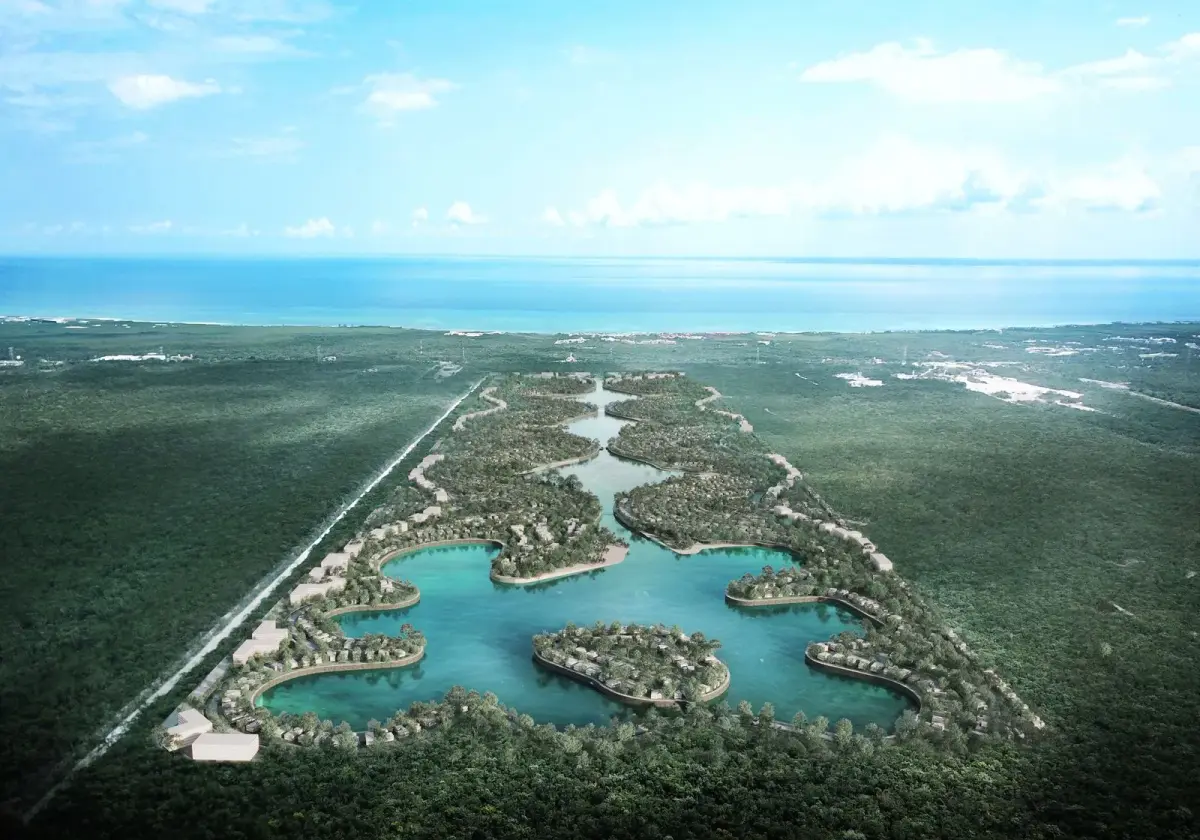
Playa del Carmen, Quintana Roo — A developer has submitted plans for a 425.85-hectare resort and real estate complex on jungle land about nine kilometers north of Playa del Carmen, with a 280-room hotel, an artificial beach, commercial areas and a system of man-made lakes created through limestone quarrying.
The project, named HAZUL, is being promoted by the company Arquitectoma Playa. It entered the General Directorate of Environmental Impact and Risk (DGIRA) of the federal Environment and Natural Resources Department (Semarnat) this week through an environmental impact statement (MIA).
The property, known as San Francisco, sits west of Federal Highway 307 near kilometer 300 — a location that stands out because the proposal calls for an artificial beach on land with no coastal frontage.
According to the environmental filing, the project would involve converting 251.10 hectares of medium sub-evergreen forest that is currently in a process of recovery, during the site preparation stage.
The plan is divided into nine phases, each estimated to last five years, making it a long-term development on one of the largest tracts of jungle contemplated in recent projects in northern Quintana Roo.
Lakes Formed by Limestone Extraction
One of the central elements of HAZUL would be a group of water bodies covering 908,217 square meters, along with an artificial beach projected over 11,020 square meters.
The environmental impact statement acknowledges that the land has a particular condition: it was previously used as a materials quarry, and limestone extraction reached the water table, creating bodies of water that would now be incorporated into the complex’s design.
The developer says wastewater would be handled through sealed storage, extraction and disposal by authorized contractors, given the hydrological conditions of the site.
The proposal also includes residential, commercial and hotel infrastructure, though the documentation must be reviewed by federal authorities to determine its possible effects on soil, water, vegetation and wildlife.
History of State Permits
The company states in its filing that the property holds prior state authorizations for limestone extraction, and that Quintana Roo’s Environment and Ecology Department (SEMA) issued authorization SEMA/DS/SGPA/DIRA/2431/2023 on October 26, 2023 for urbanization works.
The state authorization was based on zoning and land-use designations published in the state’s Official Gazette in September of that year.
The new filing with Semarnat, however, opens a federal review of the forest land-use change and the construction described in the project.
Protected Species Recorded, Including a Jaguar
The flora and fauna inventory submitted by the developer identifies several species listed under NOM-059-SEMARNAT-2010, which sets risk categories for wild species in Mexico.
Vegetation reported on the site includes chit palm, nacax, k’an lool, jobillo and despeinada, some of them with restricted distribution or considered of conservation interest.
On the wildlife side, the document records birds such as the white-fronted parrot, black catbird, mangrove vireo and collared aracari, all classified under the special protection category.
It also reports the presence of the ocellated turkey, spiny-tailed iguana and Central American river turtle, the latter species listed as threatened.
One of the most significant findings is a jaguar, a species classified as endangered. Its presence raises the need to assess the possible effects of habitat fragmentation and of the planned construction.
Semarnat must review the environmental impact statement to determine whether the works are environmentally viable and, if so, to set conditions for carrying them out.
Because the file arrived only this week, no individuals or civic organizations had formally requested a public consultation as of yet.
Whether the project is ultimately approved will depend on the federal review and on compliance with applicable environmental rules.
More Development
- Fonatur Weighs Options for Contested Malecón Tajamar Land in Cancún
- Pending Urban Development Plan Stalls Real Estate Growth in Cruz de Servicios, Playa del Carmen
- Tulum Rethinks Real Estate Growth Over Risks to the Great Maya Aquifer
- Quintana Roo Warns Against Unchecked Hotel Growth as It Courts Brazil and Colombia
- Playa del Carmen Launches Survey Work to Legalize San Judas Tadeo Neighborhood
More Playa del Carmen
- Quintana Roo Development Agency Inherits Labor Disputes from Defunct Derimaya
- New Power Outage Leaves Several Playa del Carmen Neighborhoods Without Electricity
- Xcaret Festival of Life and Death Returns for 20th Edition With Guanajuato as Guest State
- Playa del Carmen Reviews Parking Meter Concession Over Alleged Violations
- Six Detained After Security Operation in Villas del Sol