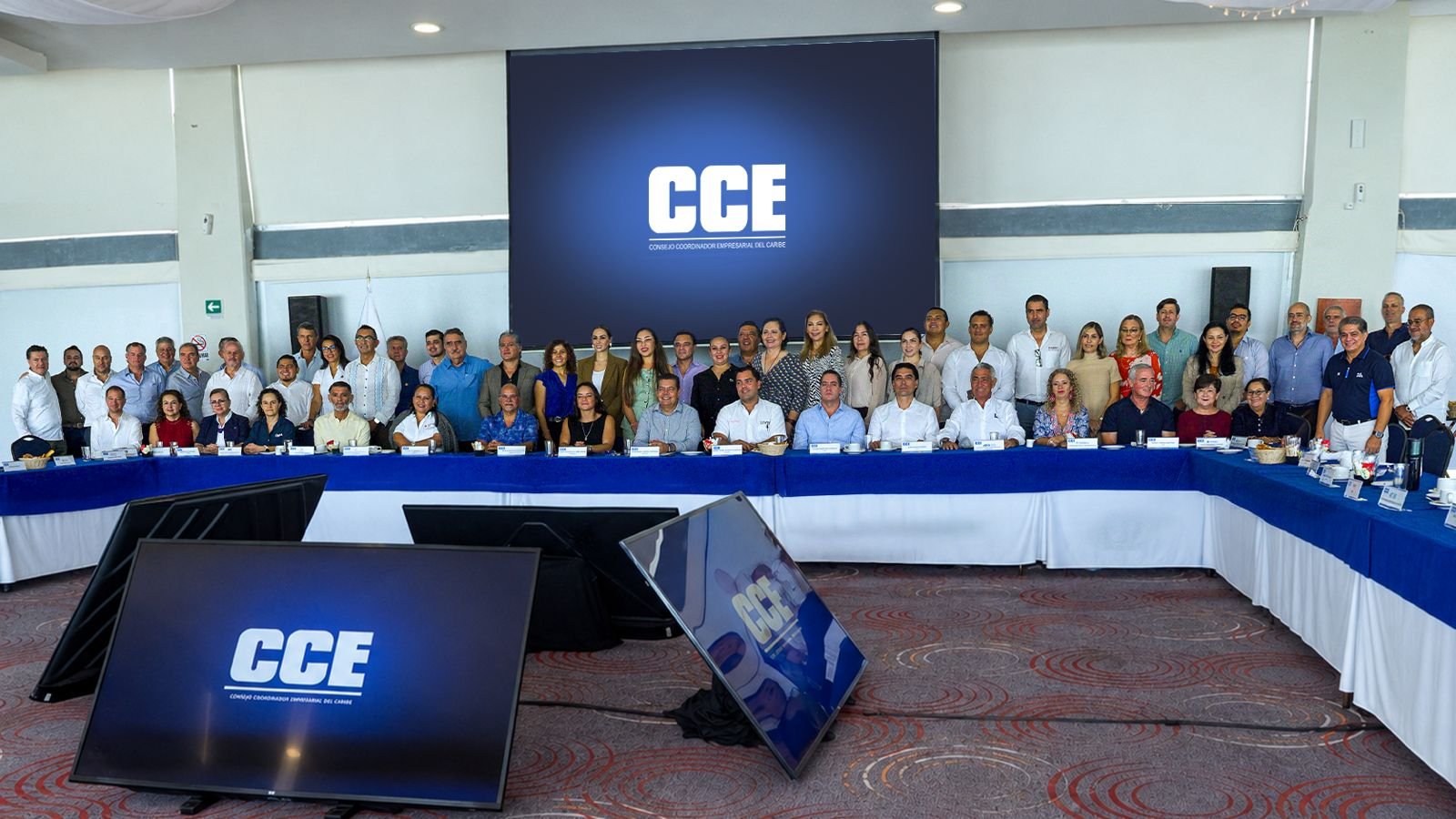
Cancún, Quintana Roo — The Caribbean Business Coordinating Council (CCE del Caribe) is preparing a new chapter under the presidency of Alejandro Adrián Arvizu Contreras, with 116 members drawn from the region’s main industries and an agenda focused on expanding investment, employment and innovation.
The 2026-2027 board will be sworn in at 7 p.m. on Oct. 28 at Secrets The Vine Cancún, in a ceremony expected to draw business leaders and officials from all levels of government.
Beyond the leadership change, the council has set itself a central challenge: reducing Quintana Roo’s heavy concentration of economic activity in services and commerce, and promoting new industries that would give the state a broader productive base.
An Economy Built on Services and Commerce
The issue is underscored by the state’s economic data. According to INEGI’s 2024 Economic Censuses, private non-financial services accounted for 50.2% of Quintana Roo’s gross census value added in 2023, while commerce contributed 39.2%.
The state economy also contracted 2.9% year-on-year in the first quarter of 2026, with tertiary activities falling 0.6%.
For the CCE del Caribe, those figures show the need to widen the productive base without sidelining tourism, which has been one of the main pillars of the Quintana Roo economy for decades. The council’s approach is to leverage the infrastructure, international connectivity, talent and business experience built around the tourism industry to create conditions for higher value-added activities.
Technology and Finance as New Engines
Central to that strategy is the Cancún Financial and Technology District, a project intended to turn some of the state’s existing capabilities into a platform for attracting investment, companies and specialized knowledge.
The decree establishing the District as a “Polo de Desarrollo Económico para el Bienestar” was published on Aug. 7, 2026, in Mexico’s Official Gazette (Diario Oficial de la Federación), as part of a plan that includes infrastructure, streamlined administrative procedures and tax incentives.
The business sector argues the project must go beyond real estate construction and become a hub for activities that complement tourism.
Among the sectors under consideration are financial and corporate services, information technology, artificial intelligence, data analytics, software development, telecommunications, digital infrastructure, scientific research, innovation, medical and educational services, audiovisual production, medical tourism, distribution centers and regional corporate headquarters.
Key Details Still Pending
The initiative still faces decisions before it can move into execution. Business leaders are waiting for the Quintana Roo government to announce the district’s new location and its planned development stages, after adjustments to the original site boundaries.
For the incoming CCE del Caribe leadership, expanding economic activity does not mean replacing tourism but creating additional engines that can strengthen it and reduce the state’s exposure to downturns in an economy that depends heavily on the industry.
New Board Lineup
The 2026-2027 board includes Sonia de la Peña as vice president and coordinator of the Tourism Agenda; Robert Henry Schmitz as secretary and liaison with business chambers; and Carlos Calderón as treasurer and coordinator of business events.
Eduardo Martínez, Lorena Fregoso, Jaime Macedo, Guillermo Muhech, Gabriel Tommasi and Javier Olvera will also serve, overseeing areas covering government and real estate affairs, universities and sustainability, tourism, legislative affairs and communications, business liaison, and the Honor and Justice Commission.
The CCE del Caribe currently brings together 116 members from sectors including hotels, tourism, technology, telecommunications, finance, construction, real estate development, transport, suppliers, restaurants and professional services. Its ranks also include universities, business organizations, environmental groups, civil society and representatives linked to security and justice.
More Economy
- Mexico’s Inflation Accelerates for a Second Straight Month to 3.45%
- Tren Maya Freight Project Targets 4.7 Million Tons by 2030
- Mexicana de Aviación Adds 24 Winter Flights to Tulum as Rivals Pull Out
- Tulum Construction Recovery Not Expected Until Late 2026, Architects Say
- Cancún Restaurants in the Red as Power Outages Add to Mounting Losses
More Cancun
- Cancún Residents Demand Governor’s Intervention Over Alleged Land Fraudster
- Cancún Taco Festival Aims to Revive Local Economy in Low Season
- Cancún Advances Yaxchilán Revitalization With Pedestrian Corridor to Avenida Nader
- Mexico’s 911 Centers Explore AI to Speed Up Emergency Response
- Quintana Roo Education Official Reported Missing in Cancún, Found Hours Later