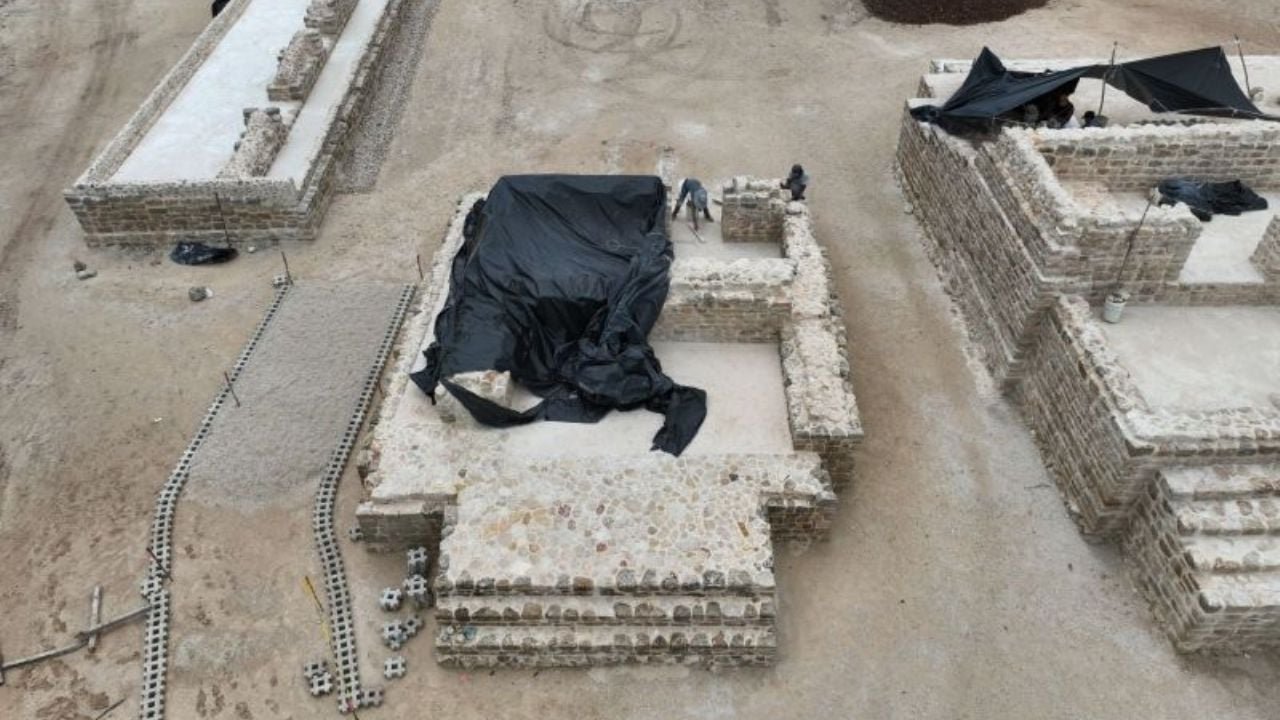
Mexico City — A bitter academic divide has emerged over the handling of archaeological sites during construction of Mexico’s Maya Train, with critics labeling monument relocations an “archaeological Frankenstein” while former officials defend the work as historic preservation.
The controversy came to a head during simultaneous events on March 17. At union offices in Mexico City’s Roma neighborhood, researchers from the National Union of Scientific Research and Teaching Professors of the National Institute of Anthropology and History (INAH) presented evidence they say documents destruction and looting of monuments. They focused particularly on the Balaam Tun Memory Park in Chetumal, Quintana Roo, and the K’awill Park in Xpuhil, Campeche.
Meanwhile, at the National Museum of Anthropology, a separate program titled “The Relocation of Archaeological Heritage in Mexico” featured eight discussion tables, including one with former INAH director Diego Prieto, who now heads the Unit of Living Cultures, Intangible Heritage and Interculturality.
The conflict began in February when researchers Fernando Cortés de Brasdefer and Noemí Castillo first denounced what they called a simulation of archaeological parks in Campeche and Quintana Roo. They alleged that structures discovered during Maya Train construction were dismantled from their original sites, reconstructed elsewhere, and completely altered in other cases—a situation they termed “archaeological crime.”
Cortés de Brasdefer faces an internal complaint at INAH for previously reporting damage to cultural heritage from the Maya Train project.
During the union presentation, researchers including Cortés de Brasdefer, Fiorella Fenoglio Limón from INAH Querétaro, and Jesús E. Sánchez from INAH’s Archaeological Studies Directorate presented additional images and videos documenting what they called crimes against archaeology.
Fenoglio Limón criticized the Archaeology Council and described the Memory Parks as “an archaeological Frankenstein” that could set a dangerous precedent for other sites nationwide. Cortés de Brasdefer argued that the concept of reconstruction had been misapplied: “They use the concept of reconstruction as if it were a material action, when in reality it’s an analytical and cognitive process. What they did was a mutilation of the object of study.”
Sánchez expressed concern about lack of transparency in project approvals and said researchers are preparing complaints against officials including former INAH director Diego Prieto, current director Joel Omar Vázquez, and others involved in the projects.
At the museum event, researcher María de Lourdes Toscano Hernández discussed international examples of monument relocation, including Egypt’s Abu Simbel temples and Madrid’s Debod Temple, as well as Mexican cases from when regulations were less strict.
Prieto then defended INAH’s work on the Maya Train archaeological salvage, rejecting what he called “media manipulations that seek to politicize technical work.” He asserted that the institute maintains its strength and independence despite controversies.
“I can confirm that INAH is large and exemplary even in debate,” Prieto said, “and will maintain a critical and analytical position.”
He justified institutional decisions regarding the Maya Train project and monument relocations, arguing they were based on rigorous methodologies and legal authorizations. “I believe there’s a before and after in what was the archaeological salvage of the Maya Train,” Prieto commented. “And of course we owe this in some measure to Dr. Manuel Pérez Rivas. I oppose the treatment some colleagues have given him—he doesn’t deserve it.”
Prieto also highlighted what he described as historic advances in digitizing findings through the Maya Train project and reaffirmed the necessary balance between heritage conservation and national infrastructure development.
Pérez Rivas presented a technical-academic presentation remotely about the deconstruction and relocation of archaeological heritage in the Maya Train Project—a type of presentation not made publicly during the previous administration.
Discover more from Riviera Maya News & Events
Subscribe to get the latest posts sent to your email.