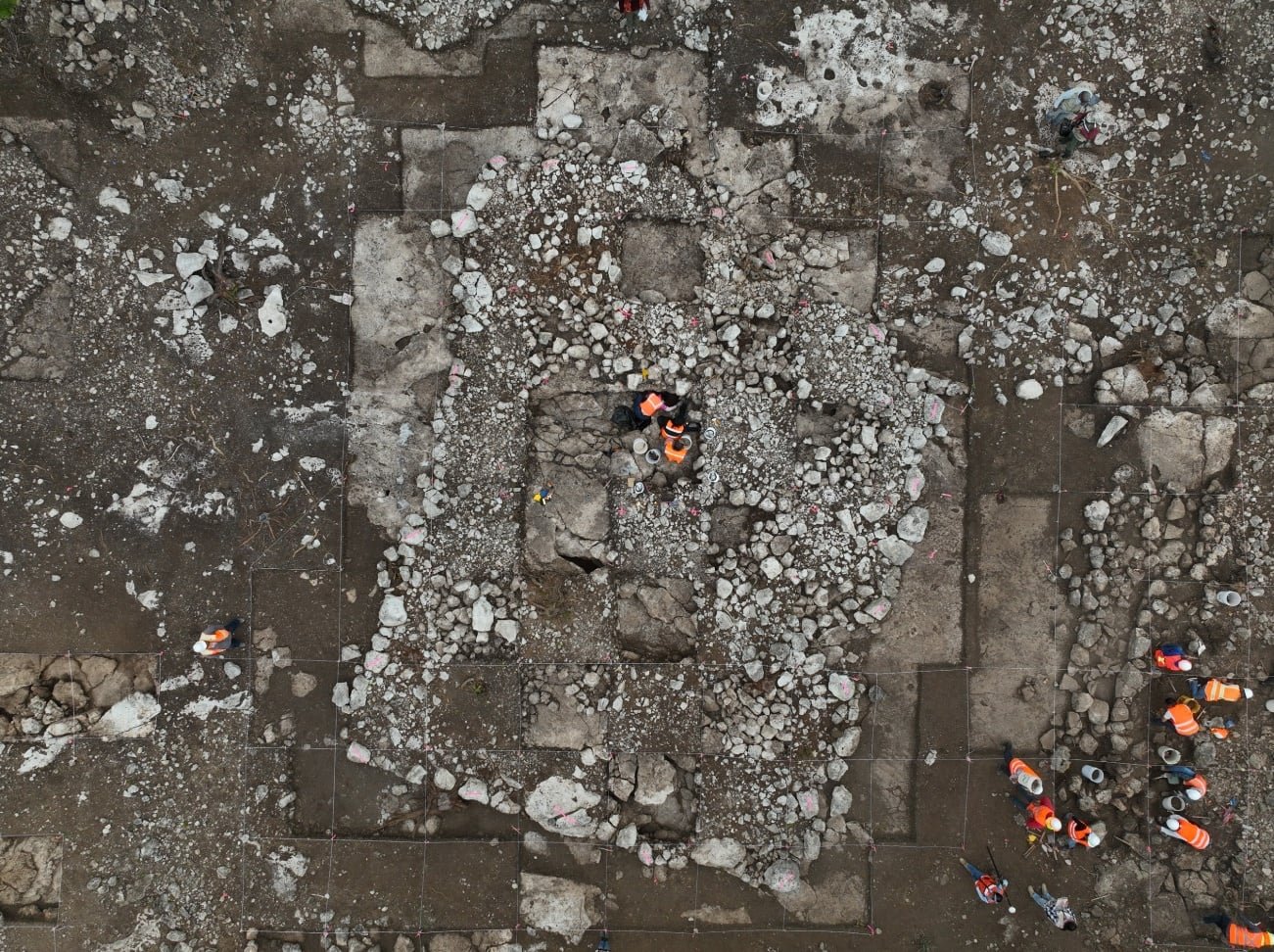
Yaxché de Peón, Yucatán — Archaeologists have uncovered a ritual deposit at the Yaxché de Peón site in Ucú municipality that provides new perspectives on the symbolic thinking and sociopolitical construction of Maya civilization during the Preclassic period (1000 BC–250 AD), the National Institute of Anthropology and History (INAH) announced.
“The ritual context located at Yaxché de Peón offers new keys to understanding community organization, symbolic thinking, and the relationship between space, fertility, and sustenance in the early Maya world,” said Claudia Curiel de Icaza, Secretary of Culture for the Mexican government.
The discovery made in January consists of a rectangular structure measuring 14 meters by 10.8 meters, designated Monument TC_17294. Built in a single construction phase with a height of 0.45 meters, the structure lacks residential upper buildings and features a design allowing entry from any side.
“Its characteristics suggest it was a semi-public space where the community gathered for decision-making or ceremonies,” INAH officials reported, adding that they believe this space was crucial for consolidating social cohesion.
At the site, researchers found two ritual contexts serving as foundational offerings. The first features a fragmented vessel shaped like a gourd—an element associated with fertility and sustenance—along with a shelter containing what appear to be deer remains, ceramic fragments, and a piece of marine shell.
“The presence of deer remains in the offering suggests symbolic implications of the animal’s connection in Maya thought, as a being linked to human experience, lord of the mountains, and provider of well-being to humans,” said Susana Echeverría Castillo, project coordinator.
The second context consists of a wide variety of Preclassic period ceramics, deer bone remains, and a circular limestone bead, reinforcing the theory that ancient inhabitants consecrated the space before its architectural construction.
“The presence of these symbolic elements (fauna and agriculture), deliberately sealed beneath public-use architecture, provides evidence of a ritual act marking the beginning of urban life in the area,” the Institute stated.
The discovery stems from the Archaeological Salvage Project of the Mérida-Progreso Multimodal Railway Bypass (Front 1), linked to the Maya Train project. Work began in June 2025 and will conclude in mid-2026, led by a team of INAH specialists including archaeologist Manuel Pérez Rivas, Field Chief of Front 1 Ricardo Antorcha Pedemonte, and archaeologist in charge of Front 1 excavation Luis Ángel Hernández Libreros.
Discover more from Riviera Maya News & Events
Subscribe to get the latest posts sent to your email.