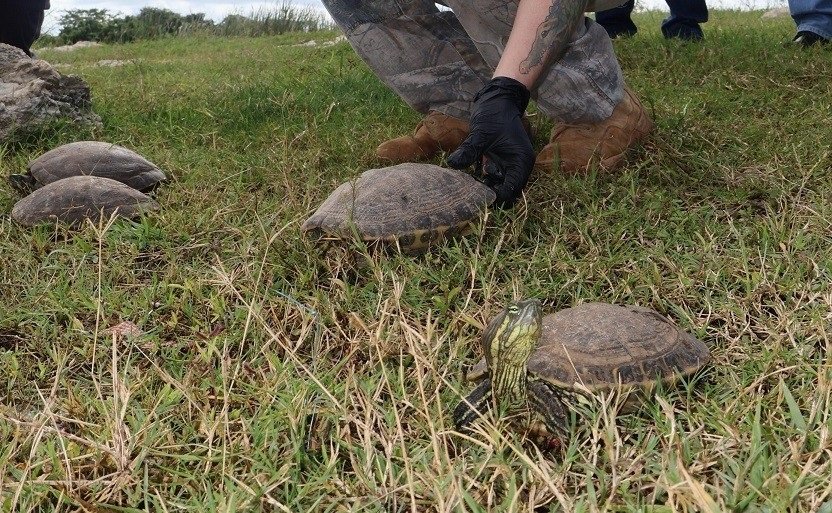
Homún, Yucatán — A total of 90 terrestrial and freshwater turtles have been reintegrated—a process scientifically termed translocation—into the Lagunas de Yalahau State Park Reserve in this Mayan community. The action was taken to strengthen the conservation of wildlife in Yucatán, according to the Secretariat of Sustainable Development (SDS).
Unlike a simple relocation, translocation involves moving living organisms to a different site, potentially farther from their original distribution, with the purpose of strengthening wild populations, restoring individuals to healthy ecosystems, or conserving at-risk species.
From this perspective, the action carried out in Lagunas de Yalahau represents an active conservation intervention, aligned with the guidelines of the International Union for Conservation of Nature (IUCN) and best practices in wildlife management.
The translocated specimens consist of 20 Guadalupe turtles or jicoteas (Trachemys venusta) and 70 mojinas (Rhinoclemmys areolata), all previously safeguarded and cared for after being handed over via citizen reports or complaints about inadequate possession, the SDS specified.
Both are native species of the Yucatán Peninsula: the Guadalupe turtle, known in Mayan as kaa nish, is a freshwater species inhabiting rivers, lakes, and cenotes; while the mojina or wood turtle, called chacpol, is terrestrial and occupies savannas, jungles, and grasslands.
These turtles perform essential ecological functions, such as seed dispersal and the control of aquatic and terrestrial populations, in addition to having reproductive cycles associated with the rainy season.
However, while Trachemys venusta has a wide distribution in Mesoamerica and has subspecies native to the region, Rhinoclemmys areolata is listed as a threatened species by the IUCN and by Mexico's NOM-059, which makes its protection a priority and reinforces the relevance of this type of conservation action.
The Lagunas de Yalahau State Park Reserve, with its body of water, native vegetation, and refuge conditions, represents an ideal space for the reestablishment of these key species and for ensuring the continuity of the ecological processes that support local biodiversity.
The Director of Management and Conservation of Natural Resources for the SDS, Elsy María Sáenz Pérez, emphasized the priority of avoiding the illegal possession of wild fauna and reminded the public that these animals—turtles—should not be kept in homes.
"Their home is the ecosystem. We invite the population to report cases of possession or specimens at risk," she added.
This translocation process—reintegrating specimens into healthy and secure ecosystems—was carried out in collaboration with the Secretariat of Environment and Natural Resources (Semarnat), the "Animaya" Wildlife Conservation Center of the Mérida city council, and the Homún city council, as part of the joint efforts to protect native species and their habitats.
Discover more from Riviera Maya News & Events
Subscribe to get the latest posts sent to your email.