Yucatán, Mexico — From the low forests to the urban groves of Mérida, the songs of birds resonate throughout the peninsula, making this territory one of the richest in biodiversity in Mexico.
With at least 456 recorded bird species, Yucatán displays an ornithological mosaic that today faces growing challenges from agricultural expansion, the use of agrochemicals, and the transformation of natural soils.
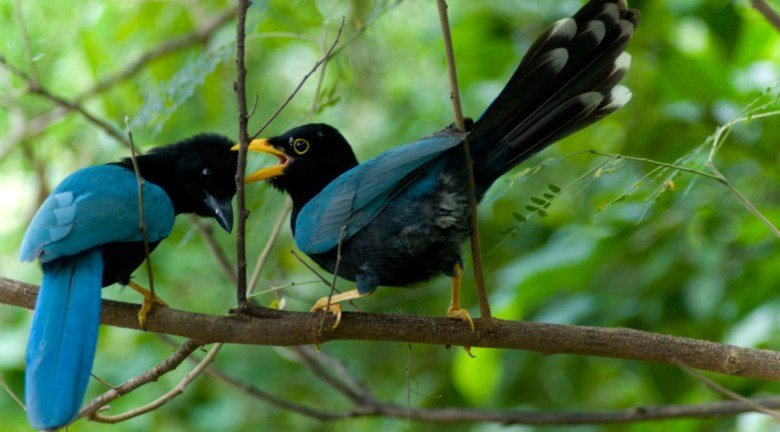
The Yucatan jay (Cyanocorax yucatanicus), also called chel (blond or fair-haired in Maya), is one of these feathered jewels that, although it does not direct its appeal to melodious song or ornamental plumage like that of parrots, has a unique beauty.
With its deep black plumage with bluish highlights, lively eyes, and elegant figure, this bird embodies the life of the low forests and scrublands of the region’s waterholes. Its constant and sociable presence on the edges of vegetation and within small human communities makes it a symbol of coexistence between nature and peninsular culture.
The chel approaches cornfields, as with the reduction of its habitat the bird is left without food, so it seeks food in areas planted with the grain.
In contrast, the turquoise-browed motmot (Eumomota superciliosa) dazzles with its bearing and color. This species, also known as the clock bird, boasts more showy plumage, with greenish and blue tones that shine in the sun and a singular tail in the shape of a brush that sways elegantly in its flights between trees.
It is an emblematic bird, a sign of the health of the forest, as well as a reference for conservation and essential environmental services for ecosystems.
Both species, although different in form and function, share the same ecological fragility: they depend on habitats that today are undermined by intensive agricultural practices, use of agrochemicals, and the progressive loss of native vegetation in plots and forest areas. These alterations not only reduce their nesting and feeding spaces but also affect the trophic network in which birds play a key role as insect controllers, seed dispersers, and ecological sentinels.
Urban Parrots
In a phenomenon that combines adaptation and alert, Mérida has witnessed an increase in the presence of parrots in urban areas, a sample of local biological richness that extends beyond the traditional forest.
According to recent results from the “Urban Parrot Monitoring,” implemented by the Santa María Project Environmental Dissemination and Conservation Center with the participation of hundreds of citizens, nine species of parrots that live freely in the city have been identified in Mérida. Among these are the white-fronted parrot, the yellow-cheeked parrot, the yellow-headed parrot, the Yucatan parrot, and the scarlet macaw, as well as other introduced or expanding species.
This urban monitoring, unique in the country for its scale and community participation, has recorded almost 3,000 sightings in one year, indicating that these birds not only survive but reproduce within the city and use more than 30 species of trees as food and resting resources.
However, this population growth in human areas is not without threats. Tree felling, environmental pollution, and the persistent capture for the illegal trade of wild birds put at risk not only parrots but also less visible species like the jay and the motmot.
The remaining conversion of forests to pastures and agricultural plots, as well as the application of persistent pesticides, continue to be critical factors of habitat loss.
Conservation
The ornithological richness of Yucatán, from the Yucatan jay to the colorful urban parrot and the elegant silhouette of the motmot, reminds us that this territory is a fragile and complex natural treasure. The interaction of species with landscapes degraded by human activities highlights the urgent need for comprehensive environmental policies, citizen education, and agricultural practices that respect biodiversity.
The conservation of these birds, which are an essential part of the identity and ecological balance of the region, constitutes not only a scientific or environmental duty but also a cultural commitment of Yucatecan communities toward their living land.
Discover more from Riviera Maya News & Events
Subscribe to get the latest posts sent to your email.