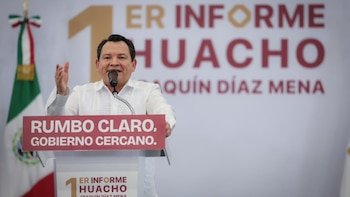
Mérida, Yucatán — Yucatán Governor Joaquín Díaz Mena presented his First Government Report in Mérida, stating that his administration is advancing with a defined direction and a close focus on the population.
During the event, held on Sunday, January 18, 2026, the governor emphasized that his management has prioritized reducing inequality and developing historically marginalized communities. According to Díaz Mena, 87% of the commitments made for the entire six-year term already have allocated budgets and are being implemented.
“The doors of the Government Palace are wide open for everyone, through the Audiences with the People, and replicating this exercise in neighborhoods and communities through the Dialogues with the People,” the governor stated.
Social and Educational Initiatives
The state executive, accompanied by the Secretary of Anti-Corruption and Good Government, Raquel Buenrostro Sánchez, personal representative of Mexican President Claudia Sheinbaum Pardo, highlighted actions aimed at equity.
He emphasized the Mujeres Renacimiento program, which will increase economic support for autonomous mothers to three thousand pesos bimonthly starting in January 2026. Additionally, he reported on the opening of 31 Centros Libre, safe and accessible spaces where women receive psychological, legal, and social assistance.
Regarding family production, the governor noted that the creation of gardens and backyard production was promoted, benefiting more than 2,200 families, strengthening food sovereignty and household income. For the livestock sector, the subsidy for genetic improvement increased from 20,000 to 30,000 pesos per stud, and direct support was provided for herd repopulation: five thousand pesos per weaned heifer and nine thousand pesos per heifer, totaling more than 1,500 supports in 72 municipalities.
In the educational sphere, the governor reported the delivery of more than 200,000 packages of school supplies, uniforms, shoes, and jackets for basic-level students. He also announced the creation of the Becas Juventudes Renacimiento, aimed at more than nine thousand university students from public institutions who did not have access to federal support.
Agriculture, Health, Fishing, and Security
During his appearance at the Mérida International Convention Center, Díaz Mena detailed the rehabilitation of more than 750 kilometers of rural roads in over 80 municipalities, with an investment of 60 million pesos. More than six thousand producers have received tools, supplies, and machinery, in addition to the installation of one thousand irrigation systems with solar panels to modernize more than 2,200 hectares. These supports aim to strengthen agricultural and livestock production.
“As long as I am governor, the land will not be forgotten again, Yucatecan producers will not walk alone, and the Yucatecan countryside has regained its direction,” expressed Díaz Mena during the event.
Regarding fishing, the governor reported on the delivery of kits from the Seguridad en el Mar scheme to more than 12,000 fishermen, which include life jackets, GPS radios, and emergency buttons. Additionally, more than 170 ecological outboard motors were distributed with an investment exceeding 16 million pesos.
In health matters, the state government allocated more than 107 million pesos in infrastructure and equipment for municipal clinics, 180 million in state-of-the-art equipment, and 450 million in supplies for the High Specialty Hospital. The governor reported on the construction of the new O’Horán Hospital and the upcoming opening of the Hospital de la Marina in Progreso.
In the security sector, Díaz Mena highlighted the acquisition of 630 new patrol vehicles, the improvement of monitoring and surveillance services of the C5i, as well as investment in police training. He announced that this year a new police training center will open to professionalize the corporation’s personnel.
Public Works, Social Prevention, and Regional Presence
The governor emphasized the reactivation of public works in Mérida neighborhoods and municipalities through the Plan Bienestar, with an investment close to four billion pesos in infrastructure and public spaces. Additionally, he detailed the construction of the Pilares Renacimiento, with a goal of creating 35 spaces throughout the state to promote digital education, sports, art, and music.
In the area of social prevention, Díaz Mena mentioned the Aliados por la Vida strategy, which has allowed for more than 5,300 actions of social crime prevention in schools, neighborhoods, and public spaces, mainly in municipalities with higher crime incidence.
In his report, Díaz Mena was accompanied by figures such as Mexico City Head of Government Clara Brugada Molina, the governors of Campeche and Veracruz, Layda Sansores and Norma Rocío Nahle, and the governor of Chiapas, Óscar Eduardo Ramírez Aguilar.
Also in attendance were high-ranking federal and state officials, including the Director General of the Banco del Bienestar, Víctor Lamoyi Bocanegra; the Director General of the National Commission of Physical Culture and Sports, Rommel Pacheco Marrufo; the Secretary of Labor and Social Welfare, Marath Baruch Bolaños López; the Commissioner of the National Migration Institute, Sergio Salomón Céspedes Peregrina; the National Director of the National Housing Commission, Rodrigo Chávez Contreras; and the Attorney General of Labor of the Government of Mexico, Plácido Morales Vázquez.
Discover more from Riviera Maya News & Events
Subscribe to get the latest posts sent to your email.