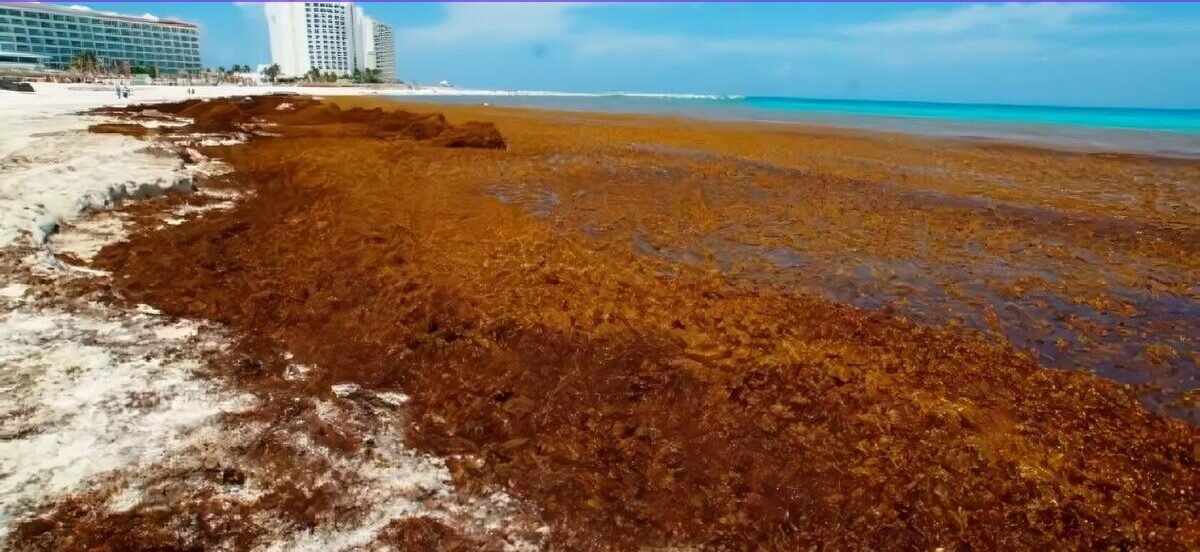
Yucatán, Mexico — A new plant in Yucatán is transforming sargassum seaweed into biofertilizers and animal feed, offering a potential solution to the recurring environmental crisis that has plagued Caribbean beaches for years. Instead of simply removing and discarding the seaweed, authorities hope to create a commercial industry from what was once only a costly nuisance.
The facility, operated by Implementaciones Estratégicas Marinas (IEM), opened in August 2025 with an investment of over 12 million pesos. Located in Yucatán’s Science and Technology Park, it represents a strategic shift: if the seaweed invasion cannot be entirely prevented, at least part of it could become a valuable resource rather than just a symbol of environmental distress.
Sargassum has become a persistent problem for the Caribbean, disrupting tourism, increasing cleanup costs, and straining local administrations. Recent scientific literature highlights impacts on ecosystems, community well-being, health, and the economy, while the National Oceanic and Atmospheric Administration (NOAA) maintains specific guidelines for managing these seaweed influx events.
The Yucatán project breaks from the traditional cycle of removal and disposal. After eight years of research, the plant focuses on generating bio-organic products from biomass collected along the coast. Promoters aim to establish a value chain where previously there was only continuous expenditure on cleanup and storage.
Initial figures released by the Yucatán government and agricultural media indicate the plant covers 600 square meters in its first phase, with a 65-square-meter applied research laboratory. It has the capacity to produce up to 50 million liters of fertilizer and 3 tons of animal feed per month, with options for future expansion.
However, the transition from environmental problem to profitable solution faces challenges. While the plant’s existence and its focus on fertilizers and animal feed are well-documented, more ambitious claims about high-value products or specific agronomic improvements remain largely promotional. Success depends not only on technology but also on health controls, traceability, and real-world field validation.
The broader context underscores the initiative’s importance. Sargassum has been part of a new Atlantic normal since 2011, linked to the Great Atlantic Sargassum Belt. Data from the University of South Florida suggests 2026 could see another strong year for these seaweed arrivals, reinforcing the need for sustainable management strategies.
Discover more from Riviera Maya News & Events
Subscribe to get the latest posts sent to your email.