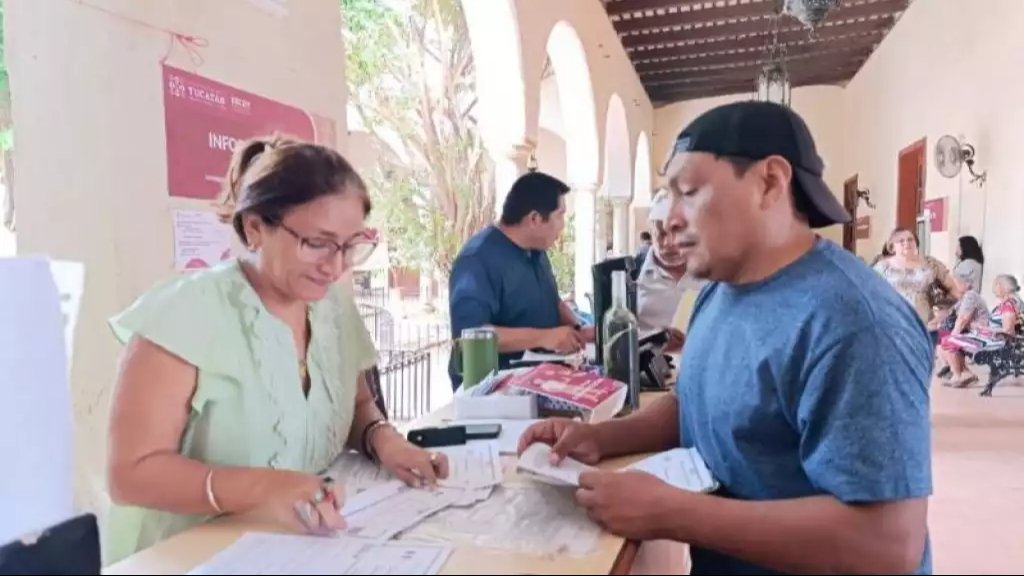
Yucatán, Mexico — In a year marked by social changes, legal adjustments, and unprecedented citizen demand, the Civil Registry of Yucatán will close 2025 with activity not seen in decades. The state agency, which for many is the first and last point of administrative life—birth, marriage, divorce, death—became this year a thermometer of contemporary Yucatán: more diverse, more demanding, and with a citizenry that wants to fully exercise its rights.
Throughout 2025, the Civil Registry resolved 27,000 procedures, almost triple the number carried out a year earlier, when 10,000 requests were attended. The data not only illustrates greater administrative activity but a profound change in the population’s needs. The director of the agency, Jorge Carlos Ramírez Granados, explains that a good part of the growth is due to the incorporation of procedures that were previously lengthy, costly, or simply non-existent.
Identity That Is Exercised
Among all the procedures, one stands out for its social dimension: the change of sex-gender identity, which went from 69 requests in 2024—a procedure that could only be achieved through legal injunction at that time—to 333 cases resolved in 2025. The increase of 382.6% reflects not only greater institutional openness but also a cultural change that is advancing with firm steps in the state.
Ramírez Granados emphasizes that this procedure represents an act of recognition and dignity. For hundreds of people, obtaining a birth certificate that corresponds to their identity is not a procedure: it is historical reparation. “It is the full exercise of a fundamental right,” he summarizes.
More Offices, More Access, More Proximity
This 2025 was also a year of territorial expansion. The Civil Registry will go from 70 to 103 registry offices, with the goal of closing the year with all of them interconnected. If 100% is not achieved before December 31, it will be—says the director—the first task of 2026.
The expansion of offices implies that more families in rural communities will be able to carry out procedures without traveling long distances, one of the main historical demands of the population.
So far this year, Yucatán has recorded 21,000 births and around 12,000 deaths. The trend continues: the state still has more births than deaths, a sign of population growth that also impacts the administrative burden of the Civil Registry.
A Ruling That Changed Surnames and Opened Rights
Another episode that marked the year was the pronouncement of the Supreme Court of Justice of the Nation, which forced Yucatán to modify Article 40 of its Civil Registry Law. The court determined that the prohibition of registering compound surnames or more than two simple surnames violated the freedom of mothers and fathers to choose the full name of their children.
The case began when the National Human Rights Commission challenged Decree 747/2024, arguing that the norm implied an arbitrary intervention by the State. On December 10, the State Official Gazette finally published the reform: now parents can register their children with compound surnames or complete combinations of maternal and paternal surnames.
The modification is not minor: for many Yucatecan families, compound surnames are part of family memory and the legacy passed between generations. The decision restores that possibility.
Love and Breakup in Figures
The Civil Registry also took the pulse of relationships and their dissolutions. In 2024, the state registered 8,903 marriages and 3,396 divorces, a figure higher than in 2023. Although the National Institute of Statistics and Geography reports slightly different numbers—a product of its own validation processes—both agree on a trend: Yucatán maintains a marriage rate lower than Quintana Roo, the national leader, but above Campeche.
The regional photograph shows contrasts: while Quintana Roo reached 10,376 marriages in 2024, Yucatán was at 5.6 unions per thousand inhabitants. Social, economic, and migratory dynamics explain a good part of these differences.
More Accessible Weddings
This year also brought direct changes for couples who wish to marry. The State Government eliminated requirements such as the presentation of three witnesses and the medical certificate, whose cost could range from 600 to 1,200 pesos.
The intention of these reforms is clear: reduce obstacles, lower the cost of the procedure, and facilitate couples being able to formalize their union without unnecessary burdens. “The medical certificate is a very personal matter; it should not be an administrative imposition,” Ramírez Granados points out.
The simplification of procedures, added to the increase in registry offices and technological advancement, could modify marriage and divorce figures in the coming years. The Civil Registry is heading toward a modernization that not only updates processes but also attempts to respond to a more diverse, more informed society with more complex needs.
Discover more from Riviera Maya News & Events
Subscribe to get the latest posts sent to your email.