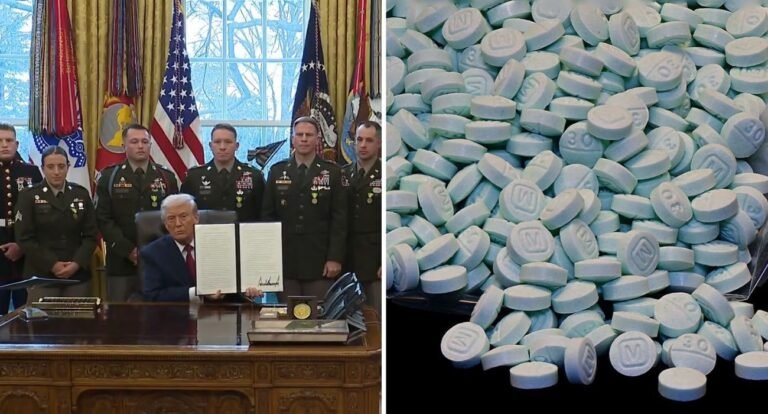
December 15, 2025, marked the most complex turning point of the century in Mexico-U.S. relations. President Donald J. Trump’s decision to classify illicit fentanyl as a weapon of mass destruction (WMD) militarizes anti-narcotics policy, bringing the bilateral crisis to an unprecedented confrontation scenario for the administration of President Claudia Sheinbaum Pardo.
The Militarization of Fentanyl: A New Paradigm of Chemical War Against Mexico
December 15, 2025, is considered an event comparable in magnitude to the anti-drug certification of the 1990s or the implementation of the Mérida Initiative, although its nature is “fundamentally distinct and more volatile.”
President Donald J. Trump’s decision to sign an Executive Order designating illicit fentanyl and its main chemical precursors as Weapons of Mass Destruction (WMD) does not constitute merely an escalation in the rhetoric of the “War on Drugs.” It represents, in doctrinal and operational terms, the total militarization of anti-narcotics policy and the redefinition of Mexican cartels as existential threats to the national security of the United States. They are equated to pariah states or terrorist groups with chemical warfare capability.
This measure occurs in a context of radical transformation within the U.S. defense apparatus. The recent symbolic and administrative restructuring restored the historic name “Department of War” (formerly Department of Defense) under the direction of Secretary Pete Hegseth. This signals a clear intention to project lethal force. The central premise of the Trump administration is that fentanyl has caused between 200,000 and 300,000 deaths annually—figures that serve as the basis for the “war” narrative—and that, therefore, the response must be military and not police-based.
For Mexico, and specifically for the government of President Claudia Sheinbaum Pardo, this turn represents the most complex diplomatic and security challenge of the 21st century. The Mexican administration is trapped between the need to maintain economic stability linked to the USMCA and the political and historical obligation to defend national sovereignty.
The Doctrinal Justification from Washington
The logic underlying the Executive Order of December 15 is based on a reinterpretation of the threat. The official document textually establishes that “illicit fentanyl is closer to a chemical weapon than a narcotic.” This distinction is critical. By classifying the substance for its potential for mass lethality (weapon), the White House activates a different legal framework:
| Concept | Traditional Approach (Narcotics) | New Approach (WMD / War Dept.) |
| Leading Agency | DEA / DOJ (Civil) | Department of War / DHS (Military/Homeland Security) |
| Aim | Interdiction, arrest, prosecution | Neutralization, destruction, dismantling of networks |
| Legal Framework | Controlled Substances Act | National Defense Laws, WMD Authority |
| Resources | Police budget, bilateral cooperation | Defense budget, satellite intelligence, cyberattacks |
| Enemy Vision | Criminals / Traffickers | Enemy combatants / Terrorists / Proliferators |
President Trump has explicitly linked cartels to Foreign Terrorist Organizations (FTOs), arguing that fentanyl profits finance global insurgencies and that there is potential for the drug to be “used as a weapon for concentrated large-scale terrorist attacks.” This narrative allows the U.S. Executive to bypass certain restrictions of the Posse Comitatus Act under the justification of national defense against an imminent threat of mass destruction.
Anatomy of the Executive Order and Its Legal Repercussions
The Executive Order “Designating Fentanyl as a Weapon of Mass Destruction” mobilizes the entire U.S. federal government.
The Role of the Department of War
The order instructs the Secretary of War (formerly Defense) and the Attorney General to determine if the threat justifies the transfer of military resources to the Department of Justice. This is an administrative step toward internal militarization. Furthermore, it orders the updating of all directives for responding to “chemical incidents” to include fentanyl, implicitly treating clandestine laboratories or drug storage sites as chemical weapons sites.
Financial Pursuit and Extraterritoriality
The order instructs the Secretary of the Treasury and the Secretary of State to aggressively pursue the assets and financial institutions involved. The definition of “involved” is broadened, putting Mexican banking and logistics companies in the crosshairs. The order defines “Illicit Fentanyl” and its “Central Chemical Precursors” (such as piperidone) under WMD statutes. By doing so, it criminalizes the supply chain not only as smuggling but as weapons proliferation, affecting pharmaceutical and chemical companies in Mexico and Asia.
The Symbolic Restructuring of the “Department of War”
The change in nomenclature of the Pentagon, authorized in September 2025 through Executive Order 14347, authorizes the use of the name “Department of War.” Although legally the statutory name remains Department of Defense, the change has already been implemented in executive communication, signage, and cyberspace (war.gov). Secretary of War Pete Hegseth has stated that this change seeks to “restore” the focus on lethality and victory. Hegseth, involved in controversies over bombings, personifies this hard line.
Implications of International Law
The WMD designation opens the door to dangerous legal arguments. The United States could be building a case for anticipatory self-defense. Washington could argue that it has the right to attack the “arsenals” (laboratories) to prevent an imminent chemical attack, under the doctrine that the cartels are non-state actors that the Mexican government is “unable or unwilling” to control.
Repercussions for Mexico: Economy Under Siege
The designation has immediate mechanical effects on the Mexican economy, functioning as a de facto trade blockade and a financial strangulation operation.
The Collapse of the Border
The most tangible consequence as of December 16, 2025, is the extreme hardening of border inspections. The Office of Customs and Border Protection (CBP) justifies the use of intrusive scanning technology on 100% of cargo and vehicles, which has generated severe increases in wait times:
| Border Crossing | Type of Cross | Current Waiting Time | Historical Average | Increase | Operational Impact |
| Otay Mesa (Tijuana-San Diego) | Commercial / Cargo | > 160 min (Reports of kilometer-long queues) | 60-70 min | +140% | Disruption of “Just-in-Time” supply chains for maquiladoras. |
| El Paso – BOTA (Juárez-El Paso) | Private Vehicles | 65-70 min (Constant peaks) | 40-50 min | +40% | Impact on daily cross-border labor flow. |
| San Ysidro (Tijuana-San Diego) | Pedestrian | 60-90 min | 30-45 min | +100% | Severe congestion during peak hours, affecting local businesses. |
| Laredo (World Trade Bridge) | Commercial | Slow flow due to WMD review | 20-30 min | Variable | Cumulative delays at the most important commercial port |
The National Chamber of Freight Transport (CANACAR) and carrier associations have denounced that these inspections generate million-dollar losses per hour, paralyzing vehicle and cargo logistics.
Financial War: The Treasury’s Blacklist
The Financial Crimes Enforcement Network (FinCEN) of the Department of the Treasury issued historic orders, designating CIBanco, Intercam Banco, and Vector Casa de Bolsa as entities of “primary concern” for money laundering and facilitating transactions for the purchase of chemical precursors.
The systemic impact includes the risk of De-risking, where U.S. correspondent banking could cut ties with other Mexican banks for fear of secondary sanctions, isolating the financial system. The political message directly attacks the Mexican business elite.
The threat of 25% tariffs on all Mexican exports, justified under the national security clause, has been explicitly linked to the fentanyl crisis. The combination of these threats has generated volatility, placing the Mexican peso on a depreciation trajectory, potentially reaching $21.00 per dollar if uncertainty persists.
The Stance of the Claudia Sheinbaum Government
President Claudia Sheinbaum has opted for a strategy of “asymmetric resistance”: avoiding direct rhetorical confrontation but deploying a firm defense of sovereignty.
The Diplomatic and Legal Response
- Diplomatic Note: The Ministry of Foreign Affairs (SRE) sent a note, establishing clear red lines: the absolute rejection of any foreign military or police intervention on Mexican soil.
- Legal Analysis: The president has declared that her government “will analyze the implications” of the WMD designation. Sheinbaum instructed her cabinet to review how this designation affects existing bilateral treaties, including the Bicentennial Understanding.
- Institutional Defense: Faced with Trump’s accusations that the Mexican government is “petrified” or colluded, Sheinbaum has categorically denied any pact with criminality, contrasting her administration with those of her predecessors and demanding respect.
The Narrative Strategy: “Attention to Causes” vs. War
The core of Sheinbaum’s stance is to dispute Washington’s diagnosis.
- National Campaign: On December 16, the Mexican government launched the massive campaign titled “Stay away from drugs. Fentanyl kills you.”
- Objective: Demonstrate internal action without validating external militarization. By focusing the response on the Ministry of Public Education (Mario Delgado) and the Ministry of Health (David Kershenobich), the government emphasizes that the problem is one of social fabric and prevention.
- Refutation with Data: Sheinbaum and her security cabinet present record figures (4 million pills, 1,760 laboratories dismantled) to refute the narrative of inaction.
The “Bicentennial Understanding” cooperation framework is in operational limbo, as the unilateral WMD designation clashes frontally with the premise of “shared responsibility” and “respect for sovereignty.”
The Stance of MORENA: Nationalism and Political Mobilization
The National Regeneration Movement (MORENA) has adopted a more combative and ideological stance, acting as the president’s political shield.
The national president of MORENA, Luisa María Alcalde Luján, has been central in articulating the party’s response:
- Rejection of the White House’s “slander” about links to drug trafficking.
- Call for unity around Claudia Sheinbaum with the mantra that “sovereignty is not for sale.”
- Accusation that the opposition (PAN, PRI) are “sellouts” for aligning with interventionist interests.
In Congress, key figures such as Gerardo Fernández Noroña (President of the Senate) have confronted the rhetoric. The central counter-argument is arms trafficking: senators like Emmanuel Reyes Carmona insist that, if fentanyl is a WMD, the assault weapons flowing from the United States to Mexico (70% of those seized) should also be treated with the same urgency. Morenista legislators have closed ranks to legally shield the Executive from attempts at extradition or forced cooperation.
MORENA has activated its grassroots networks to spread the idea that the fentanyl crisis is the fault of the “moral decay” of U.S. neoliberalism. This narrative seeks to immunize the government from internal criticism and justify the need to deepen the “Transformation” and move away from dependence on the United States.
Sociological and Security Analysis
The WMD designation has a corrosive effect on the border social fabric. By equating fentanyl with chemical weapons, the migrant population is further criminalized, falsely accused of being “mules” for these “weapons.” This increases the risk of vigilante violence and justifies draconian immigration policies.
Medical experts warn that the WMD hysteria could affect access to legitimate medical fentanyl, crucial for anesthesia and palliative care in Mexico. Over-regulation and fear of sanctions could lead to a shortage of essential medications in Mexican hospitals. The war narrative displaces the focus from harm reduction, hindering the implementation of effective public health policies to treat addictions, such as the use of naloxone or methadone.
Prospective Scenarios
Donald Trump’s decision to classify fentanyl as a WMD and rename the Department of Defense as the Department of War is not symbolic; it is the prelude to a strategy of maximum coercion. For Mexico, traditional diplomacy has lost traction and the Sheinbaum administration faces an existential threat to the country’s economic and territorial sovereignty.
Scenarios for 2026:
- Scenario 1: Economic Asphyxiation (high probability): The United States uses the WMD order to chronically slow border trade and sanction more Mexican banks, forcing Mexico to accept U.S. operations or mass deportations in exchange for economic relief.
- Scenario 2: Kinetic Incident (medium probability): A drone attack or an extraction operation of a capo on Mexican territory by U.S. special forces (under the authority of the Secretary of War), justified as “WMD neutralization.” This would provoke a rupture of diplomatic relations.
- Scenario 3: Tense Pragmatic Agreement (low probability): Mexico manages to demonstrate sufficient internal action (massive seizures, high-profile extraditions) for Trump to declare a “partial victory” and relax pressure, although the sword of Damocles of the WMD will remain in force.
The evidence suggests that the response of “hugs, not bullets” or pure sovereignty rhetoric is insufficient when dealing with an interlocutor operating under a logic of war. The Sheinbaum government and MORENA will need to quickly transition from ideological denunciation to an intelligent containment strategy that involves the U.S. private sector and international allies. 2026 will undoubtedly be the most critical year for Mexico’s national security in decades.
The key question that will define Mexico’s future in 2026 is not whether the nation can combat organized crime, but whether the Mexican state can assert its sovereignty without this implying the collapse of its economy in the face of the relentless logic of war that now governs in Washington.
Discover more from Riviera Maya News & Events
Subscribe to get the latest posts sent to your email.