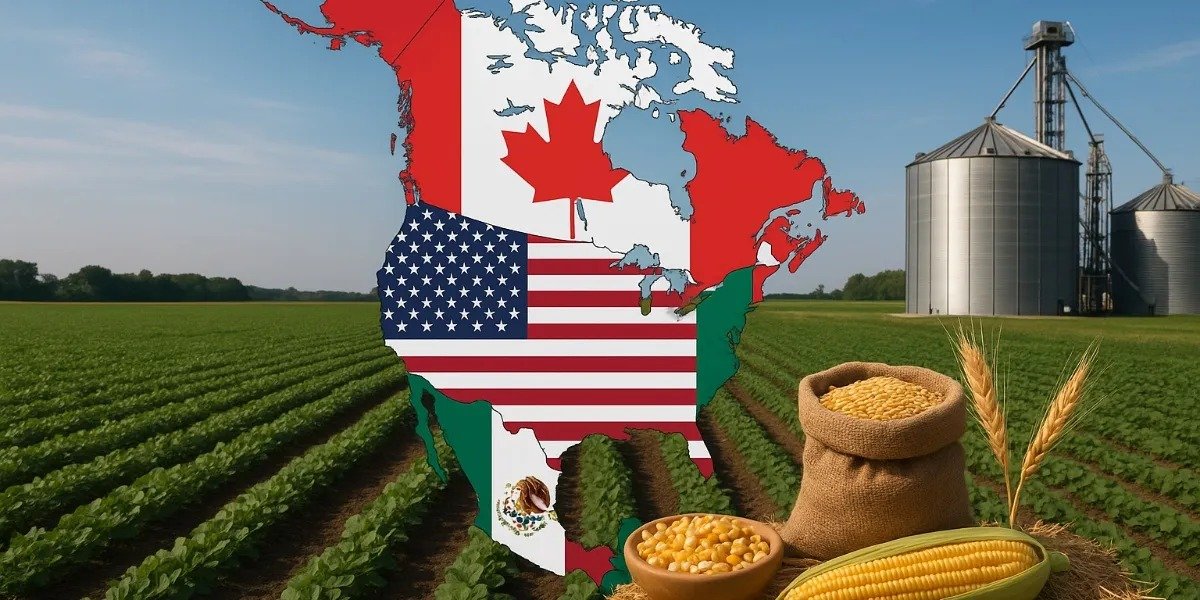
United States — As debate intensifies over the future of the USMCA trade agreement, U.S. agricultural groups have launched a coalition to defend the pact ahead of its mandatory review in July, citing data showing it supports nearly half a million American jobs.
The newly formed Agricultural Coalition for USMCA, backed by nearly 40 agricultural and agribusiness organizations, released a study showing that agricultural and seafood exports to Mexico and Canada reached $60.9 billion in 2024. Of that total, $59.7 billion came from agricultural products and $1.2 billion from seafood.
Beyond direct export value, the trade generates broader economic activity. When accounting for supply chain effects and domestic spending from export-related income, the total economic impact reaches $148.6 billion. This means for every dollar exported under USMCA, the U.S. economy generates an additional $2.45 in domestic activity.
The employment impact is substantial, with agricultural exports to Mexico and Canada supporting 493,054 full-time equivalent jobs in 2024. These positions generated $35.6 billion in labor income. The study found that every $1 billion in exports supports approximately 8,083 jobs.
Regional agricultural trade also contributed $64.1 billion to U.S. GDP and $13.2 billion in tax revenue.
Three-Tier Economic Impact
The economic impact breaks down into three categories to avoid double counting:
- Direct effect: Production specifically for export, including crop cultivation, dairy production, and meat processing. This component generated $69.5 billion in production and 181,573 jobs.
- Indirect effect: Activities supplying inputs or services to that production, such as transportation, energy, wholesale trade, or real estate. This layer contributed $47 billion in production and 167,901 jobs.
- Induced effect: Spending by workers whose incomes depend on export activity. This domestic consumption added $32 billion and supported 143,580 additional jobs.
Since USMCA took effect in July 2020, regional agricultural trade has shown stronger growth than trade with the rest of the world. Between 2020 and 2024, the value of U.S. agricultural exports to Mexico and Canada grew by $20 billion, representing a 47% expansion, according to U.S. Department of Agriculture figures. In contrast, agricultural exports to other destinations grew by 18%.
“Our farmers make decisions a year or more in advance. They need the certainty of knowing that USMCA is here to stay,” said Bryan Goodman, spokesperson for the new coalition.
Product Breakdown and Trade Patterns
Detailed product data reveals the depth of integration. In 2024, corn led U.S. exports with $5.96 billion to both partners, followed by dairy products at $3.64 billion, bakery, cereal and pasta products at $3.47 billion, pork at $3.45 billion, and fresh fruit at $2.81 billion.
Other significant exports included beef at $2.25 billion, chicken at $2 billion, and soybeans at $2.41 billion.
Mexico concentrates significant volumes in corn, wheat, pork, and soybeans, while Canada shows strength in processed products, non-alcoholic beverages, ethanol, and pet food.
The trilateral relationship represents approximately one-third of the total value of U.S. agricultural exports.
Trade Tensions and Dispute Resolution
Beyond the numbers, the coalition emphasizes the agreement’s stabilizing role. In an environment of high costs and volatile markets, predictability in sanitary rules, market access, and dispute resolution mechanisms proves crucial.
The favorable resolution for the United States in the dispute over genetically modified corn with Mexico serves as an example that the treaty provides institutional channels to address conflicts.
Despite generally positive outcomes, agricultural integration faces friction. Last year, the United States imposed a 17% anti-dumping tariff on Mexican tomatoes. U.S. producers of raspberries, strawberries, other berries, and avocados maintain complaints against Mexican imports, accusing them of unfair competition during key seasons.
Mexico also has concerns. The Secretariat of Economy maintains anti-dumping investigations on apples and some pork products from the United States.
Additional tensions exist between Washington and Ottawa over Canada’s dairy sector protection policies, as well as disagreements between Canada and Mexico regarding the ban on genetically modified canola.
The 2026 review opens space for adjustments, and the coalition acknowledges there are areas for improvement but maintains that the agreement’s foundation preserves competitiveness, investment, and stability.
Discover more from Riviera Maya News & Events
Subscribe to get the latest posts sent to your email.