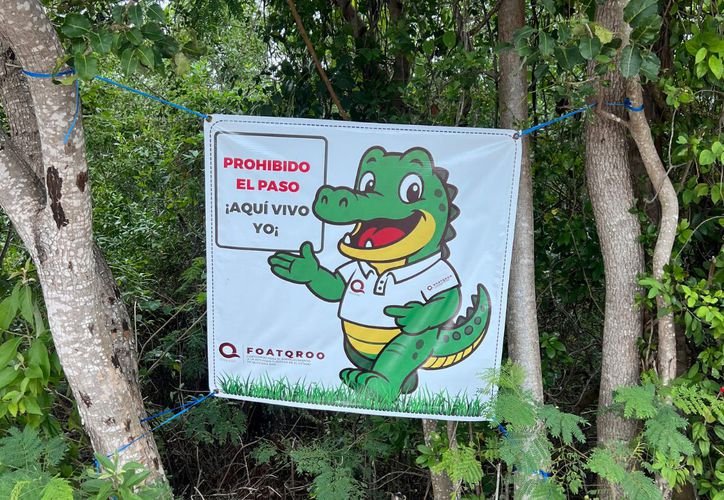
Cancun, Quintana Roo — As urban development expands in Quintana Roo, experts are calling for greater public understanding and coexistence with crocodiles, warning that habitat loss and widespread misconceptions threaten these ecologically vital reptiles.
Rogelio Sedeño, a researcher with extensive experience studying crocodiles at the Colegio de la Frontera Sur (Ecosur), emphasized the need to dispel myths that have created widespread fear of these animals.
“The topic of crocodiles has been somewhat controversial, as media and old films have heavily influenced negative perceptions by portraying them as cruel, merciless animals,” said the expert in ecology and sustainable development.
While acknowledging their predatory nature, Sedeño stressed that human fear should transform into knowledge to ensure conservation of the resource.
The Yucatan Peninsula hosts significant populations of two protected species: the Morelet’s crocodile (Crocodylus moreletii) and the American crocodile (Crocodylus acutus). Although national reports show population recoveries, local studies indicate significant challenges in tourist areas.
For example, research in Cancun’s Nichupté Lagoon has noted up to a 50% decline in crocodile populations in recent years, largely due to habitat loss and poaching activities. In contrast, populations remain more stable in protected areas like Banco Chinchorro.
Beyond unfounded fear, crocodile presence serves as an indicator of ecosystem health. The researcher highlighted their crucial role in regulating other animal populations, which in turn benefits human activities like fishing.
“In some areas where crocodile resources have been decimated, fishermen have had problems with fish harvesting. There appears to be an important relationship between crocodile presence and fisheries,” he explained.
Regarding direct interactions in urban areas, particularly along Chetumal Boulevard, the researcher urgently calls on residents and tourists to avoid actions that risk both humans and reptiles.
“If we see a crocodile there on the boulevard near the shore, avoid giving it any type of food… we’re putting ourselves at risk and altering the crocodile’s behavior,” warned the biologist.
In the northern region of the state, Laguna Chacmochuc and neighboring Manatí Lagoon reportedly experience overpopulation, with daily sightings recorded.
The species inhabiting these natural reserves “coexists” with students from the Universidad del Caribe, prompting monitoring studies to determine reproduction rates. These studies involve collaboration with the Wildlife Laboratory of the Universidad Autónoma de México and Amigos de Sian Ka’an.
Guillermina Pech Pech, secretary of University Extension and Outreach, also noted that the widespread negative image of crocodiles has driven them to create a coexistence manual.
Species Data in State Zones
- Two native species inhabit the state: Morelet’s crocodile (Crocodylus moreletii) and American crocodile (Crocodylus acutus).
- More than 1,000 individuals are estimated in the northern zone of the state (especially Cancun) according to monitoring reports prior to the 2020 pandemic.
- A 50% population decline has been reported in recent years in high-pressure urban zones like Cancun’s Nichupté Lagoon, due to habitat loss.
- 3 meters is the average length of adult specimens of both species, though they can reach larger sizes.
- 30 to 40 eggs is the average per clutch laid by a female during nesting season (which begins in April).
Discover more from Riviera Maya News & Events
Subscribe to get the latest posts sent to your email.