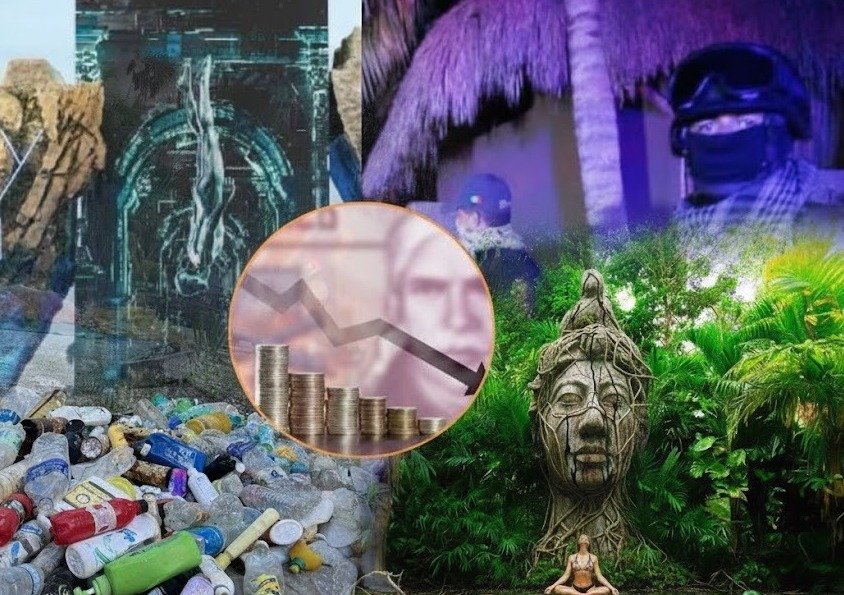
Tulum, Quintana Roo — The municipality of Tulum is at a breaking point. What was once a municipality governed from community roots now shows clear signs of institutional wear, loss of direction, and social fragmentation. The absence of a common project has given way to a crisis that cannot be explained by a single factor, but rather by the sum of disconnected decisions, prolonged omissions, and a development vision that prioritized immediate economic gain over collective stability.
Following the disappearance of the last leadership deeply rooted in the community, Tulum stopped being thought of from a local perspective. The municipality went from constructing policies with social meaning to administering permanent conflicts. The idea of a close government, with identity and commitment to its people, was replaced by a logic where external interests, speculation, and improvisation gained ground.
Today, governability is trapped between anticipated power disputes and a chronic inability to address everyday problems. Public discussion revolves more around who will control the municipality in the future than how to resolve present backlogs. In that void, citizens have been relegated to spectators of a political game that barely dialogues with the reality lived on the streets.
The economic model being promoted does not escape criticism either. The repeated bet on massive events as a growth engine exhibits a fundamental contradiction: the economic spillover is brief and concentrated, while the social, security, and image costs extend over time. The saturation of roadways, pressure on public services, and exposure to episodes of violence end up affecting the destination’s perception, far more than what a few days of high occupancy contribute.
To this is added clearly overwhelmed infrastructure. Tulum does not have the installed capacity to absorb influx peaks that double or triple its population. Hospitals, emergency services, and security forces operate at their limit, raising the risk of serious incidents and highlighting the lack of urban planning.
The crisis also manifests in the territory. Evictions of irregular settlements reveal a historical debt in housing and zoning matters. While land becomes more expensive and commodified, dozens of families seek spaces to settle, generating social conflicts that erupt when authorities act reactively rather than preventively. The problem is not just the invasion, but the absence of comprehensive policies that guarantee access to dignified housing and legal certainty.
In terms of security, complaints of abuses and irregular practices by municipal corporations have once again placed Tulum under public scrutiny. Each accusation that goes viral damages the trust of visitors and residents, deepening the perception of a municipality where the law is applied discretionally and without clear controls.
All this occurs while political debate is contaminated by the imposition of figures alien to local roots. The municipality risks being administered with external agendas, disconnected from Tulum’s history, needs, and social complexity. Community leaders, with knowledge of the territory and proven commitment, are marginalized in favor of personal projects that see the municipality as a prize rather than a responsibility.
The underlying problem is structural: a development model that privileged accelerated growth without building solid institutions, without planning, and without social justice. Tulum needs more than speeches or promises of economic spillover. It requires a government capable of guaranteeing security, functional public services, equitable fiscal policies, and a rights-based approach that replaces welfare assistance.
The dilemma is clear. Either the municipality continues deepening a path of fragmentation, conflicts, and reputational wear, or it rebuilds from social consensus, roots, and a long-term vision that sets limits to disorderly growth. Otherwise, Tulum not only risks its tourist appeal: it jeopardizes its social cohesion and viability as a community.
Discover more from Riviera Maya News & Events
Subscribe to get the latest posts sent to your email.