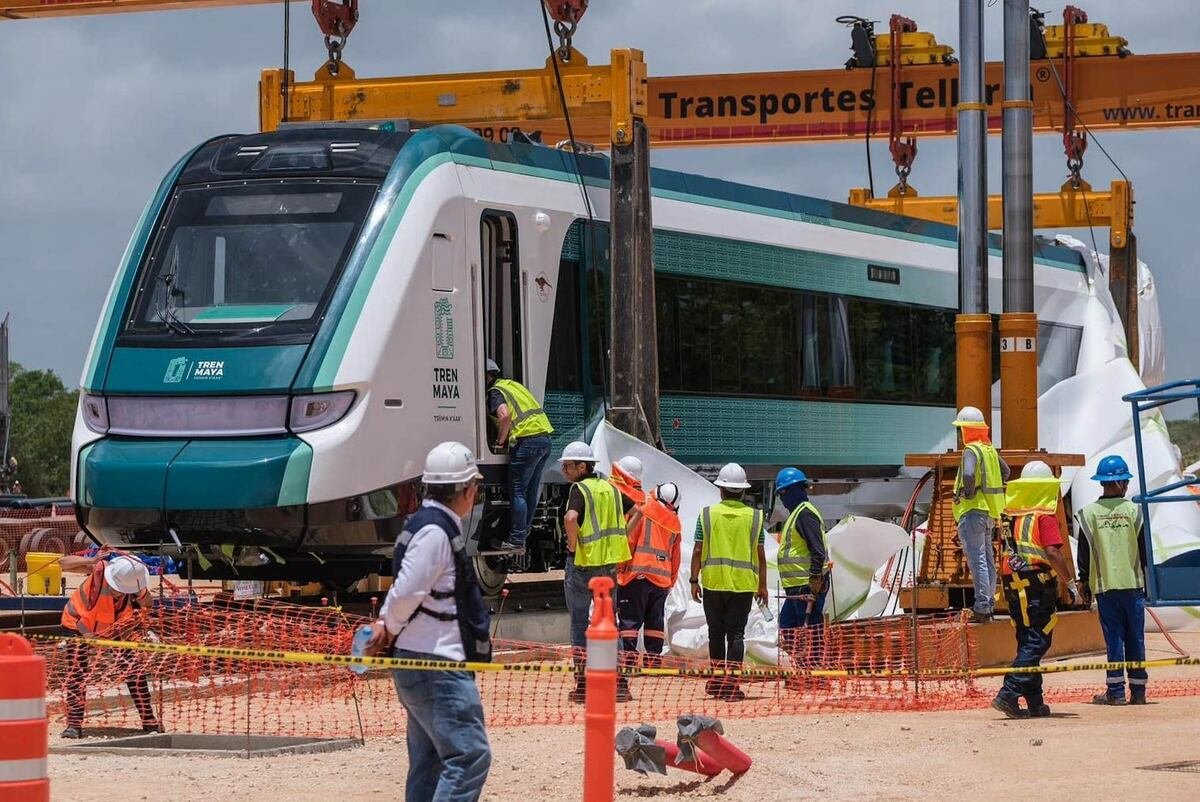
Chetumal — Hundreds of kilometers of railway tracks from the troubled Tren Maya project are being used for the illegal transportation of drugs and undocumented migrants, particularly on sections that are not yet fully operational, such as the routes from Chetumal to Cancún and Chetumal to Mérida.
This is how the active routes in southeastern Mexico are projected, already being utilized for smuggling with trucks and vehicles adapted to use the abandoned tracks that remain unmonitored 24 hours a day.
The trafficking of drugs and undocumented migrants occurs in this area during late night hours, as it is a route that crosses almost all of Yucatán without surveillance, starting in Montes de Halachó and extending to Nuevo Xcán in Yucatán, among others that form part of the Quintana Roo corridor.
The Tren Maya route has become a logistical highway for organized crime, opening new routes for drug and migrant trafficking. There is no promised regional growth or economic spillover, turning it into the new “Beast” of the southeast.
Increasing Activities
In Yucatán, methods of drug trafficking and the movement of undocumented migrants have increased, alert residents of various communities located along the Tren Maya lines.
According to reports, luxury vehicles and pickup trucks circulate during late night hours along routes that cross almost the entire state without surveillance, from Montes de Halachó, Maxcanú, Xtepen, Poxilá, Izamal, Valladolid, and up to Nuevo Xcán.
While state and federal authorities reinforce surveillance at permanent checkpoints, criminal groups seek alternative routes to evade controls. An example of this is the federal highway Mérida-Peto, where vehicles detour toward Acanceh, head to Seyé, and travel along adjacent roads that are little traveled and almost unsupervised.
Despite established checkpoints, large shipments manage to go unnoticed while controls focus on smaller shipments. The National Guard monitors routes from moving trains and stations, but effective control of the dirt roads connecting various towns has not been achieved.
These roads are used by criminals for transporting drugs and migrants without being detected by any authority.
These paths are difficult to navigate for those unfamiliar with them. Reports to 911 have demonstrated the ease with which they are used; for example, an SSP patrol managed to reach Campeche solely by following the dirt road route, undetected by C5 or any authority, until an incident occurred with a truck transporting illicit products.
Authorities warn that these activities represent a constant danger for the rural population and those traveling through the region’s forests, as any observed anomaly could jeopardize their safety.
Crime Walks on Rails
The Tren Maya was sold as the great transformative project of southeastern Mexico: development, well-being, employment, and social justice for a historically forgotten region.
However, that discourse is beginning to crack in the face of an uncomfortable reality that the government insists on minimizing: the insecurity that moves silently along its rails.
It is no longer just about devastated forests, fractured communities, or unfulfilled economic promises.
Now, various voices warn that the Tren Maya route is being exploited as a new corridor for drug trafficking and other organized crime activities. What was promised as an axis of progress is beginning to dangerously resemble a logistical highway for illegality.
In Yucatán, a state that for years boasted of being one of the safest in the country, concern is growing. Residents of communities located along the railway route warn of an increase in the movement of drugs and undocumented people.
Pickup trucks and luxury vehicles travel at dawn along routes that cross almost the entire state—from Halachó and Maxcanú to Izamal, Valladolid, and Nuevo Xcán—without effective surveillance, without checkpoints, without official explanation.
Several years after its announcement, the Tren Maya has also failed to meet the economic expectations that were sold with such enthusiasm. There is no promised regional growth, no expected economic spillover, no substantial improvement in the quality of life of communities.
What does exist is annoyance, disillusionment, and the perception that a project was imposed without listening to those who now bear the consequences.
The problem is twofold: a megaproject that does not generate real development and that, additionally, opens new routes for organized crime. A dangerous combination that erodes public trust and jeopardizes the stability of a region that for decades was an example of tranquility.
Denying these signs will not make them disappear. Minimizing complaints will not stop criminal groups. If the government does not recognize that the Tren Maya also brought new vulnerabilities, the project will end up being remembered not as a symbol of transformation, but as a monument to improvisation, arrogance, and denial of reality.
And when crime advances on rails, citizens always pay the price.
Environmental Insurance
To all of the above, it is added that Tren Maya delivered to Liberty Fianzas an insurance contract costing more than 11 million pesos to protect itself for over one billion pesos in case of environmental catastrophes that the railway could perpetrate while passing through the peninsula states during 2025; however, the company has faced multiple lawsuits for payment defaults with other Federal Government agencies.
This requirement is part of the environmental mitigation measures demanded by the Ministry of Environment and Natural Resources (Semarnat) in the resolutions with which the federal project was authorized, mainly in the municipalities of Playa del Carmen and Tulum, documents that the federal agency has decided to hide because they concern National Security.
The service provision contract was signed early in the year between Tren Maya S.A. de C.V., a commercial company founded by the Army to administer and operate the railway route in the five sections that pass through the peninsula states of Quintana Roo, Yucatán, and Campeche.
Although in this instance the bonding company also covers the remaining sections that run through Chiapas and Tabasco.
The contract identified by Sol Quintana Roo with file number TM-CGRMSG-SVS-0003/2025 through Transparency indicates that in case the Tren Maya incurs an environmental catastrophe, the company is obligated to pay 1,343,678,395 pesos.
But currently it cannot be determined if this insurance has already been invoked because last November, the Ministry of Environment and Natural Resources (Semarnat) announced the reservation of information regarding any possible environmental damage that the Tren Maya might already be generating in any of the sites where the project runs.
It was precisely in the municipalities of Tulum and Playa del Carmen where the mitigation report remained most closed because it was in both territories where the Federation, via the Ministry of National Defense (Sedena) with various private companies, determined to drive pilings into the water table to support the elevated bridge and embankment where the Tren Maya passes.
Compromised Company
According to reviews conducted by Sol Quintana Roo, Liberty Fianzas has been one of the most benefited in the awarding of contracts by the federal government.
However, it also has various judicial processes initiated by state-owned companies for payment defaults, carried out by their various legal representations.
The most notable case is that of the Integral Port Administration of Altamira, in Tamaulipas, which sued it for a payment default of bonds amounting to 10,075,000 pesos.
Likewise, it accumulates legal processes against it stemming from other companies, including one in the railway sector from northern Mexico, such as Kansas City Southern De Mexico, dedicated to cargo train transportation through various border states.
The above resulted again in civil conflicts that this company maintains with private individuals.
Despite these precedents, the Tren Maya company awarded the most lucrative contracts for insurance against probable environmental damages.
However, it cannot be determined what damages could be remedied with the monetary insurance because the state-owned company decided, together with other agencies, to hide the environmental damages that the federal project could cause.
This is because during the second half of the year, the information was requested through the National Transparency Platform. The request is identified with the file number ending in 58825, responded to by Semarnat.
In the response, the agency refuses to provide an answer by invoking the sensitivity of the topic and being unable to deliver what was requested because it concerns national security material, which was established in 2023.
Discover more from Riviera Maya News & Events
Subscribe to get the latest posts sent to your email.