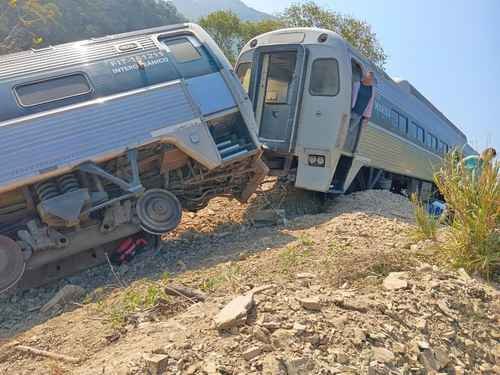
Tragedy on the Interoceanic Railway
Thirteen people died and 98 were injured, with 36 requiring hospitalization—five in critical condition—while 139 others were reported “out of danger” after a passenger train derailed on the Interoceanic Corridor in Oaxaca, Mexico. The accident occurred on the Trans-Isthmus Train traveling from Salina Cruz, Oaxaca, to Coatzacoalcos, Veracruz, according to the Mexican Navy (Semar).
The train was carrying 241 passengers and nine crew members in two locomotives and four cars when it left the tracks. The derailment site is located between the towns of Nizanda and Chivela in the municipality of Asunción Ixtaltepec, Oaxaca, within the Isthmus of Tehuantepec region.
Emergency Response and Investigation
Mexican Attorney General Ernestina Godoy announced that the Attorney General’s Office (FGR) has opened an investigation into the derailment. Federal and state criminal investigation agents have been deployed to the area to coordinate with authorities.
The Mexican Navy reported that injured passengers were taken to local hospitals for medical attention. The agency deployed five ground ambulances, one air ambulance, and approximately 40 naval health personnel to assist in the response.
Rescue operations involved 360 naval personnel, 20 vehicles, four ground ambulances, three air ambulances, and a tactical drone. Authorities conducted maneuvers to assist victims who fell down an approximately seven-meter-high embankment at the accident site.
Hospital Response and Coordination
Zoé Robledo, director of the Mexican Social Security Institute (IMSS), stated that emergency protocols were immediately activated in regional medical units to receive and treat patients. The IMSS transferred six injured individuals to General Hospital Zone Number 2 in Salina Cruz and 23 to Rural Hospital Number 27 in Matías Romero.
IMSS-Bienestar received 41 injured passengers: 11 at a hospital in Ixtepec, 22 in Juchitán, two in Salina Cruz, and six in Tehuantepec. Medical units in Oaxaca, Veracruz, and Puebla were placed on alert and prepared to provide services if needed.
Oaxaca Governor Salomón Jara stated that his administration is working with federal authorities to assist victims, establishing an operational module to manage the emergency.
Passenger Accounts and Complaints
A passenger traveling in the last car of the train reported in a social media video that the train was traveling at high speed when it derailed. He stated that survivors helped passengers from other cars, noting that “many people were lying on the ground.”
Family members of injured passengers taken to Rural Hospital Number 37 complained of being treated arrogantly by staff, who reportedly refused to provide information and initially denied admission to patients, citing lack of beds and medications.
Second Derailment in Three Weeks
This is the second derailment involving the Trans-Isthmus Train in three weeks. On December 8, a train derailed in Juan Rodríguez Clara, Veracruz, while transporting liquid chlorine and silica sand. That incident involved a locomotive and four freight cars but resulted in no injuries.
The Interoceanic Corridor, inaugurated on December 22, 2023, by then-President Andrés Manuel López Obrador, aims to connect the Pacific and Atlantic Oceans with passenger and freight trains to optimize commercial connections between Asia, the eastern United States coast, and Europe.
Joint protocols have been initiated with the Ministry of Infrastructure, Communications and Transportation and the Railway Transport Regulatory Agency to determine the cause of the accident.
Discover more from Riviera Maya News & Events
Subscribe to get the latest posts sent to your email.