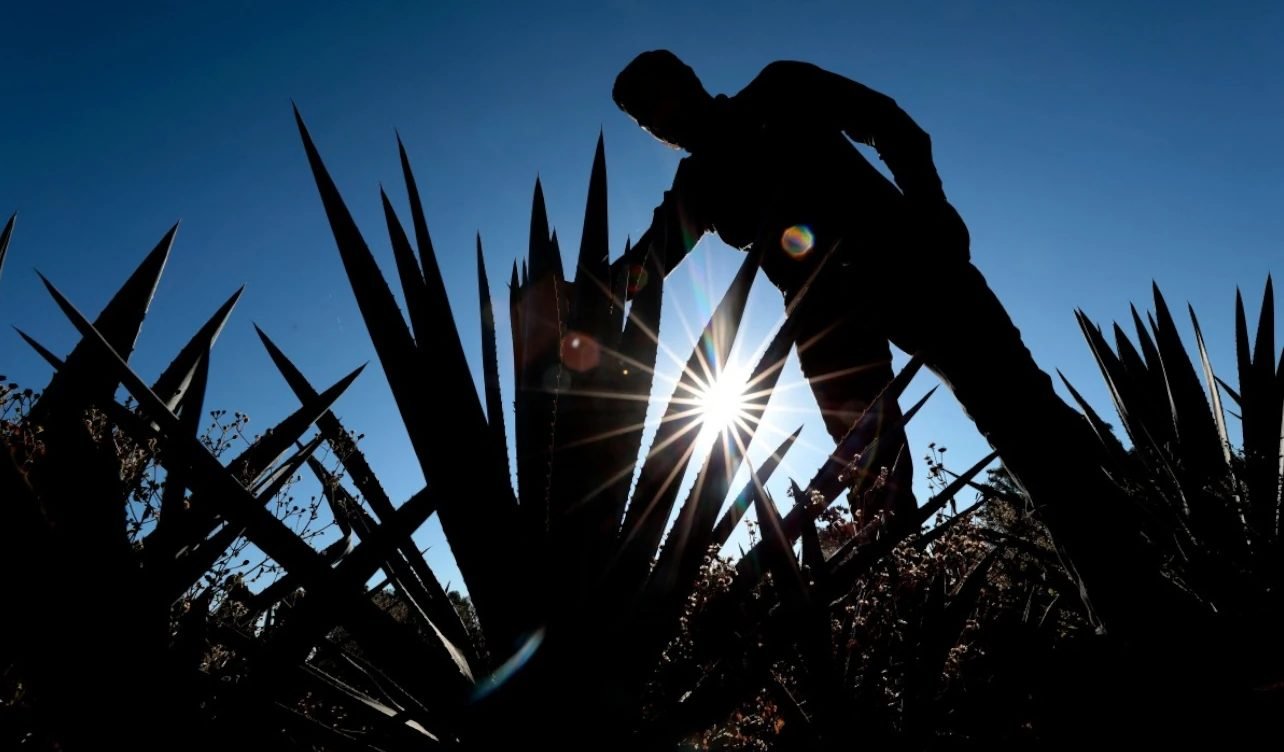
Jalisco, Mexico — Surging tequila exports have triggered an agave planting frenzy in Mexico, a boom that has crashed prices for the raw material while the prized spirit itself remains expensive.
“Even God likes the good stuff,” Francisco Javier Guzmán, leader of the Barzón Agavero organization representing about 5,000 traditional producers in tequila denomination of origin municipalities, told AFP.
Exports of the Mexican distillate, particularly to the United States, skyrocketed from 224.1 million liters in 2018 to a record 402.1 million last year, according to the Tequila Regulatory Council (CRT), which oversees compliance with denomination of origin requirements.
With this sudden prosperity, agave became scarce and tequila companies paid up to 35 pesos per kilogram ($1.75 at current exchange rates), recalls Guzmán, a producer from the Los Altos region in western Jalisco state.
“Those prices motivated people unrelated to traditional producers to plant agave haphazardly, left and right,” said the 80-year-old farmer.
“Some people sold their factories, hotels, land, ranches to get into agave cultivation,” added the patriarch in Zapotlanejo, where the arid landscape has turned green with the plant in recent years.
Celebrities like Elon Musk and basketball star LeBron James have also entered the business with their own tequila brands, further boosting the distillate’s fame.
The frenzy led registered producers to increase from 3,180 in 2014 to 42,200 in 2024, while cultivated area grew from 95,089 hectares in 2018 to 214,620 in 2023, according to Mexican government figures.
This caused an overproduction that crashed agave prices to an average of 8 pesos per kilogram today (40 U.S. cents), producers report.
The new players “made inventory exceed what the industry can consume in a year,” Alexis Álvarez, secretary of the CRT, told AFP.
Because of this, traditional growers urgently need a price of about 60 U.S. cents per kilogram to at least cover production costs, says Martín Franco, vice president of Barzón Agavero.
But they face additional threats: “coyotes” or intermediaries who exploit farmers’ desperation to buy harvests for as little as 10 cents per kilogram, and the 25% tariffs that President Donald Trump wants to impose on Mexico.
“The United States consumes about 85% of the tequila produced under the denomination of origin… so of course I’m worried,” acknowledges Guzmán.
To counter the “coyotes,” the CRT launched a digital platform where traditional growers can apply to tequila companies’ purchase orders with prices that guarantee “reasonable profitability.” So far, 280 have registered.
Expensive Tequila
Paradoxically, the agave situation isn’t reflected in tequila prices, which have increased amid growing international demand whose top 10 markets include Germany, Spain, Canada, France, the United Kingdom, China, Australia, Colombia, and Japan.
Domestic tequila consumption represents one-third of production, competing internally with mezcal.
“For us who consume and aren’t in the business, it hasn’t benefited or affected us… If agave went down, the liquor should go down a bit for us, but it hasn’t,” said Salvador Magaña, 55, while drinking at the bar of La Iberia, a cantina in downtown Guadalajara, Jalisco’s capital, founded in 1877.
Martín Martínez, manager of this mariachi-themed establishment, estimates tequila prices have doubled in the last six years, which he considers excessive.
He has had to reduce profit margins to avoid losing customers, some of whom have migrated to “slightly more accessible” brands “to the detriment of reposados and añejos,” he says.
Still, Martínez feels calm. He managed to avoid closing La Iberia after economic difficulties and is confident that tequila consumption, a product of “exceptional quality,” is guaranteed even if quantity decreases.
Discover more from Riviera Maya News & Events
Subscribe to get the latest posts sent to your email.