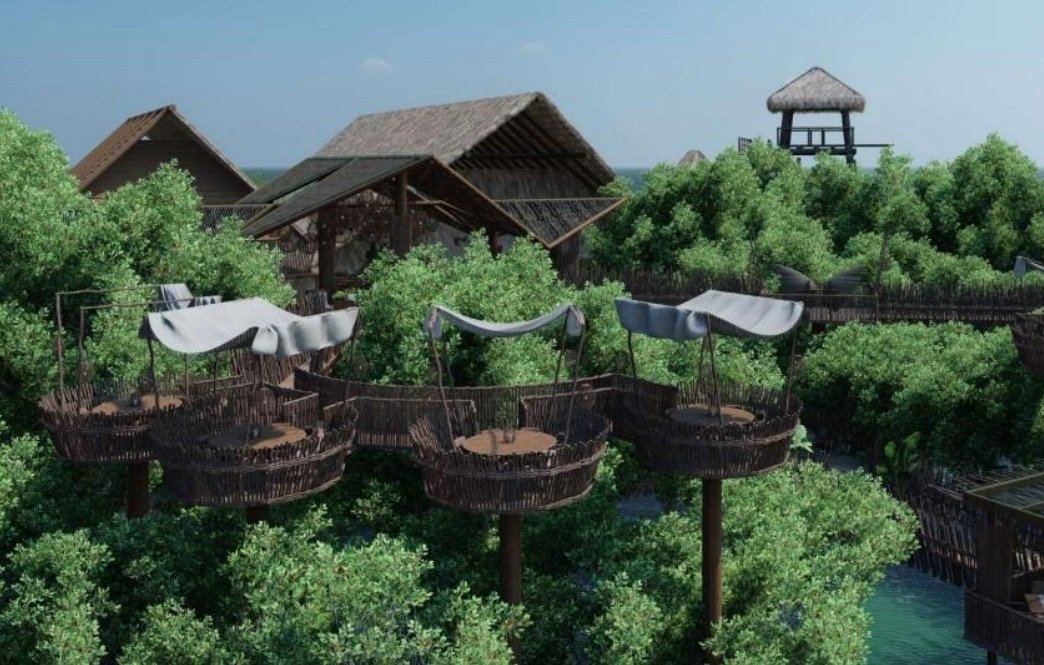
QUINTANA ROO, Mexico — The Mexican Ministry of Environment and Natural Resources (Semarnat) has denied environmental permits for three projects proposed for coastal zones in Quintana Roo: the Kában Holbox Condo Hotel, the Manglares project in Puerto Morelos, and the Nikte-Ha Restaurant in Cancún's hotel zone. Authorities determined that the project proponents failed to meet the necessary technical and environmental requirements to guarantee the protection of ecosystems such as mangroves, wetlands, and seagrass beds.
Condo Hotel Kában Holbox: Risk to a Fragile Ecosystem
The first project, named "Condo Hotel Kában Holbox," was promoted by FAV Capital Group S.A.P.I. de C.V. and sought to be developed on a plot of just 966 square meters in the municipality of Lázaro Cárdenas, on the island of Holbox. The plan consisted of constructing a three-story building with 21 apartments, founded upon 75 pilings at a height of 1.8 meters. In total, the construction would occupy over 60% of the land, leaving less than half as green space.
According to technical reports, the site is located in a coastal scrub ecosystem with the presence of mangrove, a habitat for at least 14 species of birds, two mammals, two amphibians, and two reptiles, including the mourning dove, the coati, and the striped iguana. Inspectors from the National Commission of Natural Protected Areas (Conanp) confirmed that the area had vegetation in good condition and stagnant bodies of water, characteristic of a wetland.
The National Commission for the Knowledge and Use of Biodiversity (Conabio) also observed that the environmental impact study lacked dates and representative fauna sampling, which could omit migratory species or those with temporary habits. Furthermore, the mitigation measures proposed by the company were considered insufficient to avoid impacts on terrestrial, aerial, and aquatic fauna.
For these reasons, Semarnat denied the change of land use for forestry purposes and rejected the project, considering that it represented a direct threat to the ecological balance of the area.
Manglares Project in Puerto Morelos: Canceled Due to Withdrawal
The second case corresponds to the "Manglares" project, promoted by Kaab Tulum SAPI de CV, which intended to be built in Puerto Morelos, one of the areas most visited by national and international tourists. The proposal contemplated a six-story building with modern apartments and amenities such as three swimming pools, a rooftop garden, parking, and a lobby, in addition to green areas designed to integrate with the coastal landscape.
The plan relied on sustainable materials and ecological solutions, with the goal of offering luxury lodging with low environmental impact. However, the company itself decided to withdraw from the process, so the file was officially closed. Although there was no formal denial for non-compliance with environmental regulations, the voluntary withdrawal of the promoter implies that the project cannot be developed unless a new, updated environmental impact statement is presented.
Nikte-Ha Restaurant in Cancún: Lack of Studies and Risks for the Mangrove
The third project, "Restaurante Nikte-Ha," was promoted by the company Infinito Maya S.A. de C.V. and is located on Boulevard Kukulcán, kilometer 16.2, in the heart of Cancún's hotel zone, on the shores of the Nichupté Lagoon. The intention was to expand the existing restaurant by constructing an additional deck at the lagoon's edge to allow for the arrival of small vessels, with an estimated investment of 8 million pesos.
Although the restaurant already holds a prior permit from 2016 to operate on a concession of the Federal Maritime Terrestrial Zone (Zofemat), the expansion required a new environmental analysis. However, Semarnat determined that the promoter did not present the necessary information regarding the potential impacts arising from the construction and operation of the new pier.
Among the principal observations were the absence of exact coordinates for the project's boundaries, the lack of site plans indicating the height of the structures relative to the mangrove, and the omission of technical data regarding the number, size, and location of the pilings to be used. Furthermore, the file did not include mitigation measures to protect the mangrove vegetation or the seagrass beds that inhabit the area.
For these reasons, the environmental authority concluded that it was not possible to evaluate the impacts or guarantee that the construction would not affect the Nichupté Lagoon, one of the most valuable and sensitive ecosystems in the Mexican Caribbean.
Discover more from Riviera Maya News & Events
Subscribe to get the latest posts sent to your email.