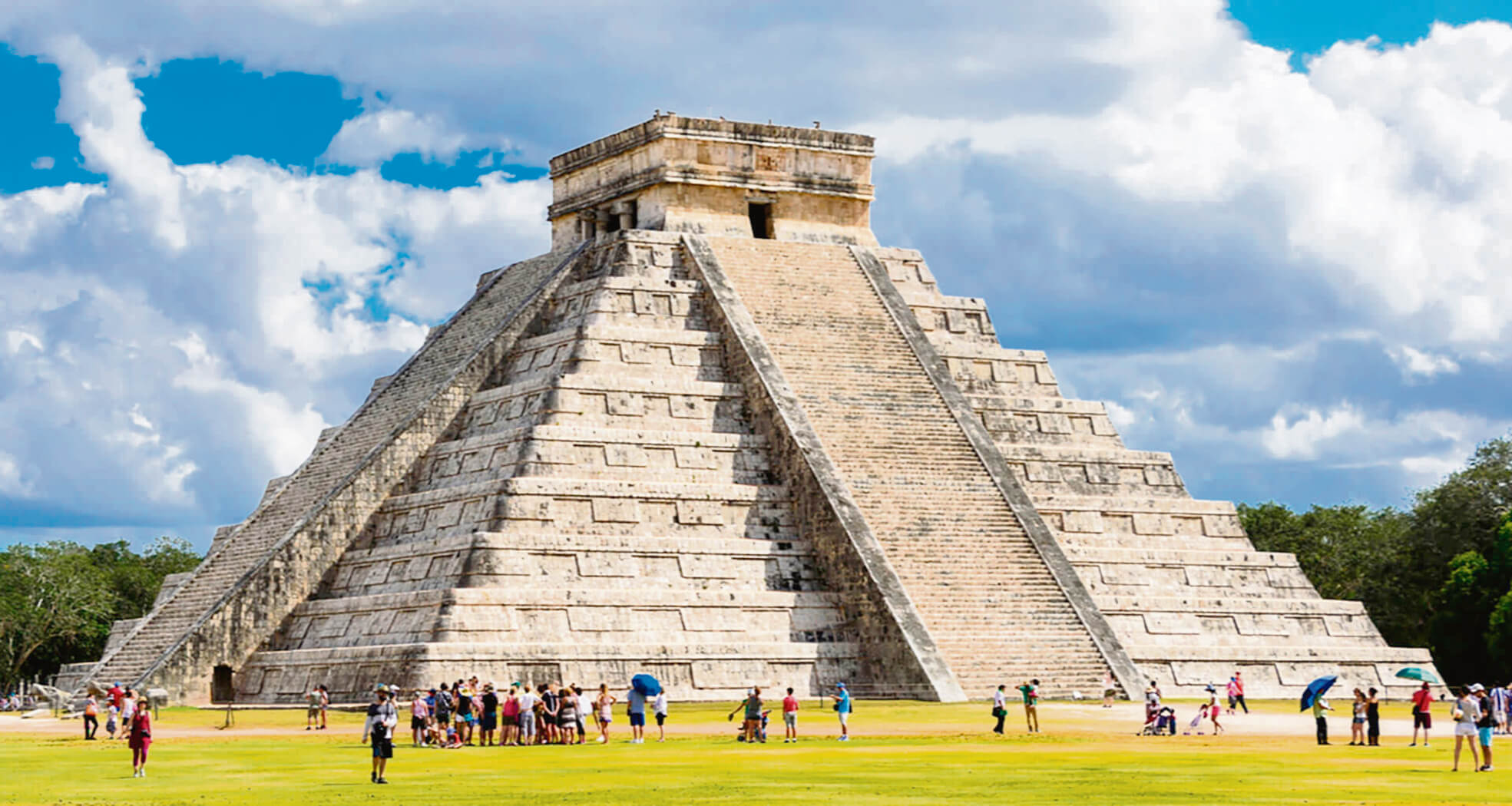
Chichén Itzá, Yucatán — A team of Mexican and U.S. scientists is preparing to carry out an unprecedented internal scan of El Castillo, the main pyramid at Chichén Itzá, using a cutting-edge technique based on the detection of muons—subatomic particles generated by cosmic rays.
The project, approved by the Archaeology Council of the Instituto Nacional de Antropología e Historia (INAH), brings together specialists from INAH with physicists and engineers from the Universidad Nacional Autónoma de México (UNAM), Chicago State University, Dominican University, the University of Virginia, and the Fermi National Accelerator Laboratory in the United States.
El Castillo—measuring nearly 55.5 meters on each side and about 30 meters high—is the largest structure by volume in the ancient Maya city. Researchers will use muon tomography to investigate its interior, potentially revealing unknown chambers or architectural features without disturbing the monument.
The project’s principal investigator, Edmundo García Solís, said the study represents the culmination of years of experimentation and that the first fieldwork phase is scheduled for the final quarter of 2025. The effort will test the effectiveness of muon imaging on one of the most important pre-Columbian monuments in the Americas, using detectors designed and built by North American scientists.
According to Guadalupe Espinosa Rodríguez, director of the Chichén Itzá Archaeological Zone, El Castillo dates to around the 10th century and, like many Maya temples, was built in multiple construction phases. In the 1930s, archaeologists Eduardo Martínez Cantón and José Erosa Peniche excavated a tunnel from the north side, leading to the Chambers of Offerings and Sacrifices, where a Chac Mool sculpture and a red-painted jaguar throne were discovered. The first application of muon technology will focus on studying these known chambers through existing tunnels.
García Solís noted that earlier research by UNAM’s Institute of Geophysics and Faculty of Engineering used electrical resistivity tomography in 2016, suggesting the presence of additional internal space. However, muon imaging allows exploration at virtually unlimited depths, making it possible to generate a full internal scan of the pyramid.
The approach builds on prior success at Teotihuacan, where a tunnel beneath the Pyramid of the Sun enabled a similar experiment led by UNAM physicist Arturo Menchaca Rocha—now also part of the Chichén Itzá team.
For El Castillo, two identical muon detectors have been constructed and will be installed in the pyramid’s north and south tunnels. Each detector consists of three folding electronic planes mounted on a frame, designed to function in tight spaces with nearly 100 percent humidity and temperatures around 32°C.
“These detectors measure differences in density,” García Solís explained. “The most extreme difference is a void. If a third chamber exists, it may be partially filled, which would require more data to identify because the contrast is lower.”
The initial six-month field season aims to clearly map the known chambers. If anomalies suggesting an additional chamber appear, the detectors will be repositioned to estimate its size. Beyond that, García Solís said, the team’s contribution would be complete.
Researchers believe the technique could help confirm or rule out long-standing archaeological hypotheses, including one proposed by architectural historian Virginia E. Miller, who has suggested that an earlier substructure within El Castillo may have served as a royal burial site.
Discover more from Riviera Maya News & Events
Subscribe to get the latest posts sent to your email.