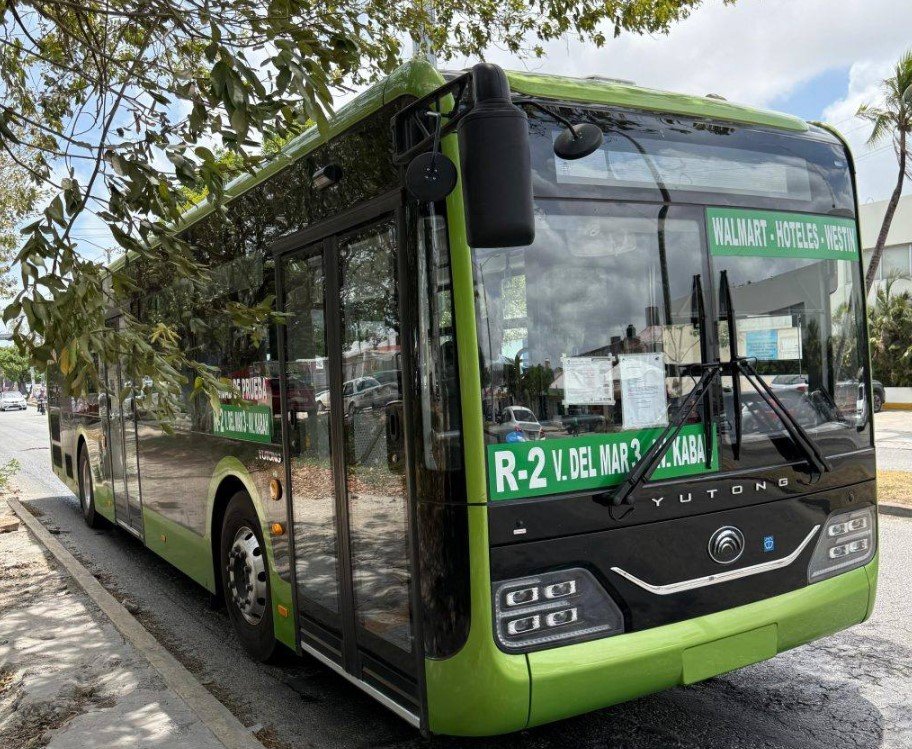
Chetumal, Quintana Roo — The first year of modernizing state-run public transport in Quintana Roo will carry a projected price tag of nearly 2 billion pesos, according to state financial documents. The overhaul, which will initially cover cities like Chetumal, Cancún, and possibly Playa del Carmen, is estimated to cost 1,832,307,436 pesos in 2026.
The State Secretariat of Finance and Planning (Sefiplan) provided the budget impact assessment to the state legislature as part of the reform process. The estimate was prepared by staff from the Quintana Roo Institute of Mobility (Imoveqroo).
Sefiplan stated that this budgetary impact is viable and will be covered “with the institute’s own resources, without requiring additional funds from the state.” The agency did not provide further details on the source of these funds.
However, the approved reform legislation indicates the money will come from a newly created Public Trust for the Operation of the Quintana Roo Integrated Transport System (Sitqroo). This investment and administration trust is designed to collect and distribute revenue generated from fares that belong to Imoveqroo from concessions and services it already operates by law or through agreements with municipalities for urban transport.
The trust will also receive income from Imoveqroo’s commercialization, administration, or use of Sitqroo’s advertising spaces, as well as funds from a 1.5% fee charged on contracted services from private passenger transport platforms like Didi and Cabify.
Operating urban transport will multiply Imoveqroo’s current spending by just over five times. In 2025, the institute’s total expenditure was 580,374,000 pesos for administering services like cargo and taxi concessions, intercity transport, and issuing driver’s licenses.
Regarding income, Imoveqroo earned 397,668,000 pesos in 2025 from “sale of goods and provision of services,” plus 111,269,000 pesos in subsidies, and other smaller amounts from products and various benefits, totaling 159,423,000 pesos. This resulted in a deficit operation leaving debts of 60,950,000 pesos, according to its Public Account financial statements.
The reform legislation states the Sitqroo Trust aims for “transparent, efficient management subject to control and auditing mechanisms for the system’s income, guaranteeing its long-term financial sustainability and the proper application of resources for maintenance, fleet renewal, and infrastructure.”
Pay-Per-Kilometer Model
Operationally, the state-administered urban transport will use a pay-per-kilometer system for concessionaires, similar to the “Va y ven” (Come and Go) transport system in Yucatán. That system was implemented under former PAN governor Mauricio Vila Dosal by Rafael Hernández Kotasek, who now directs Imoveqroo.
This means concession holders—who will receive concessions valid for 10, 15, or up to 30 years depending on bus technology and investment—will be paid a set rate per kilometer traveled, as established in their concession titles.
The reform says the pay-per-kilometer model aims to provide certainty and economic viability for the service by considering variables like operational, financial, and maintenance costs, rather than making remuneration dependent on the number of passengers transported.
Payment rates may vary depending on specific service characteristics covered by each concession, such as vehicle type and fuel used. Payment will be calculated from the sum of the fixed cost per unit—considering the number of routes, kilometers traveled, and adherence to established schedules—plus variable costs per unit, updated annually for inflation and input price variations like fuel.
Payment will be made even when buses run empty, though concessions will include a maximum number of payable empty kilometers.
During a legislative hearing to present the reform, Imoveqroo director Rafael Hernández Kotasek did not specify or give examples of the per-kilometer payment rates for routes in Cancún, Chetumal, and Playa del Carmen. This was despite a question from Movimiento Ciudadano congressman José Luis Pech Várguez, who asked about the differences and similarities between Quintana Roo’s planned system and Yucatán’s “Va y ven,” which Kotasek himself implemented, and its financial sustainability.
As a result, the minimum and maximum per-kilometer payment amounts may only become known once concession titles are signed or submitted to the state legislature for ratification.
Hernández Kotasek stated only that the pay-per-kilometer model guarantees buses provide service to the city on schedule, respect fares and social fare programs, avoid racing each other for passengers, and fulfill night and weekend schedules, eliminating harmful incentives.
He asserted that Yucatán’s “Vaivén” model has few legal similarities with what will be applied in Quintana Roo, but operationally it does, as do systems in Mexico City, Nuevo León, Jalisco, Guanajuato, Querétaro, and Aguascalientes—all fundamentally based on paying per kilometer traveled, using transfer centers, electronic payment, social fares, and requiring unit modernization.
Regarding financial sustainability, he said subsidies to the transport system do not go to concessionaires but to discounts for users with disabilities, students, seniors, transfers, and coverage of low-usage hours.
He emphasized that the key to sustaining the system is the funding sources available, citing Jalisco where transport is sustained by traffic camera fine revenue, and Nuevo León which has a subsidy linked to land use income. He assured that for Quintana Roo, the system will have no financial impact on the state budget.
Imoveqroo has a 180-business-day deadline, expiring in early November, to establish the public trust for Sitqroo’s financial operation and payment of related services. Until the trust is constituted, Sitqroo resources will be deposited and managed in an account, from which they will be transferred to the trust within no more than 90 business days after its establishment.
Discover more from Riviera Maya News & Events
Subscribe to get the latest posts sent to your email.