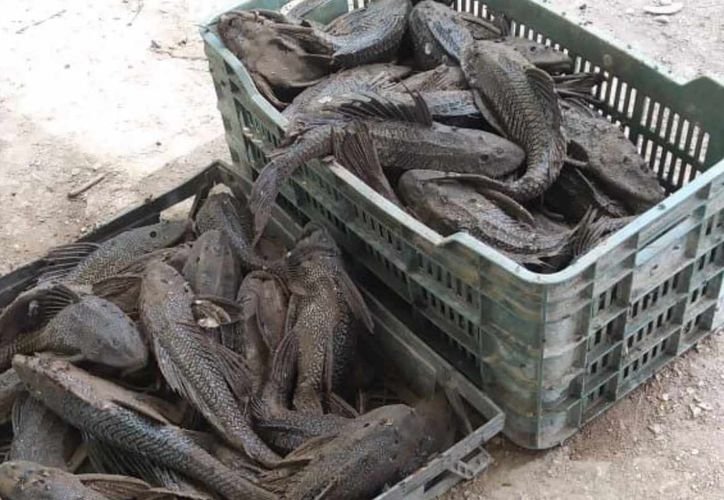
Chetumal, Quintana Roo — Authorities in Quintana Roo are developing strategies with researchers and non-governmental organizations to manage the invasive devil fish, which poses a serious threat to the state’s aquatic biodiversity following discoveries in the Hondo River, Chetumal Bay, and Bacalar Lagoon.
Javier Carballar Osorio, director of the Institute of Biodiversity and Protected Natural Areas of Quintana Roo (Ibanqroo), warned that the presence of this species in marine and freshwater ecosystems represents a high risk, primarily because it lacks natural predators in the region.
“We saw it advancing, but it was a surprise to find it not only in the Hondo River but also in Chetumal Bay and Bacalar. There haven’t been other findings beyond that, but we are trying to control it so populations don’t increase,” he explained.
Drawing on the experience of the uncontrolled expansion of the lionfish, Ibanqroo has activated a joint monitoring and containment scheme to address the new threat, involving academia, NGOs, and local fishermen.
“Sometimes we forget that this is an invasive species. We have priority species in the area that are endangered, but we also have exotic species we must address to avoid affecting the state’s biodiversity. However, there has been significant progress because with the arrival of the lionfish, there was a lot of awareness that it came from the sea, while this one comes inland, in lagoons and rivers, so it’s another threat,” he emphasized.
The main goal of this collaboration is to identify the exact distribution of the devil fish to design and implement effective containment actions before the invasion spreads uncontrollably from the south to the north of the state.
Discover more from Riviera Maya News & Events
Subscribe to get the latest posts sent to your email.