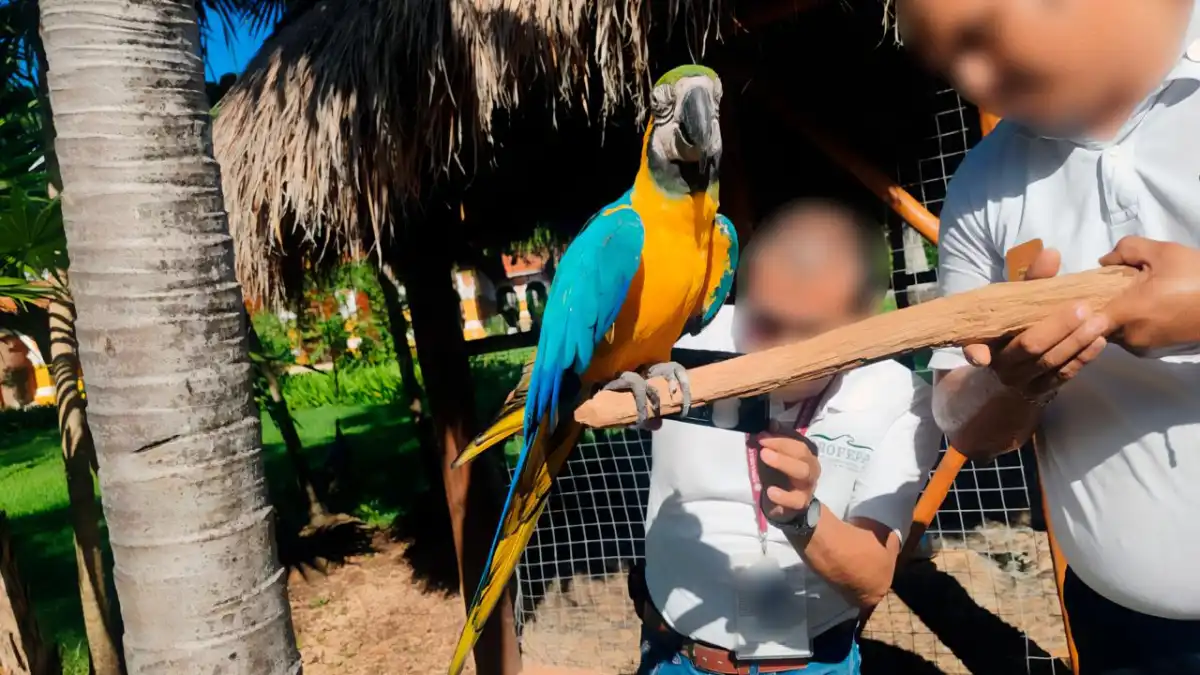
Playa del Carmen, Quintana Roo — The Federal Environmental Protection Agency (Profepa) has seized 20 wild animals from a wildlife management facility inside a hotel complex in Playa del Carmen after staff could not prove the animals’ legal origin.
In a statement, the federal agency said inspectors visited the site to check the animals’ living conditions and to verify that the facility had the required documentation to prove their legal provenance.
During the inspection, Profepa inventoried the native and exotic wildlife at the facility, checked their marking systems, reviewed their physical condition and examined the documents presented regarding their authorization, management plan and legal provenance.
Profepa determined that the facility is registered as a Collection of Native and Exotic Wild Species and has a management plan approved by the SEMARNAT’s General Directorate of Wildlife. The animals appeared to be in good physical condition, and the facilities matched what was authorized, with no violations of dignified and respectful treatment observed.
However, the facility could not prove the legal origin of 20 animals, so Profepa imposed a precautionary seizure as a safety measure. The animals are:
- Two pond sliders (Trachemys scripta)
- One Central American wood turtle (Rhinoclemmys areolata)
- One green peafowl (Pavo muticus)
- Three Indian peafowl (Pavo cristatus)
- Five American flamingos (Phoenicopterus ruber)
- Seven European fallow deer (Dama dama)
- One black swan (Cygnus atratus)
The animals will remain temporarily in the custody of the inspected party, who was named administrative depositary during the same procedure.
Profepa said documentation proving legal origin, along with registration and marking systems, is essential to guarantee the traceability of wild animals and to verify that their possession and management comply with environmental law.
The agency will follow the administrative procedure to determine any measures and sanctions that may apply under the General Wildlife Law and other applicable regulations.
More Environment
- Punta Esmeralda Access Road Work on Track for Mid-December Opening in Playa del Carmen
- Playa del Carmen Tourism Sector Alarmed by Return of Sargassum Ahead of Winter Season
- Heavy Rain Floods Cancún Neighborhoods and Hotel Zone
- Aguakan Completes Sewer Network on Cancún’s Avenida Nazareth, Benefiting Over 16,000 Residents
- Puerto Morelos Installs Committee to Protect Public Beaches and Blue Flag Sites
More Playa del Carmen
- Playa del Carmen Health Centers Log 1,065 Visits and 793 Vaccinations in One Week
- Quintana Roo Launches First Targeted Mpox Vaccination Drive After 333 Cases Since 2022
- Wetland Filled 10 Meters From Protected Mangrove in Playa del Carmen as Environment Office Sits Vacant
- Playa del Carmen Suspends 12 Police Officers and Opens Five Cases Over Abuse Complaints
- Ultramar to Raise Ferry Fares on Isla Mujeres and Cozumel Routes from November 26