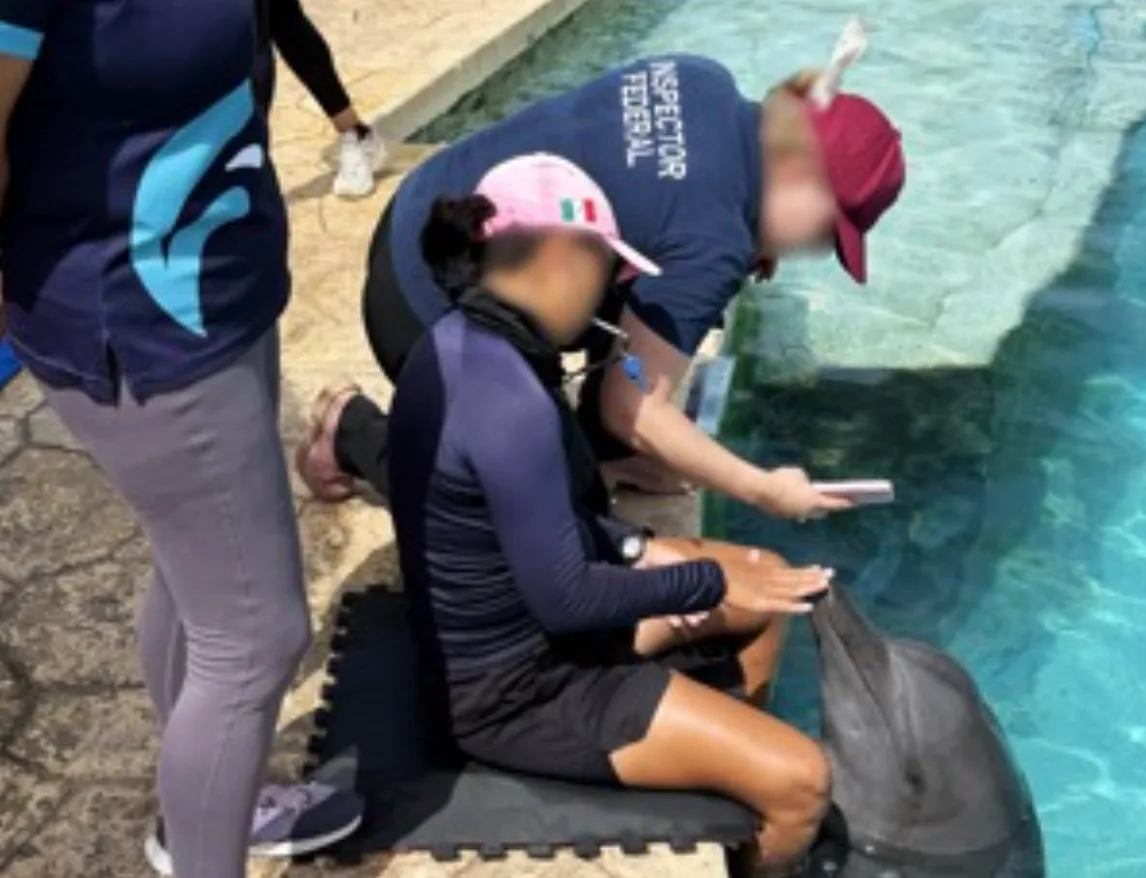
Cancún, Quintana Roo — Nearly a year after federal authorities shut down a Cancún dolphin facility, the nine dolphins left behind are still there — and new medical evaluations suggest at least three may be too fragile to move.
Mexico’s Federal Attorney for Environmental Protection (Profepa) said three of the nine dolphins at Dolphin Connection Cancún, formerly Dolphinaris Cancún, are unlikely to be candidates for relocation because transporting them could pose too great a risk to their health.
The other six are being evaluated individually for a possible move, although Profepa has not announced where they might go or when a transfer could take place.
The decision is more complicated than simply finding another facility willing to take them.
Profepa says any dolphin considered for relocation must first demonstrate adequate blood-test results and medical stability. The animals would also have to undergo a strict quarantine intended to protect both the dolphins being moved and animals already living at the destination.
All Nine Dolphins Have Health Problems
According to Profepa, all nine dolphins have conditions requiring continued monitoring.
Veterinary evaluations have documented eye problems, lesions and abnormalities of the tongue and oral mucosa, dental wear and other chronic conditions.
Those findings mean the animals cannot be treated as a group when considering relocation. Each dolphin’s medical condition, behavior and social relationships must be evaluated separately.
Profepa has not publicly identified which three animals it considers least likely to withstand a transfer.
The agency says specialists are continuing to assess the remaining six and that any decision will prioritize the animals’ survival and welfare rather than simply removing them from the closed facility.
Why Are They Still There?
The dolphins have remained in the same pools since October 2025, when Profepa temporarily closed the facility and placed all nine animals under federal protection.
Inspectors found a number of irregularities, including pools with cloudy water and inadequate cleaning.
Profepa then ordered corrective measures intended both to stabilize the dolphins’ health and improve their environment.
The agency now says conditions at the facility have improved substantially.
The life-support system has been upgraded to increase water recirculation, pools are cleaner and clearer, and recent water testing has met required quality parameters. Profepa also says pathogens previously detected in the water are no longer present.
The dolphins continue to receive medical examinations, individual feeding supervision and veterinary monitoring.
However, Profepa stressed that the improvements do not erase the problems that led to the closure. The administrative case surrounding the facility remains open.
Viral Videos Added Pressure
The dolphins’ continued presence at the closed attraction has repeatedly drawn public attention.
Videos circulated on social media earlier this year showing dolphins swimming in pools at what appeared to be an abandoned water park. Profepa responded in April, saying the animals had not been abandoned and remained under professional care.
There was also some confusion over exactly where the dolphins were located. The animals are at the former Dolphinaris/Dolphin Connection facility next to Ventura Park rather than in the water park itself.
Concern continued through the summer. In September, residents and animal-welfare advocates demonstrated in Cancún’s Hotel Zone calling for the dolphins to be moved, preferably to sea pens rather than another concrete-pool facility.
State Environment Secretary Óscar Rébora Aguilera said at the time that Quintana Roo officials were working with Profepa and that potential relocation sites had been discussed, but that the federal agency would ultimately determine whether, how and where the dolphins could safely be transferred.
Mexico’s New Dolphin Law Adds Another Layer
The case comes as Mexico is fundamentally changing how dolphins and other cetaceans can be kept in captivity.
Changes to the General Wildlife Law published in July 2025 sharply restricted the use of marine mammals for entertainment and established a transition toward sea pens and other permitted conservation arrangements for cetaceans already under professional care.
Under the legislation, owners and operators must eventually relocate eligible cetaceans to sea pens or other situations permitted under the law, following transfer protocols established by the federal Environment Ministry.
The law does not, however, mean that every dolphin can simply be moved.
The Cancún case illustrates one of the difficult questions created by that transition: What happens when an animal is too old, sick or medically fragile to safely withstand relocation?
For the three dolphins now considered poor candidates for transfer, remaining where they are may ultimately present less immediate risk than transporting them elsewhere.
Could Cozumel Eventually Be Part of the Answer?
The situation also comes as Quintana Roo considers creating a dolphin sanctuary on Cozumel.
State environmental officials have been studying potential locations for a sanctuary that could provide dolphins with a more natural, semi-free marine environment. Chankanaab Park has emerged as the leading candidate, although the project remains in the study and permitting stage.
There is currently no indication from Profepa that the six Cancún dolphins being evaluated for relocation would be sent to Cozumel, and the proposed sanctuary does not yet exist.
Still, the two developments are part of the same larger issue facing Mexico.
As traditional dolphin attractions are phased out or transformed under the new law, authorities will have to determine where existing animals can safely spend the rest of their lives — and whether each individual dolphin is healthy enough to make the journey.
For these nine dolphins in Cancún, that decision will now be made one animal at a time.
More Environment
- Screwworm Cases Detected in Two Dogs and a Horse in Tulum
- Playa del Carmen Recognized as International Bull Shark Zone
- Five Zones in Playa del Carmen Lose Urban Jungle to Construction Boom
- Hurricane Isaias Strengthens to Category 3 as Heavy Rain Hits Quintana Roo
- Hurricane Isaías to Bring Rain and Heat to Cancún and Playa del Carmen This Weekend
More Cancun
- Cancún Residents Demand Governor’s Intervention Over Alleged Land Fraudster
- Cancún Taco Festival Aims to Revive Local Economy in Low Season
- Cancún Advances Yaxchilán Revitalization With Pedestrian Corridor to Avenida Nader
- Mexico’s 911 Centers Explore AI to Speed Up Emergency Response
- Quintana Roo Education Official Reported Missing in Cancún, Found Hours Later