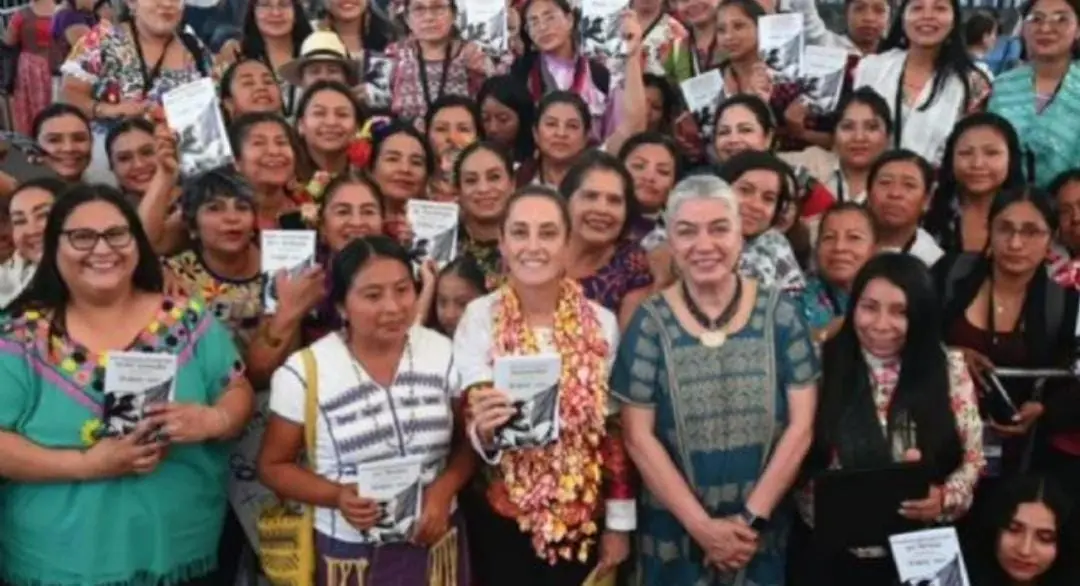
Santo Domingo Tehuantepec, Oaxaca — President Claudia Sheinbaum recognized the crucial role of indigenous translators in Mexico for translating a women’s rights guide into 67 languages, bringing essential information to diverse communities across the country.
During a visit to Santo Domingo Tehuantepec, Oaxaca, Sheinbaum highlighted that these linguistic specialists played the primary role in translating the women’s rights cartilla, an official promotional document presented in March 2025. The guide is designed to disseminate women’s rights, including access to health, education, and a life free from violence.
“Today we recognize the translation of the women’s cartilla into 67 languages with 69 varieties,” Sheinbaum said. “It was complex to find speakers of each language to translate, and it’s not just word for word—you translate a concept.”
The president emphasized that the effort’s significance lies in bringing ideas and rights to different cultural and linguistic contexts beyond Spanish while preserving their original meaning.
Citlalli Hernández, Secretary for Women, noted that through this translation process, indigenous interpreters have become the main promoters of women’s rights in their communities. “They are the main promoters of rights… they have conquered spaces that were denied to them,” Hernández said.
Sheinbaum’s recognition came during a weekend tour that began in Quintana Roo, where she held a public event in Cancún on Friday, attended the National Banking Convention, and rode the Maya Train to visit communities in the southern part of the state. She then traveled to Oaxaca on Saturday to commemorate the birthdays of former President Benito Juárez García and his wife, Margarita Maza, whom she recognized as Mexico’s first woman ambassador.
Discover more from Riviera Maya News & Events
Subscribe to get the latest posts sent to your email.