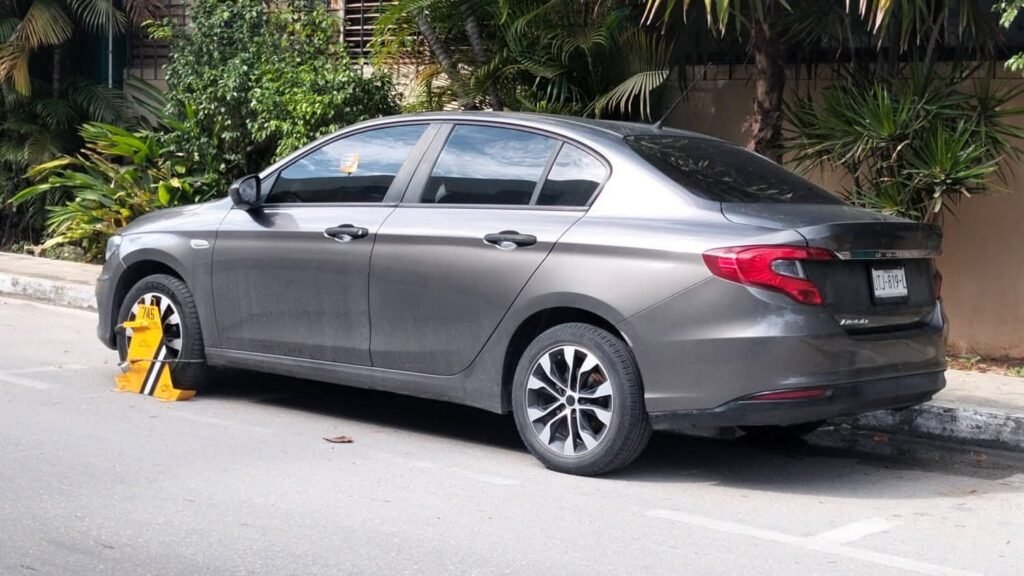
Playa del Carmen, Quintana Roo — The municipal government’s announcement that it will review the operation of parking meters in Playa del Carmen comes in response to a surge of citizen complaints. For many drivers, however, the problem extends far beyond malfunctioning machines or isolated fines. At its core, critics argue, the issue is a model of urban control that penalizes residents and visitors through unclear rules, broad enforcement discretion, and limited safeguards against abuse.
Municipal authorities confirmed that the metered parking system will be evaluated following repeated reports of high fines, confusing penalties, and opaque procedures. The review, however, arrives after years of friction between users and enforcement personnel, during which discretion has become a normalized method of managing public space.
For drivers, the experience is often predictable. Penalties are issued without clear notification, enforcement criteria appear to vary from inspector to inspector, and motorists are left with a persistent sense of wrongdoing even when attempting to comply. A system originally designed to regulate mobility and improve turnover in commercial areas has increasingly been perceived as a source of daily financial pressure.
Regulated parking is not new to Playa del Carmen. Parking meters were introduced as part of broader mobility and urban-order strategies adopted by rapidly growing tourist cities across Mexico, particularly in the 2010s. Similar systems operate in Cancún, Mérida, Mexico City, and Guadalajara, where meters are typically justified as tools to reduce congestion, promote short-term parking, and encourage the use of alternative transportation.
However, the pattern seen in Playa del Carmen mirrors broader concerns in Quintana Roo. As with vehicle checkpoints, traffic stops, and fines related to window tinting or documentation, administrative violations often function as immediate punishment mechanisms rather than regulated enforcement tools. In these cases, rules are loosely defined for the citizen, while authorities retain wide latitude in how and when penalties are applied.
Residents report that the parking meter system prioritizes revenue generation over orderly mobility. Errors—whether technical or procedural—are costly, while contesting a fine is often slow, bureaucratic, or impractical. There are few visible protocols, limited public information on user rights, and no streamlined process to challenge sanctions perceived as unjustified.
The underlying concern is not regulated parking itself, but an enforcement ecosystem lacking checks and balances. Without effective oversight, systems designed to organize urban life can become fertile ground for abuse. Authorities inspect, sanction, and collect; citizens hesitate, pay, or disengage.
As with traffic operations conducted under vague regulatory frameworks, the parking meter controversy in Playa del Carmen highlights a recurring issue: institutional disorder transferred directly to the citizen’s wallet. Instead of transparent, equitable rules, a punitive logic takes hold, gradually eroding public trust.
Municipal officials have not yet detailed the scope or timeline of the announced review. Critics warn that any evaluation limited to software upgrades or contractual terms with operating companies will fall short. The central issue, they argue, lies in how authority is exercised, how penalties are imposed, and who oversees enforcement practices.
In a city that promotes itself as modern, sustainable, and visitor-friendly, the debate remains unresolved: do parking meters genuinely organize public space, or do they primarily function as revenue tools in an environment where citizens lack effective recourse? When legality operates without transparency or accountability, order risks becoming indistinguishable from normalized abuse.
Discover more from Riviera Maya News & Events
Subscribe to get the latest posts sent to your email.