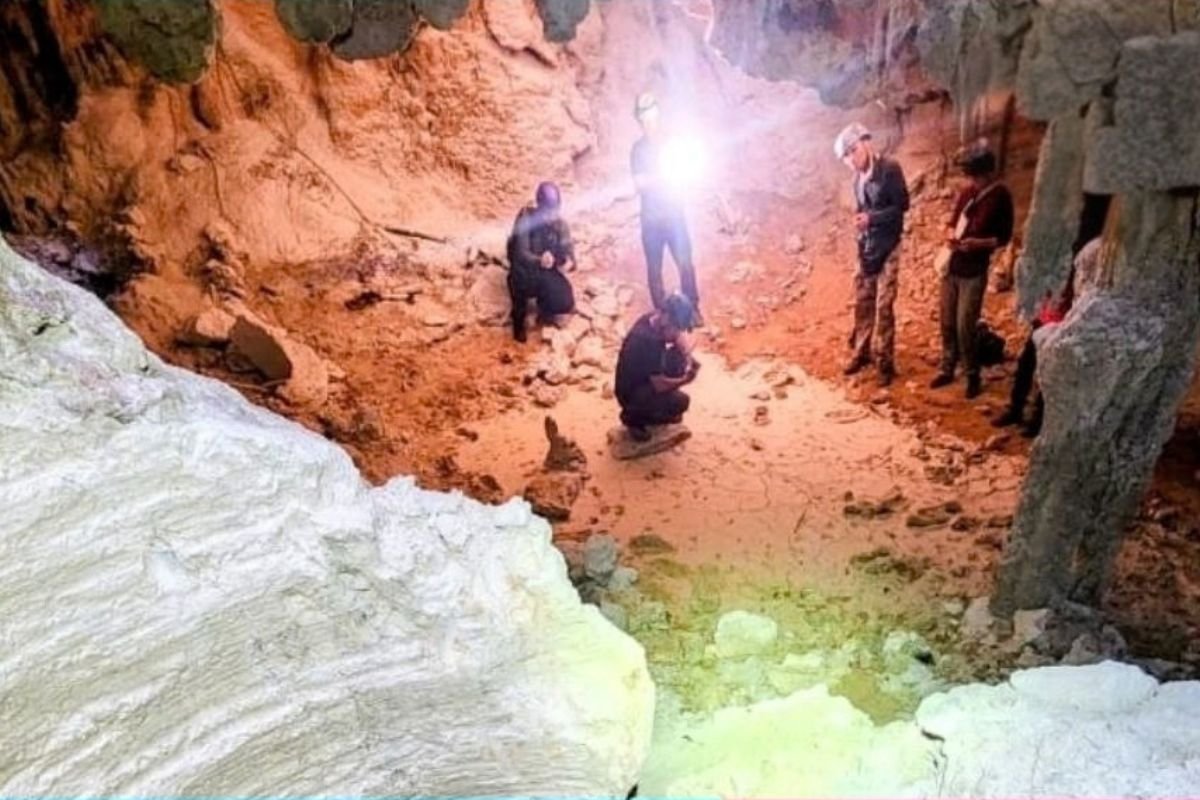
Cancún, Quintana Roo — A photograph taken inside a cave in the Yucatan Peninsula has focused attention on the fragility of the karst system that holds the Mexican Caribbean’s aquifer, showing a drilling that punched through limestone to reach the groundwater beneath a stretch of jungle.
The image, taken by photographer José Urbina Bravo, shows the cave’s limestone formations alongside the depth of the borehole. A group of people appears in the frame while documenting the damage. What looks like an impossible image, almost generated by artificial intelligence, is in fact a direct record of human intervention in one of the planet’s most fragile and least understood ecosystems, Urbina Bravo said.
A Cave Cut Open, an Aquifer at Risk
The cave, like hundreds of others that have been directly damaged, was covered by jungle. Beneath it flows the aquifer that links the region’s vegetation, mangroves and reef.
According to Urbina Bravo, rather than studying the terrain, someone drilled through the rock to install metal structures filled with concrete. Fuel and oil were spilled, and tons of cement, acids and garbage were dumped into the cavity. The corrosion continues, he said.
Where water, biodiversity, geological memory and cultural heritage once existed, a construction now stands. The impacts were warned about repeatedly, he added.
The Value of Caves and Karst
UNESCO has designated September 13 as International Cave and Karst Day, following an initiative promoted by the International Union of Speleology. The date highlights the importance of these systems: caves and karst landscapes store water and underground biodiversity, and preserve geological archives along with invaluable natural and cultural heritage. They also serve as a reminder of how vulnerable they are.
Urbina Bravo argued that if specialists had been heeded instead of hotel owners, business figures and politicians, the cave would still be providing its ecosystem services — as would many others like it. The site, he said, would still be home to endangered species while protecting water supplies and forming part of a natural and cultural treasure.
He acknowledged that hotels, homes, roads and urban areas have caused similar damage, which he said is precisely why he and others insisted on repairing past mistakes and concentrating development in areas that had already been affected.
Damage in Plain Sight
The photographer said the evidence of the damage is visible in the drilled rock, the exposed water, the altered caves and the affected jungle. The issue, he stressed, is not a single cave but the system beneath the surface that sustains much of life on Mexico’s Caribbean coast.
The lessons learned, he concluded, should be used to defend the jungle that shelters the karst, the caves and the region’s water more effectively.
More Environment
- Cancún’s Benito Juárez Recycling Drive Recovers 6.8 Tons of Waste
- US Releases 1 Billion Sterile Flies to Stop Screwworm’s Return
- Delphinus Blue Planet Pulls Out of Deal to Buy The Dolphin Company, Leaving 101 Marine Animals in Limbo
- New Pemex Oil Spill in Gulf Won’t Reach Campeche Beaches, Company Says
- Cozumel Beach Club Kuzá Targets 4,000 Daily Visitors in Protected Area With CONANP Backing