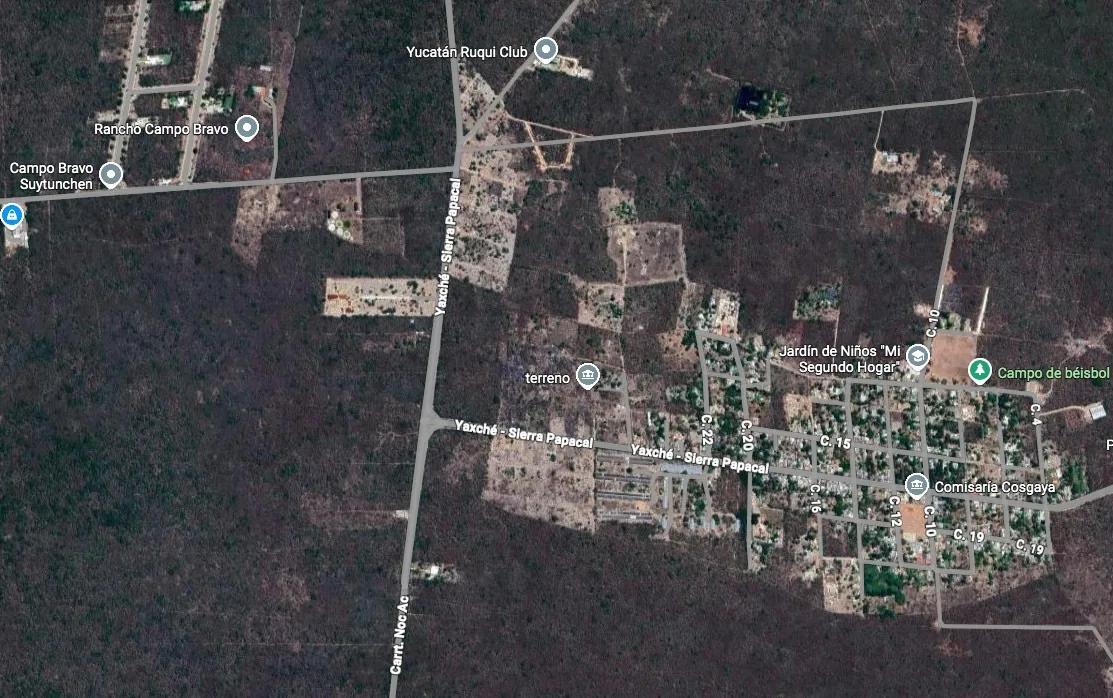
Mérida, Yucatán — A new residential development called “San Matías” is proposed for construction north of Mérida in the Cosgaya area, with the project currently undergoing federal environmental review.
The developer, Grupo Financiero Mifel through a real estate trust, submitted the Environmental Impact Statement to Mexico’s Environment and Natural Resources Secretariat (Semarnat) on February 13. The submission is part of the mandatory process to obtain federal authorization for the project.
The development would occupy an irregular polygon of 38,082.62 square meters along the Sierra Papacal–Cosgaya highway. The project requires federal approval because it involves changing land use in forested areas with secondary vegetation of low deciduous jungle.
Project Details
San Matías would be a private residential subdivision with 68 single-family lots planned. The initial phase focuses on site development rather than home construction, including opening internal streets, installing sidewalks, and setting up water, drainage, and electrical networks. The plan also includes building amenities, a security booth, three wastewater treatment plants, roadways, and green areas.
The first stage would cover 14,835.03 square meters, with 3,245.83 square meters designated as conservation area. A second phase would complete the remaining 23,044.16 square meters for the full 68 residential lots.
Environmental Considerations
The main environmental impact would be the removal of secondary vegetation and permanent soil modification within the property. While not primary jungle, the existing vegetation serves as habitat for local wildlife.
The environmental study identifies groundwater as the most sensitive component, since the area is part of Yucatán’s karst system where water easily infiltrates the subsurface. Proper wastewater treatment would be crucial to prevent aquifer contamination.
The project estimates generating 47.21 cubic meters of domestic wastewater daily, which would be treated in three plants designed to meet current environmental standards. Construction would also produce temporary, localized dust emissions, noise, and construction waste.
The property is located in a peri-urban area that has seen residential growth in recent years. The document states the project is compatible with current ecological and urban planning instruments.
Mitigation Measures
Proposed mitigation actions include rescuing and relocating flora and fauna, delimiting work areas, controlling dust emissions, proper waste management, and maintaining conservation areas. The plan also calls for preserving green spaces within the development and using stormwater infiltration systems to partially maintain the soil’s natural dynamics.
Discover more from Riviera Maya News & Events
Subscribe to get the latest posts sent to your email.