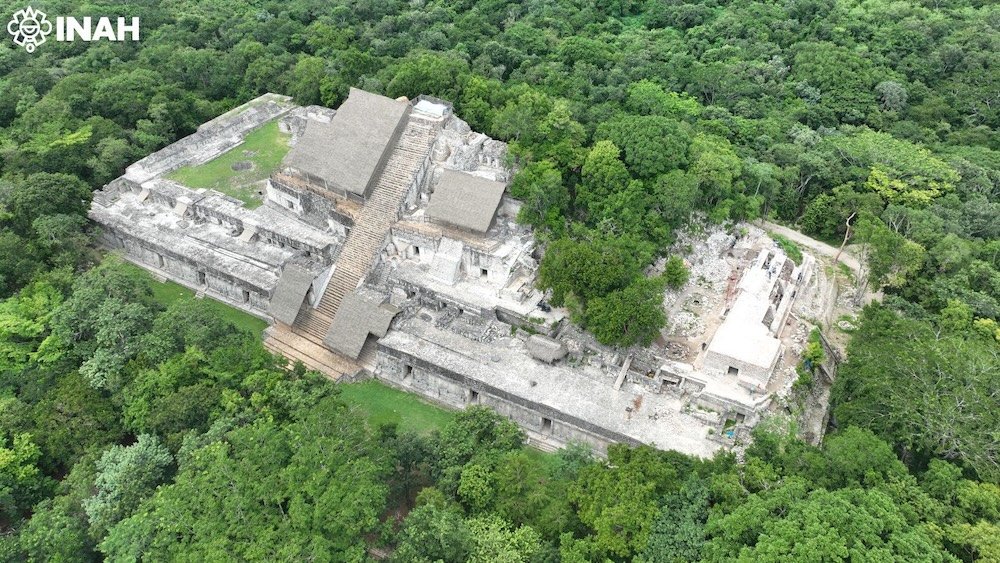
Recent archaeological work carried out in the Acropolis of Ek’ Balam has revealed inscriptions and architectural elements that modify the understanding of the religious and political life of the Maya elite, particularly during the rule of Ukit Kan Lek Took’, one of the most prominent figures of the ancient kingdom of Talol.
During work conducted by the National Institute of Anthropology and History (INAH) between December 2022 and January 2024, as part of the Program for the Improvement of Archaeological Zones (Promeza), archaeologists Leticia Vargas de la Peña and Víctor Rogerio Castillo Borges discovered a vault cap (TB 29) bearing the name of Ukit Kan Lek Took’ and a date corresponding to September 18, 782 AD. The piece also features the figure of the god K’awiil, associated with power and royalty.
The discovery reinforces the hypothesis that this architectural complex functioned as the residence of Ukit Kan Lek Took’, and that the decoration of the place had a profound symbolic charge linked to religion and authority. In the same area, another vault cap (TB 28) with a similar name was found, suggesting a possible reference to the same person.
Additionally, facades decorated with masks, figures of warriors, animals, and solar symbols were identified, linked to the Maya worldview concerning life, death, and divine power.
During the excavations, the team consolidated nine rooms and recovered eight vault caps in a building approximately 40 meters long by 10 meters wide, belonging to the third constructive level of the Acropolis. According to the specialists, these discoveries offer new clues about the political and religious identity of Ukit Kan Lek Took’ and reaffirm the role of Ek’ Balam as one of the most important centers of the ancient kingdom of Talol.
Discover more from Riviera Maya News & Events
Subscribe to get the latest posts sent to your email.